Counter top inline keg dispenser that can serve ice cold beer from unchilled kegs Compact and portable. Use anywhere you have access to 110V power Superior cooling capacity. Chill up to 8 gallons of beer, inline, per hour! Fill the reservoir with tap water, or use a glycol solution for optimal performance NukaTap Flow Control Faucets, tap handles, and drip tray included Great for bars, restaurants that need to add capacity These style chillers are how beer is poured in most European cafes If you're looking for a home draft system, but don't have the space for a kegerator or keezer, we've got the answer! The KOMOS KRYO benchtop keg dispenser can serve ice cold beer from unchilled kegs. It's essentially an electric jockey box that chills beer inline as it passes from the keg through the internal draft coils that sit submerged in the glycol reservoir. Simply place it on your counter or benchtop, fill the reservoir with a 20% glycol solution, and hook up your keg to the draft shank bulkheads. In roughly an hour, the reservoir will have cooled down enough that you'll be ready to pour! And thanks to the compact size, the KRYO can easily be transported from your home to the next backyard BBQ, cabin trip, wedding, or virtually any gathering of thirsty people you can think of. For homebrewers this would allow you to keep your refrigerator at fermenation temperatures while always seving your beer ice cold. Glycol Reservoir Although you can fill the reservoir with water only, for optimal performance we highly recommend using a glycol/water mix so you can lower the chilling solution below freezing. You simply won't be able to get your beer as cold if using water only. The sight gauge at the front will let you know if it's time to top up the reservoir, but also functions as a drain. When it's time to move the KRYO from one location to another, drain out the glycol into a sealable container to avoid spills during transportation. The glycol reservoir provides an exceptional amount of cooling power that makes it perfect for servicing small bars or cafes, as well as home use. If you're deciding between this model and the KRYO Nomad, note that peak chilling capacity for this model is approximately 8 gallons per hour, whereas the Nomad can chill up to roughly 2 gallons per hour. NukaTap Flow Control Faucets These stainless steel forward sealing faucets allow you to make instant adjustments to the beverage flow as you pour. A perfect faucet for those who often switch between beer styles with different carbonation levels. No need to rebalance your lines or play with your regulator settings. Adjust the flow control level to dial in the flow rate and pour perfect pints every time! They also have the lowest thermal mass and best laminar flow design to further reduce foaming issues. Draft Shank Bulkheads The draft shank bulkheads with beer thread allow you to choose the type of fittings and draft line that best suits your needs. We highly recommend EVABarrier draft line and Duotight fittings—the same lines and fittings that come standard with our KOMOS Kegerators. These Duotight Female Beer Thread Adapters will allow you to hook up 8 mm OD EVABarrier, and also work with sanke keg couplers if you'll be dispensing commercial kegs. For homebrew kegs, we recommend Duotight Flare Adapters for your QDs, or if you're starting from scratch, consider the Duotight Ball Lock Quick Disconnects. Includes: (2) NukaTap Stainless Flow Control Faucets (2) Tap Handles Stainless Countertop Drip Tray w/ Removable Grill Features: Chill 8 gallons of beer per hour (based on 68°F ambient) Draft shank bulkheads compatible with Duotight fittings or nut & tailpiece combos STC-1000 temperature controller (reads in °C) Reservoir volume: 4.2 gal Voltage: 110V-120V Current: 0.9A Frequency: 60Hz Dimensions: 19" x 12" x 17.5" (not including faucets / drip tray) CE Certified Reservoir Temp Controller: Follow these steps to adjust the SET temperature on the controller. If using water only, be sure to keep the reservoir temp set at or above 2°C to avoid freezing. With a 20% glycol solution, you can set the temp as low as -2°C. The reservoir volume is 4.2 gallons, so you will only need to purchase 1 gallon of glycol to make a 20% mix. Hold the 'Up" button for 3 seconds until the number is flashing While the number is flashing, press the 'Down' button to decrease the set temperature or press the 'Up' button to increase the set temperature. Wait 3 seconds and the controller will save the setting and return to normal operation mode. Warning: Do not set the reservoir temperature controller lower than 28°F (-2ºC). Running the unit below this temperature may negatively affect the unit's efficiency and has the potential to freeze beer.
Counter top inline keg dispenser that can serve ice cold beer from unchilled kegs Compact and portable. Use anywhere you have access to 110V power Superior cooling capacity. Chill up to 8 gallons of beer, inline, per hour! Fill the reservoir with tap water, or use a glycol solution for optimal performance NukaTap Flow Control Faucets, tap handles, and drip tray included Great for bars, restaurants that need to add capacity These style chillers are how beer is poured in most European cafes If you're looking for a home draft system, but don't have the space for a kegerator or keezer, we've got the answer! The KOMOS KRYO benchtop keg dispenser can serve ice cold beer from unchilled kegs. It's essentially an electric jockey box that chills beer inline as it passes from the keg through the internal draft coils that sit submerged in the glycol reservoir. Simply place it on your counter or benchtop, fill the reservoir with a 20% glycol solution, and hook up your keg to the draft shank bulkheads. In roughly an hour, the reservoir will have cooled down enough that you'll be ready to pour! And thanks to the compact size, the KRYO can easily be transported from your home to the next backyard BBQ, cabin trip, wedding, or virtually any gathering of thirsty people you can think of. For homebrewers this would allow you to keep your refrigerator at fermenation temperatures while always seving your beer ice cold. Glycol Reservoir Although you can fill the reservoir with water only, for optimal performance we highly recommend using a glycol/water mix so you can lower the chilling solution below freezing. You simply won't be able to get your beer as cold if using water only. The sight gauge at the front will let you know if it's time to top up the reservoir, but also functions as a drain. When it's time to move the KRYO from one location to another, drain out the glycol into a sealable container to avoid spills during transportation. The glycol reservoir provides an exceptional amount of cooling power that makes it perfect for servicing small bars or cafes, as well as home use. If you're deciding between this model and the KRYO Nomad, note that peak chilling capacity for this model is approximately 8 gallons per hour, whereas the Nomad can chill up to roughly 2 gallons per hour. NukaTap Flow Control Faucets These stainless steel forward sealing faucets allow you to make instant adjustments to the beverage flow as you pour. A perfect faucet for those who often switch between beer styles with different carbonation levels. No need to rebalance your lines or play with your regulator settings. Adjust the flow control level to dial in the flow rate and pour perfect pints every time! They also have the lowest thermal mass and best laminar flow design to further reduce foaming issues. Draft Shank Bulkheads The draft shank bulkheads with beer thread allow you to choose the type of fittings and draft line that best suits your needs. We highly recommend EVABarrier draft line and Duotight fittings—the same lines and fittings that come standard with our KOMOS Kegerators. These Duotight Female Beer Thread Adapters will allow you to hook up 8 mm OD EVABarrier, and also work with sanke keg couplers if you'll be dispensing commercial kegs. For homebrew kegs, we recommend Duotight Flare Adapters for your QDs, or if you're starting from scratch, consider the Duotight Ball Lock Quick Disconnects. Includes: (2) NukaTap Stainless Flow Control Faucets (2) Tap Handles Stainless Countertop Drip Tray w/ Removable Grill Features: Chill 8 gallons of beer per hour (based on 68°F ambient) Draft shank bulkheads compatible with Duotight fittings or nut & tailpiece combos STC-1000 temperature controller (reads in °C) Reservoir volume: 4.2 gal Voltage: 110V-120V Current: 0.9A Frequency: 60Hz Dimensions: 19" x 12" x 17.5" (not including faucets / drip tray) CE Certified Reservoir Temp Controller: Follow these steps to adjust the SET temperature on the controller. If using water only, be sure to keep the reservoir temp set at or above 2°C to avoid freezing. With a 20% glycol solution, you can set the temp as low as -2°C. The reservoir volume is 4.2 gallons, so you will only need to purchase 1 gallon of glycol to make a 20% mix. Hold the 'Up" button for 3 seconds until the number is flashing While the number is flashing, press the 'Down' button to decrease the set temperature or press the 'Up' button to increase the set temperature. Wait 3 seconds and the controller will save the setting and return to normal operation mode. Warning: Do not set the reservoir temperature controller lower than 28°F (-2ºC). Running the unit below this temperature may negatively affect the unit's efficiency and has the potential to freeze beer.
Portable, Inline, Keg Dispensing unit that can be powered via 110V outlet Replaces a traditional Draft Box/Jockey Box with no ice required Differs from the regular Komos Kryo Inline Chiller in that there is no glycol reservoir / The Nomad is liquid-free and easier to transport Can chill up to 2 gallons of room temperature beer, inline, per hour NukaTap Flow Control Faucets, tap handles, and drip tray included Mobile draft dispensing has never been easier with the KRYO Nomad electric keg dispenser. As with a jockey box, beer is chilled inline as it passes from the keg through the internal draft coils which are chilled by the electrically powered solid carbon based heat sink. With a standard 110V outlet, you can serve ice cold beers from an unchilled keg, and unlike the KRYO glycol unit, this model is absolutely liquid-free, making it the ideal choice for mobile draft dispensing. No need to wait an hour for glycol solution to chill, once you power on the Nomad, you'll be ready to go in as little as 15 minutes! Carbon Heat Sink The secret to the KRYO Nomad's incredible chilling capacity and portability is the solid carbon based heat sink. This heat exchange technology requires no liquid whatsoever, so you'll never run into issues with emptying or spilling coolant when you transport this chiller from place to place. It provides roughly 300 watts of cooling power which allows you to chill about 2 gallons of beer per hour. Just be sure to give the unit about 2 minutes to recover for each 16 oz pour. The Nomad is very power efficient, drawing only 60 watts of power when the compressor is running. When idling, the chiller uses only 1.6 watts of power, meaning it it averages only 15 watts of power draw when turned on and periodically cycling the compressor. NukaTap Flow Control Faucets These stainless steel forward sealing faucets allow you to make instant adjustments to the beverage flow as you pour. A perfect faucet for those who often switch between beer styles with different carbonation levels. No need to rebalance your lines or play with your regulator settings. Adjust the flow control level to dial in the flow rate and pour perfect pints every time! They also have the lowest thermal mass and best laminar flow design to further reduce foaming issues. Duotight Bulkheads Draft lines connect directly to 8 mm Duotight bulkheads located at the rear of the unit. To hook up your kegs to the KRYO Nomad, we highly recommend EVABarrier draft line and Duotight fittings—the same lines and fittings that come standard with our KOMOS Kegerators. 8 mm OD EVABarrier plugs directly into the bulkheads, then depending on what type of kegs you'll be pouring, you can use these Duotight Female Beer Thread Adapters for sanke keg couplers if you'll be dispensing commercial kegs, or for homebrew kegs, we recommend Duotight Flare Adapters for your QDs, or if you're starting from scratch, consider the Duotight Ball Lock Quick Disconnects. Includes: (2) NukaTap Stainless Flow Control Faucets (2) Tap Handles Stainless Countertop Drip Tray w/ Removable Grill Features: Chill 2 gallons of beer per hour (based on 68°F ambient) Duotight bulkheads compatible with 8 mm OD EVABarrier tubing AC Voltage via IEC Plug: 110-120V Max Power Draw: 300W Dimensions: 9.25" x 13.7" x 18.1" (not including faucets / drip tray) CE Certified Temp Controller: Follow these steps to adjust the SET temperature on the controller. Press and release the 'SET' button to enter into the user menu. Press 'SET' will display the value of the target temperature setting. Press the 'Up' or 'Down' button to increase or decrease the set temperature. Press the snowflake icon button or wait 30 seconds and the controller will save the setting and return to normal operation mode. Warning: Do not set the temperature controller lower than 28°F (-2ºC). Running the unit below this temperature may negatively affect the unit's efficiency and has the potential to freeze beer which may impact the finished beer's flavor.
Portable, Inline, Keg Dispensing unit that can be powered via 110V outlet Replaces a traditional Draft Box/Jockey Box with no ice required Differs from the regular Komos Kryo Inline Chiller in that there is no glycol reservoir / The Nomad is liquid-free and easier to transport Can chill up to 2 gallons of room temperature beer, inline, per hour NukaTap Flow Control Faucets, tap handles, and drip tray included Mobile draft dispensing has never been easier with the KRYO Nomad electric keg dispenser. As with a jockey box, beer is chilled inline as it passes from the keg through the internal draft coils which are chilled by the electrically powered solid carbon based heat sink. With a standard 110V outlet, you can serve ice cold beers from an unchilled keg, and unlike the KRYO glycol unit, this model is absolutely liquid-free, making it the ideal choice for mobile draft dispensing. No need to wait an hour for glycol solution to chill, once you power on the Nomad, you'll be ready to go in as little as 15 minutes! Carbon Heat Sink The secret to the KRYO Nomad's incredible chilling capacity and portability is the solid carbon based heat sink. This heat exchange technology requires no liquid whatsoever, so you'll never run into issues with emptying or spilling coolant when you transport this chiller from place to place. It provides roughly 300 watts of cooling power which allows you to chill about 2 gallons of beer per hour. Just be sure to give the unit about 2 minutes to recover for each 16 oz pour. The Nomad is very power efficient, drawing only 60 watts of power when the compressor is running. When idling, the chiller uses only 1.6 watts of power, meaning it it averages only 15 watts of power draw when turned on and periodically cycling the compressor. NukaTap Flow Control Faucets These stainless steel forward sealing faucets allow you to make instant adjustments to the beverage flow as you pour. A perfect faucet for those who often switch between beer styles with different carbonation levels. No need to rebalance your lines or play with your regulator settings. Adjust the flow control level to dial in the flow rate and pour perfect pints every time! They also have the lowest thermal mass and best laminar flow design to further reduce foaming issues. Duotight Bulkheads Draft lines connect directly to 8 mm Duotight bulkheads located at the rear of the unit. To hook up your kegs to the KRYO Nomad, we highly recommend EVABarrier draft line and Duotight fittings—the same lines and fittings that come standard with our KOMOS Kegerators. 8 mm OD EVABarrier plugs directly into the bulkheads, then depending on what type of kegs you'll be pouring, you can use these Duotight Female Beer Thread Adapters for sanke keg couplers if you'll be dispensing commercial kegs, or for homebrew kegs, we recommend Duotight Flare Adapters for your QDs, or if you're starting from scratch, consider the Duotight Ball Lock Quick Disconnects. Includes: (2) NukaTap Stainless Flow Control Faucets (2) Tap Handles Stainless Countertop Drip Tray w/ Removable Grill Features: Chill 2 gallons of beer per hour (based on 68°F ambient) Duotight bulkheads compatible with 8 mm OD EVABarrier tubing AC Voltage via IEC Plug: 110-120V Max Power Draw: 300W Dimensions: 9.25" x 13.7" x 18.1" (not including faucets / drip tray) CE Certified Temp Controller: Follow these steps to adjust the SET temperature on the controller. Press and release the 'SET' button to enter into the user menu. Press 'SET' will display the value of the target temperature setting. Press the 'Up' or 'Down' button to increase or decrease the set temperature. Press the snowflake icon button or wait 30 seconds and the controller will save the setting and return to normal operation mode. Warning: Do not set the temperature controller lower than 28°F (-2ºC). Running the unit below this temperature may negatively affect the unit's efficiency and has the potential to freeze beer which may impact the finished beer's flavor.
Kupzit® is an innovative copper citrate preparation developed for the elimination of sulfide off-flavors, particularly hydrogen sulfide odors in wine and fruit wine. Kupzit® contains 2 % copper citrate. For easy dosage and handling, it is coated onto a mineral carrier material, a particularly pure, high-quality granulated bentonite.
Kupzit® reacts within minutes with sulphur compounds such as hydrogen sulfide and mercaptans. These compounds bind with Kupzit and then settle out to the bottom.
Dosage and Application:
Trials are absolutely recommended. Generally, the dosage amount is 5-20 g/100 L or .05-.2 g/L. Exceptionally bad cases may require up to twice as much.
See the attached Manufacturer's instructions for further details along with information on dosage and storage.
Produces beers with dominant orange, tangerine, and citrus flavors, complemented by subtle notes of tropical fruit and a mild spiciness
Multi-Strain Kveik Yeasts are original blends of kveik yeast cultures rather than isolated single-strain yeasts
Ferments effectively across a broad spectrum (59-104°F), offering flexibility for various beer styles
Achieves complete fermentation in as little as 72 hours at optimal temperatures (88-95°F), speeding up the brewing process
Well-suited for a variety of beer styles, including farmhouse ales, IPAs, pale ales, and sours
Voss multi-strain comes from Sigmund Gjernes in Voss. The flavor and aroma primarily stem from orange, tangerine, and citrus. Secondary flavors include tropical fruit and mild spiciness. Voss ferments well between 59-104°F and will ferment faster at higher temperatures. At an optimal temperature of 88-95°F, you can expect fermentation to take up to 72 hours. Voss is well-suited for farmhouse ales, IPAs, pale ales, and sours.
The Voss kveik comes from Sigmund Gjernes in Voss, Norway. Voss is situated south of the Jostedal glacier. Voss was somewhat isolated from the larger cities, and most people were farming and self-sustained. People shared kveik mainly with each other, and because of the distance to other settlements, the kveik was rarely mixed with other types. The Voss kveik is unique in taste and aroma, much because of the great work done by Sigmund and others to preserve the yeast throughout the years.
The Multi-Strain Difference
Kveik Yeastery's unique multi-strain kveik yeasts capture the true essence of traditional Norwegian farmhouse brewing, delivering a depth of flavor and robust fermentation unmatched by single-strain alternatives. While other suppliers offer isolated kveik strains, Kveik Yeastery is the only source for authentic, dried multi-strain blends, providing brewers with the complex, nuanced profiles that define classic kveik. These diverse blends offer a superior brewing experience, unlocking the full potential of this remarkable yeast.
Flavor and Aroma
Primary flavors: Orange, tangerine and citrus
Secondary flavors: Tropical fruit and mild spiciness
The intensity is medium at high fermentation temperatures, and at lower temperatures, it will be less intense.
Fermentation
Voss ferments well from 59°F up to 104°F. The higher fermentation temperature, the faster fermentation. At the optimum temperature 88-95°F expect fermentation to finish in 72 hours. When fermentation is done at low temperatures you can expect fermentation time to increase. For high gravity beers, we recommend users to pitch two packs of yeast and add yeast nutrition to ensure a healthy fermentation.
Pitching
Pitch directly into wort by sprinkling it across the surface, or rehydrate yeast. For fermentation below 64°F, or high gravity, increase pitching rate to 2.25 g/Gal.
One 7 g sachet treats 5 to 8 gallons of wort.
One 300 g brewery pouch treats 8.5 bbl of wort.
Effective Fermentation Temp: 59-104°F
Optimum Fermentation Temp: 88-95°F
Flocculation: High
Alcohol Tolerance: 13% ABV
Attenuation: High
Produces beers with dominant apricot and peach flavors, complemented by subtle notes of orange and pineapple
Multi-Strain Kveik Yeasts are original blends of kveik yeast cultures rather than isolated single-strain yeasts
Ferments effectively across a broad spectrum (59-100°F), offering flexibility for various beer styles
Achieves complete fermentation in as little as 72 hours at optimal temperatures (88-95°F), speeding up the brewing process
Well-suited for a variety of beer styles, including IPA, Pale Ale, NEIPA, Stouts, and Porters
Eitrheim multi-strain comes from Reidar Eitrheim in Tokheim. The flavor and aroma primarily derive from apricot and peach, with secondary notes of orange and pineapple. Eitrheim ferments well between 59-100°F and will ferment faster at higher temperatures. At an optimal temperature of 88-95°F, you can expect fermentation to take up to 72 hours. Eitrheim is suitable for IPAs, pale ales, and NEIPAs.
The Eitrheim kveik comes from Reidar Eitrheim from Tokheim, Norway. Tokheim is located close to Odda in the heart of the Hardangerfjord and next to the Folgefonna National Park. The yeast has been passed on for generations, and Reidar got it from his grandfather. The yeast is very versatile and can be used in different beer types such as IPA, Pale Ale, NEIPA, Stouts, and Porters.
The Multi-Strain Difference
Kveik Yeastery's unique multi-strain kveik yeasts capture the true essence of traditional Norwegian farmhouse brewing, delivering a depth of flavor and robust fermentation unmatched by single-strain alternatives. While other suppliers offer isolated kveik strains, Kveik Yeastery is the only source for authentic, dried multi-strain blends, providing brewers with the complex, nuanced profiles that define classic kveik. These diverse blends offer a superior brewing experience, unlocking the full potential of this remarkable yeast.
Flavor and Aroma
Primary flavors: Apricot and peach
Secondary flavors: Orange and pineapple
The intensity is medium at high fermentation temperatures, and at lower temperatures, it will be less intense.
Fermentation
Eitrheim ferments well from 59°F up to 100°F. The higher fermentation temperature, the faster fermentation. At the optimum temperature 88-95°F expect fermentation to finish in 72 hours. When fermentation is done at low temperatures you can expect fermentation time to increase. For high gravity beers, we recommend users to pitch two packs of yeast and add yeast nutrition to ensure a healthy fermentation.
Pitching
Pitch directly into wort by sprinkling it across the surface, or rehydrate yeast. For fermentation below 64°F, or high gravity, increase pitching rate to 2.25 g/Gal.
One 7 g sachet treats 5 to 8 gallons of wort.
One 300 g brewery pouch treats 8.5 bbl of wort.
Effective Fermentation Temp: 59-100°F
Optimum Fermentation Temp: 88-95°F
Flocculation: Medium
Alcohol Tolerance: 12% ABV
Attenuation: Medium
Produces beers with dominant tropical fruit, mango and pineapple flavors, complemented by subtle notes of orange and lemon
Multi-Strain Kveik Yeasts are original blends of kveik yeast cultures rather than isolated single-strain yeasts
Ferments effectively across a broad spectrum (46-100°F), offering flexibility for various beer styles
Achieves complete fermentation in as little as 72 hours at optimal temperatures (88-95°F), speeding up the brewing process
Well-suited for a pseudo-lagers and IPAs
Stalljen multi-strain originates from Stig Seljeset in Hornindal. The flavor and aroma primarily come from tropical fruit, mango, and pineapple, with secondary notes of orange and lemon. Stalljen ferments well between 46-100°F and will ferment faster at higher temperatures. At an optimal temperature of 88-95°F, you can expect fermentation to take up to 72 hours. Stalljen is highly versatile and works well for pseudo-lagers and IPAs.
The Stalljen kveik comes from Stig Seljeset in Hornindal, Norway. Hornindal is situated north of the Jostedal glacier. Historically, the main industry in Hornindal was farming and scythe forging. The Seljeset farm was a traditional self-sustained farm holding animals. The Stalljen name means stable, and comes from their old horse stable which now holds a private pub and brewery.
The Multi-Strain Difference
Kveik Yeastery's unique multi-strain kveik yeasts capture the true essence of traditional Norwegian farmhouse brewing, delivering a depth of flavor and robust fermentation unmatched by single-strain alternatives. While other suppliers offer isolated kveik strains, Kveik Yeastery is the only source for authentic, dried multi-strain blends, providing brewers with the complex, nuanced profiles that define classic kveik. These diverse blends offer a superior brewing experience, unlocking the full potential of this remarkable yeast.
Flavor and Aroma
Primary flavors: Tropical fruit, mango and pineapple
Secondary flavors: Orange and lemon
The intensity is medium at high fermentation temperatures, and at lower temperatures, it will be less intense.
Fermentation
Stalljen ferments well from 46°F up to 100°F. The higher fermentation temperature, the faster fermentation. At the optimum temperature 88-95°F expect fermentation to finish in 72 hours. When fermentation is done at low temperatures you can expect fermentation time to increase. For high gravity beers, we recommend users to pitch two packs of yeast and add yeast nutrition to ensure a healthy fermentation.
Pitching
Pitch directly into wort by sprinkling it across the surface, or rehydrate yeast. For fermentation below 64°F, or high gravity, increase pitching rate to 2.25 g/Gal.
One 7 g sachet treats 5 to 8 gallons of wort.
One 300 g brewery pouch treats 8.5 bbl of wort.
Effective Fermentation Temp: 46-100°F
Optimum Fermentation Temp: 88-95°F
Flocculation: High
Alcohol Tolerance: 15% ABV
Attenuation: Medium
Produces beers with dominant apple and pear flavors, complemented by subtle notes of tropical fruit and citrus
Multi-Strain Kveik Yeasts are original blends of kveik yeast cultures rather than isolated single-strain yeasts
Ferments effectively across a broad spectrum (59-100°F), offering flexibility for various beer styles
Achieves complete fermentation in as little as 72 hours at optimal temperatures (88-95°F), speeding up the brewing process
Perfect for IPAs
Ebbegarden multi-strain originates from Ebbegarden farm in Stordal. The flavor and aroma primarily come from apple and pear, with secondary notes of tropical fruit and citrus. Ebbegarden ferments well between 15-38°C and will ferment faster at higher temperatures. At an optimal temperature of 31-35°C, you can expect fermentation to take up to 72 hours. Ebbegarden is perfect for IPAs.
Ebbegarden kveik comes from Ebbegarden farm in Stordal, Norway. Ebbegarden has traditionally produced fruit, which is believed to be the source of the fruitiness in their kveik. During the Viking age, the mild climate made many Vikings settle down to fish and farm the land in Stordalen, and the first church was built in the 1100s. Beer and spirits were a big part of celebrations and gatherings for birth, confirmations and burials, and people made their own beer with kveik, especially for these gatherings.
The Multi-Strain Difference
Kveik Yeastery's unique multi-strain kveik yeasts capture the true essence of traditional Norwegian farmhouse brewing, delivering a depth of flavor and robust fermentation unmatched by single-strain alternatives. While other suppliers offer isolated kveik strains, Kveik Yeastery is the only source for authentic, dried multi-strain blends, providing brewers with the complex, nuanced profiles that define classic kveik. These diverse blends offer a superior brewing experience, unlocking the full potential of this remarkable yeast.
Flavor and Aroma
Primary flavors: Apple and pear
Secondary flavors: Tropical fruit and citrus
The intensity is medium at high fermentation temperatures, and at lower temperatures, it will be less intense.
Fermentation
Ebbegarden ferments well from 59°F up to 100°F. The higher fermentation temperature, the faster fermentation. At the optimum temperature 88-95°F expect fermentation to finish in 72 hours. When fermentation is done at low temperatures you can expect fermentation time to increase. For high gravity beers, we recommend users to pitch two packs of yeast and add yeast nutrition to ensure a healthy fermentation.
Pitching
Pitch directly into wort by sprinkling it across the surface, or rehydrate yeast. For fermentation below 64°F, or high gravity, increase pitching rate to 2.25 g/Gal.
One 7 g sachet treats 5 to 8 gallons of wort.
One 300 g brewery pouch treats 8.5 bbl of wort.
Effective Fermentation Temp: 59-100°F
Optimum Fermentation Temp: 88-95°F
Flocculation: Medium
Alcohol Tolerance: 16% ABV
Attenuation: High
Perfect for powering 230V / 30 amp electric elements, power controllers and brewing systems away from your main wall socket. Comes with male and female L6-30 sockets on either end. 10 feet long. Do Not string multiple cords together for a longer length.
Safe and easy operation compared to handheld shrink guns
Shrink capsules adhere quickly, simply slide the bottle into position then remove immediately
Made from stainless steel for longevity and easy cleaning
800W power
The safest and most simple solution to applying heat shrink capsules to your wine bottles. The horizontal heat shrinker allows you to keep your hands free and clear of the heating element during operation. Shrinking only takes a moment—simply slide the bottle into position and then quickly remove it. Stainless steel construction for easy cleaning. On/Off switch. 800 Watt / 110V.
Due to high demand, this item is currently out of stock. Be the first to receive your items by placing a pre-order today. We will automatically ship this to you when we receive more inventory.
Shaped to fit around a bottle neck to apply even heat from all sides
Insulated handle and wire support stand to rest the shrinker between uses
700W power
Simple, effective, and easy to use. This manual heat shrink gun uniformly applies heat from all sides to evenly shrink capsules to your wine bottle. Chrome plated steel body with insulated handle and fold out wire stand so you can safely set the shrinker down between uses. 700 Watt / 110V.
Example photos show a European style plug. Updated images coming soon.
Forced air for fast, consistent results
Insulated handle with 3-position switch (off/cooling/use)
1,000W power
The La Tecno ST1 Heat Shrink Gun features forced air to evenly apply heat across the surface of the capsule. Hot air is pushed downwards over the shrink capsule and results in more uniform shrinking, faster process, and consistent results. Traditional heat shrink guns with hot coils, but no internal fan for forced air, can cause the capsule to wrinkle as it shrinks. Chrome-plated body with insulated handle and three-position switch for off, cooling, and use. 1,000 Watt / 110V.
Forced air for fast, consistent results
Insulated handle with 3-position switch (off/cooling/use)
1,000W power
The La Tecno ST1 Heat Shrink Gun features forced air to evenly apply heat across the surface of the capsule. Hot air is pushed downwards over the shrink capsule and results in more uniform shrinking, faster process, and consistent results. Traditional heat shrink guns with hot coils, but no internal fan for forced air, can cause the capsule to wrinkle as it shrinks. Chrome-plated body with insulated handle and three-position switch for off, cooling, and use. 1,000 Watt / 110V.
A handy addition to any Home Lab, this wash bottle is great for cleaning out pipettes after use, rinsing pH electrodes and cleaning out components of your Aeration/Oxidation set. Also fun to squirt people with!
One fourth as sweet as cane sugar (sucrose) and non-fermentable by yeast. Use lactose when you want to sweeten a dry or bitter wine or beer. Also used to add sweetness and body to beers such as sweet stouts (milk stouts). Add a small amount, mix, and taste. Lactose can be added until desired flavor is obtained. There is no fermentation period or rest needed, so wine/beer may be bottled immediately. Add to hot water and mix thoroughly before adding to wine/beer. Add at end of fermentation, before bottling.
Usage: 8 oz. per 5 gallons, or to taste
Common name: Milk sugar
Want to make the perfect Black and Tan but don't want to bend a spoon? The Lagerhead is your answer. A formed piece of stainless steel shaped like a snapping turtle, the Lagerhead fits over the rim of the glass. Your nitrogenated stout is then poured over the "shell" of the turtle, creating the perfect Black and Tan. The "mouth" of the unit doubles as a bottle opener. You can also create other drinks with different beverages - try a "Snapper", Murphy's Irish Stout and Redhook ESB, or a "Snakebite", Guinness and hard cider. How about a "Bohemian", Pilsner Urquell and Beamish. A portion of the sale of this item goes toward turtle habitat conservation and restoration.
Assmanshausen (AMH) is the ideal choice for winemakers seeking to produce elegant, terroir-driven red wines with aromatic complexity and structured tannins Whether perfecting a Pinot Noir, elevating the freshness of Gamay, or crafting a refined Burgundy-style blend, AMH consistently delivers elegance, balance, and nuanced flavor in every bottle Enhanced aromatics and structured tannins for elegant red wines Assmanshausen (AMH) is a specialty wine yeast strain prized for its ability to enhance aromatic complexity and develop structured tannins in cool-climate red wines. Originally selected from the Assmanshausen region in Germany, this strain is ideal for crafting elegant, age-worthy wines that benefit from extended fermentation and maceration periods. Its steady, controlled fermentation allows for nuanced expression of delicate fruit and spice characteristics. Enhanced Aromatics: Elevates subtle cherry, cranberry, and spice notes, ideal for cool-climate reds. Structured Tannin Development: Promotes refined tannin integration, enhancing mouthfeel and ageability. Alcohol Tolerance: Effective up to 14% ABV, suitable for balanced red wine styles. Temperature Range: Performs optimally between 59°F (15°C) and 82°F (28°C), allowing for slow, controlled fermentations. Low Flocculation: Extended suspension during fermentation aids in complex flavor development. Minimal SO₂ Production: Preserves clean aromatics and avoids off-flavors. Applications: Pinot Noir: Enhances delicate fruit and floral notes while promoting smooth tannin development. Gamay: Elevates fresh berry expressions and accentuates vibrant acidity. Cool-Climate Reds: Ideal for crafting structured, elegant wines that express terroir. Blended Reds: Perfect for Burgundy-style blends and Beaujolais Nouveau. Flavor Profile: Red Fruits: Highlights cherry, cranberry, and raspberry for a bright, aromatic profile. Spice and Floral Notes: Subtle expressions of clove, cinnamon, and violet enhance complexity. Silky Tannins: Promotes refined tannin structure for a smooth, elegant mouthfeel. Aging Potential: Supports graceful aging with layered complexity and aromatic depth. Guidelines: Rehydration: Rehydrate in 10 times its weight of chlorine-free water at 95°F (35°C) for 15–20 minutes. Stir gently to prevent clumping. Pitch Rate: Use 1–1.5 grams per gallon (0.25–0.4 grams per liter) for optimal fermentation and aromatic expression. Nutrient Addition: Supplement with yeast nutrients, particularly in low-nitrogen musts, to prevent sluggish fermentation. Fermentation Temperature: Maintain between 59°F and 82°F for optimal aromatic expression and structured tannin development. Extended Maceration: Suitable for long fermentations to develop depth and complexity. Download the PDF Download the PDF
CROSS EVOLUTION is your gateway to crafting wines with extraordinary aromatic lift, vibrant fruit expressions, and a silky-smooth mouthfeel
Whether you're producing a crisp Sauvignon Blanc, an elegant rosé, or a bright, fruit-forward Pinot Gris, this yeast strain ensures clean fermentation with enhanced complexity and balanced character in every bottle
Revolutionize aromatic expression and mouthfeel in your wines
CROSS EVOLUTION is an innovative Saccharomyces cerevisiae hybrid yeast strain developed to enhance the sensory profile of white and rosé wines. Its unique enzymatic capabilities are designed to unlock bound aroma precursors, leading to intensified floral and tropical fruit notes, while promoting a rich, balanced mouthfeel. Optimized for fermentations requiring robust performance under challenging conditions, CROSS EVOLUTION delivers wines that are vibrant, fruit-forward, and elegantly structured.
High Ester Production: Generates elevated levels of tropical fruit, citrus, and stone fruit esters, enhancing the aromatic profile of wines.
β-Glucosidase Activity: Releases bound terpene and thiol precursors, amplifying varietal expression and bouquet complexity.
Enhanced Mouthfeel: Promotes polysaccharide and glycerol production, contributing to a fuller, silkier palate experience.
Controlled Fermentation: Exhibits consistent fermentation kinetics with low volatile acidity and minimal hydrogen sulfide production.
Alcohol Tolerance: Effective up to 15% ABV, ensuring robust fermentation across various wine styles.
Temperature Range: Performs optimally between 57°F (14°C) and 68°F (20°C), allowing precise aroma development and balance.
Applications:
White Wines: Ideal for enhancing citrus, floral, and tropical fruit notes in varieties such as Chardonnay, Chenin Blanc, Gewürztraminer, Pinot Gris, Riesling, Roussanne, Sauvignon Blanc, and Viognier.
Rosé Wines: Amplifies red fruit and floral aromas, contributing to a fresh, lively palate with crisp acidity.
Sparkling Wines: Enhances aromatic lift and mouthfeel in traditional and Charmat method sparkling wines.
Ciders: Suitable for apple and pear ciders, boosting fruity aromas and providing a smooth texture.
Flavor Profile:
Tropical Fruits: Expressive notes of pineapple, mango, and passion fruit.
Citrus & Stone Fruits: Bright accents of lemon zest, peach, and apricot add depth and complexity.
Floral Aromatics: Highlights jasmine, honeysuckle, and orange blossom for a layered bouquet.
Soft, Rounded Mouthfeel: Enhanced glycerol production delivers a smooth, well-structured body.
Usage Guidelines:
Rehydration: Rehydrate in 10 times its weight of chlorine-free water at 95°F (35°C) for 15–20 minutes. Stir gently to avoid clumping.
Pitch Rate: Use 1–1.5 grams per gallon (0.25–0.4 grams per liter) for optimal fermentation and aromatic development.
Nutrient Addition: Supplement with yeast nutrients to prevent sluggish fermentation and enhance ester formation, especially in low-nitrogen musts.
Fermentation Temperature: Maintain between 57°F and 68°F (14°C and 20°C) to optimize ester production and prevent off-flavors.
Oxygenation: Light oxygenation at inoculation promotes robust fermentation and enhanced aroma release.
CVRP is the perfect strain for winemakers seeking consistent fermentations with clean, fruit-driven aromatic profiles
Whether crafting a bold Cabernet Sauvignon, a crisp Pinot Grigio, or a fresh rosé, CVRP ensures purity, structure, and vibrant expression in every glass
Enhance fermentation efficiency and amplify fruit-forward aromatics
CVRP is a robust Saccharomyces cerevisiae strain developed to deliver clean, efficient fermentations across a broad spectrum of wine styles. Selected for its steady fermentation kinetics and low volatile acidity production, CVRP enhances varietal fruit expression while contributing to a balanced mouthfeel and refined structure. Its high polysaccharide production results in wines with decreased astringency and bitterness, stable color, and complex, ripe fruit flavors.
Clean Fermentation Profile: Promotes crisp, fruit-forward expressions with minimal off-flavors.
Enhanced Ester Production: Amplifies red fruit, stone fruit, and citrus notes, creating vibrant aromatics.
Alcohol Tolerance: Efficiently ferments up to 16% ABV, suitable for a variety of wine styles.
Temperature Range: Performs optimally between 64°F (18°C) and 86°F (30°C), providing flexibility for fermentation strategies.
Low Volatile Acidity: Minimizes acetic acid production for a cleaner, purer wine profile.
High Flocculation: Settles quickly post-fermentation, allowing for easier clarification and reduced sediment.
Applications:
Red Wines: Exceptional for Cabernet Sauvignon, Merlot, Syrah, and Zinfandel, enhancing fruit intensity and structure.
White Wines: Ideal for Chardonnay, Sauvignon Blanc, and Pinot Grigio, delivering bright, clean fruit expressions.
Rosé Wines: Brings forward fresh berry aromas and a crisp finish, perfect for modern rosé profiles.
Fortified Wines: Handles higher alcohol levels gracefully, maintaining balance and aromatic integrity.
Flavor Profile:
Red Fruit Dominance: Bold expressions of cherry, strawberry, and raspberry, ideal for fruit-forward reds and rosés.
Citrus & Stone Fruits: Subtle notes of peach, nectarine, and lemon zest for added complexity.
Balanced Acidity: Preserves natural acidity, resulting in a crisp and refreshing finish.
Clean Finish: Promotes clarity and structure, avoiding harshness and off-flavors during fermentation.
Usage:
Rehydration: Rehydrate in 10 times its weight of chlorine-free water at 95°F (35°C) for 15–20 minutes. Stir gently to avoid clumping.
Pitch Rate: Use 1–1.5 grams per gallon (0.25–0.4 grams per liter) for optimal fermentation and flavor development.
Nutrient Addition: Supplement with yeast nutrient for optimal cell health and complete fermentation, especially in low-nitrogen musts.
Fermentation Temperature: Maintain between 64°F and 86°F (18°C and 30°C) to enhance ester production and prevent off-flavors.
Aging Potential: Suitable for both early-drinking wines and those intended for short-term aging, preserving vibrant fruit character and clarity.
CSM is the choice for winemakers seeking to craft powerful, full-bodied wines with rich fruit expression and a smooth, structured mouthfeel
Whether you’re perfecting a bold Cabernet Sauvignon, crafting a structured Malbec, or enhancing a rich Viognier, CSM brings out the best in your must with reliability and finesse
Unlock rich, complex aromatics and deep structure in every pour
CSM is a versatile Saccharomyces cerevisiae yeast strain designed to enhance the fruit intensity, mouthfeel, and aromatic complexity of full-bodied red wines and robust whites. Specially cultivated for its exceptional ability to promote polyphenol extraction and stabilize color, CSM is ideal for winemakers aiming to produce wines with bold structure, rich fruit character, and a smooth, rounded finish.
Enhanced Polyphenol Extraction: Promotes deep color stability and intensified mouthfeel, particularly in red wines.
Fruit-Driven Aromatics: Elevates notes of blackberry, plum, and dark cherry, creating a bold, fruit-forward profile.
Structured Mouthfeel: Encourages polysaccharide production, adding body and smoothness to the palate.
Alcohol Tolerance: Supports ABV levels up to 15.5%, enabling strong fermentation even in high-sugar musts.
Temperature Range: Optimally ferments between 64°F (18°C) and 82°F (28°C), maximizing flavor extraction and tannin integration.
Low H₂S and SO₂ Production: Minimizes sulfur-related off-flavors, ensuring a clean, pure wine expression.
Applications:
Bold Red Wines: Perfect for Cabernet Sauvignon, Merlot, Syrah, and Zinfandel, enhancing fruit concentration and tannic structure.
Aged Reds: Ideal for Barolo, Bordeaux blends, and Malbec, where deep structure and long-term aging potential are desired.
Rich White Wines: Works well with Chardonnay and Viognier, contributing to enhanced mouthfeel and aromatic depth.
Fortified Wines: Excellent for Port-style wines, supporting strong alcohol tolerance and fruit preservation.
Flavor Profile:
Dark Fruits: Bold expressions of blackberry, plum, dark cherry, and blackcurrant.
Spice & Earthiness: Subtle hints of black pepper, tobacco, and cedar, adding complexity and depth.
Silky Tannins: Promotes smooth, integrated tannins for a well-rounded mouthfeel.
Deep Color Stability: Encourages anthocyanin preservation for wines with vibrant, long-lasting color.
Usage:
Rehydration: Rehydrate in 10 times its weight of chlorine-free water at 95°F (35°C) for 15–20 minutes. Stir gently to prevent clumping.
Pitch Rate: Use 1–1.5 grams per gallon (0.25–0.4 grams per liter) for optimal fermentation and flavor development.
Nutrient Addition: Supplement with yeast nutrient to enhance fermentation strength, particularly in high-Brix musts.
Fermentation Temperature: Maintain between 64°F and 82°F to optimize tannin extraction and aromatic retention.
Extended Maceration: Ideal for long maceration periods to extract deeper color and tannin complexity.
RP15 is the yeast of choice for winemakers seeking to craft powerful, fruit-driven red wines with structured tannins and bold character Whether perfecting a Cabernet Sauvignon, enhancing the richness of Zinfandel, or deepening the complexity of Syrah, RP15 consistently delivers boldness, clarity, and exceptional flavor intensity Enhanced fruit intensity and structured tannins for bold red wines RP15 is a powerful red wine yeast strain specifically selected for its ability to amplify fruit intensity while supporting structured tannin development. Ideal for crafting big, full-bodied reds, RP15 promotes deep color extraction and emphasizes rich, dark fruit aromatics. Its robust fermentation kinetics ensure complete attenuation, even in high-Brix musts, delivering wines with vibrant complexity and age-worthiness. Fruit-Driven Aromatics: Boosts expressions of blackberry, black cherry, and plum, enhancing depth and richness. Enhanced Tannin Structure: Promotes smooth, well-integrated tannins for improved mouthfeel. Alcohol Tolerance: Effective up to 16% ABV, providing stability for high-alcohol wines. Temperature Range: Performs optimally between 64°F (18°C) and 86°F (30°C), allowing for versatile fermentation conditions. Medium to High Flocculation: Contributes to clarity and stability post-fermentation. Low SO₂ Production: Minimizes sulfurous off-flavors, preserving fruit purity. Applications: Cabernet Sauvignon: Elevates boldness and structure while enhancing dark fruit notes. Zinfandel: Highlights spicy characteristics with deep berry undertones. Syrah & Petite Sirah: Enhances complexity with intense fruit and structured tannins. Merlot: Brings forward lush plum and cherry while smoothing tannins for a balanced finish. Flavor Profile: Dark Fruits: Prominent expressions of blackberry, black cherry, and plum. Spice and Earthiness: Accentuates subtle hints of black pepper, tobacco, and cedar. Smooth Tannin Integration: Balances structure with a rounded mouthfeel. Aging Potential: Supports long-term aging, improving depth and complexity over time. Guidelines: Rehydration: Rehydrate in 10 times its weight of chlorine-free water at 95°F (35°C) for 15–20 minutes. Stir gently to prevent clumping. Pitch Rate: Use 1–1.5 grams per gallon (0.25–0.4 grams per liter) for optimal fermentation and tannin extraction. Nutrient Addition: Supplement with yeast nutrients, particularly in high-Brix musts, to support strong fermentation. Fermentation Temperature: Maintain between 64°F and 86°F to maximize fruit expression and tannin development. Extended Maceration: Suitable for long maceration periods to boost color intensity and mouthfeel. Download the PDF Download the PDF
Syrah is the perfect choice for winemakers aiming to craft powerful, structured red wines with bold fruit expression and deep color stability Whether perfecting a Syrah/Shiraz, boosting the intensity of Cabernet Sauvignon, or refining a GSM blend, Syrah Yeast delivers exceptional flavor, structure, and age-worthiness in every batch Bold structure and intense aromatics for rich, full-bodied reds Syrah is a specialized wine yeast strain meticulously selected to bring out the bold structure and vibrant aromatics characteristic of Syrah and other robust red wines. Renowned for its ability to enhance color stability, deepen tannin integration, and highlight dark fruit notes, Syrah Yeast is the ideal choice for crafting powerful, age-worthy wines. Its controlled fermentation kinetics ensure balanced attenuation, minimizing off-flavors while preserving the wine’s natural complexity. Enhanced Color Stability: Promotes deep anthocyanin extraction for rich, lasting color. Tannin Development: Integrates structured tannins for a smooth, full-bodied mouthfeel. Alcohol Tolerance: Effective up to 16% ABV, supporting the creation of high-alcohol red wines. Temperature Range: Optimally ferments between 64°F (18°C) and 86°F (30°C), allowing for full expression of bold flavors. High Flocculation: Contributes to clarity and stability post-fermentation. Low SO₂ Production: Preserves fruit purity and aromatic intensity. Applications Syrah/Shiraz: Elevates bold black fruit flavors, peppery spice, and deep color. Cabernet Sauvignon: Enhances structure and tannin integration for age-worthy complexity. Grenache: Promotes ripe berry notes with smooth tannins. Malbec: Boosts dark fruit intensity and earthy undertones. Blended Reds: Perfect for GSM (Grenache, Syrah, Mourvèdre) blends, enhancing body and color. Flavor Profile Dark Fruits: Prominent expressions of blackberry, plum, and dark cherry. Spice and Earthiness: Accentuates hints of black pepper, leather, and subtle tobacco. Full-Bodied Mouthfeel: Enhances the structure and richness of the wine. Aging Potential: Supports long-term aging, improving depth and complexity with time. Usage Rehydration: Rehydrate in 10 times its weight of chlorine-free water at 95°F (35°C) for 15–20 minutes. Stir gently to prevent clumping. Pitch Rate: Use 1–1.5 grams per gallon (0.25–0.4 grams per liter) for optimal fermentation and tannin development. Nutrient Addition: Supplement with yeast nutrients, particularly in high-sugar musts, to ensure complete fermentation. Fermentation Temperature: Maintain between 64°F and 86°F for optimal color extraction and structured tannin formation. Extended Maceration: Ideal for long fermentations to deepen color and enhance tannin complexity. Download the PDF Download the PDF
GlutaStar – Lallemand Yeast Derivative for Enhanced Glutathione Protection
Improves protection against oxidation during aging and storage
Delivers high concentrations of reduced glutathione (GSH) for maximum antioxidant effect
Enhances tropical and citrus aroma stability, especially in thiol-rich varietals
Boosts mouthfeel and roundness without increasing bitterness
Outperforms traditional inactivated yeasts with a more targeted composition and higher GSH yield
GlutaStar is a next-generation specific yeast derivative developed by Lallemand using a proprietary process that yields exceptionally high levels of naturally reduced glutathione. Designed for use in white and rosé wines, especially those with delicate thiol-driven profiles, GlutaStar helps lock in freshness and prevent oxidative damage during maturation, bottling, and shelf life. In addition to preserving bright aromas like grapefruit, passionfruit, and lemon zest, it contributes to a rounder mouthfeel without adding astringency. Compared to conventional inactivated yeasts, GlutaStar delivers superior antioxidant protection and stability, particularly when used early in the winemaking process.
Usage Rates
White and rosé wines: 0.2–0.4 grams per liter
Equivalent to: 0.76–1.5 grams per gallon
Protocol
Rehydrate GlutaStar in ten times its weight of water at 30–35°C. Let sit for 10 minutes, then stir thoroughly. Add to must or wine at the beginning of fermentation or at the end of fermentation, depending on the goal. Do not combine directly with bentonite or tannins to preserve efficacy.
Storage: Dated expiration. Store in a cool and dry environment at 18°C (65°F). Once opened, keep tightly sealed and dry.
BIODIVA is your solution for unlocking hidden aromatic potential and elevating textural quality across a range of wine styles
From expressive whites to elegant reds and specialty wines, it delivers complexity, polish, and a distinct aromatic signature that sets your wines apart
Elevate aromatic complexity and enhance mouthfeel in your wines
BIODIVA is a specialized Torulaspora delbrueckii yeast selected for its ability to enhance aroma and texture in wine. Used in sequential inoculation with Saccharomyces cerevisiae, this strain releases bound aroma precursors and increases mouthfeel, resulting in expressive wines with a full, polished palate. Ideal for winemakers seeking to amplify floral, tropical, and pastry-like notes while improving balance and finesse in both whites and reds.
Aromatic Release: High enzymatic activity unlocks terpene and thiol precursors, bringing forward notes of tropical fruit, citrus blossom, and white flowers.
Improved Mouthfeel: Increases polysaccharide content during fermentation, contributing to roundness, perceived sweetness, and a smoother finish.
Clean Fermentation Kinetics: Reduces volatile acidity and off-aromas when used in sequence with a compatible Saccharomyces strain.
Alcohol Tolerance: Performs well in high-sugar musts, contributing up to 6% ABV before transition to secondary yeast.
Temperature Range: Effective between 59–71°F (15–22°C), supporting gentle fermentation and controlled aromatic expression.
Osmotolerant & Versatile: Withstands high-sugar environments—ideal for late-harvest, botrytized, or ice wines.
Applications:
White Wines: Especially suited for varieties such as Chardonnay, Chenin Blanc, Viognier, and Semillon—enhancing citrus, stone fruit, and floral aromas.
Rosé Wines: Accentuates red berry notes, light florals, and textural depth.
Aromatic Reds: Elevates fruit character in Pinot Noir, Grenache, and Merlot while softening tannin edges and increasing mid-palate volume.
Late Harvest & Specialty Wines: Excellent for high-sugar musts where aromatic lift and softness are desired.
Flavor Profile:
Tropical & Stone Fruits: Releases aromatic esters reminiscent of mango, pineapple, and peach.
Citrus & Floral Notes: Highlights elements of grapefruit, lemon zest, and orange blossom.
Subtle Spice & Pastry Hints: Adds nuance with underlying notes of jasmine, brioche, and green tea.
Creamy Mouthfeel: Builds body and roundness, resulting in a smooth and elegant palate impression.
Usage:
Inoculation Method: Begin fermentation with BIODIVA 15697. After 1.5–4°Brix of sugar depletion, inoculate with Saccharomyces cerevisiae to complete fermentation.
Rehydration: Rehydrate in 10x its weight of chlorine-free water at 95°F (35°C) for 15–20 minutes.
Pitch Rate: 1–1.5 grams per gallon (0.25–0.4 g/L) based on must conditions and desired impact.
Fermentation Conditions: Maintain between 59–71°F (15–22°C). Ensure free SO₂ is below 15 ppm at the start.
Nutrient Management: Supplement appropriately during fermentation to support yeast health and maximize aromatic expression.
Vit End – Lallemand Yeast Nutrient for Securing Fermentation Completion
Supports yeast vitality during the final stages of alcoholic fermentation
Provides essential vitamins, minerals, and survival factors to avoid sluggish finishes
Reduces the risk of stuck fermentation by reactivating stressed or nutrient-starved yeast
Enhances sugar-to-ethanol conversion efficiency for cleaner fermentation ends
More targeted than general nutrients due to its late-fermentation formulation
Vit End is a specialized nutrient developed by Lallemand for use at the end of alcoholic fermentation, when yeast cells are most vulnerable to nutrient depletion, ethanol toxicity, and osmotic stress. Unlike standard yeast nutrients formulated for the growth phase, Vit End is designed to support cell survival, membrane integrity, and residual sugar metabolism. It contains inactivated yeast rich in survival factors, specific vitamins, minerals, and sterols that help re-energize exhausted yeast populations, allowing them to finish fermentation smoothly. Wines showing signs of slowing kinetics, high residual sugar, or difficult fermentation conditions benefit from the targeted support Vit End provides.
Protocol
Suspend Vit End in ten times its weight of clean must or wine at 20–25°C. Stir thoroughly to dissolve. Add when fermentation is slowing (often near 0–5°Brix) or when signs of yeast stress appear. Mix well to ensure even distribution. Do not add simultaneously with bentonite or sulfites.
Usage Rates
Recommended dosage: 20–40 grams per hectoliter
= 0.2–0.4 grams per liter
= 0.76–1.5 grams per gallon
Use 20 g/hL in moderate stress conditions. Increase to 40 g/hL in fermentations that are near-stuck, have high residual sugar, or show signs of yeast stress. Vit End can also be used proactively in fermentations known to be high-risk due to low YAN, high sugar, or challenging varietals.
Opti’Malo Blanc – Malolactic Nutrient for White and Rosé Wines
Supports reliable malolactic fermentation in nutrient-deficient white and rosé wines
Provides amino acids, peptides, polysaccharides, and minerals essential for bacterial activity
Shortens MLF duration, allowing faster wine stabilization and reduced microbial risk
Particularly beneficial in Chardonnay, where peptide levels are naturally low
OMRI listed and ideal for use in organic winemaking
Opti’Malo Blanc is a targeted malolactic fermentation nutrient designed specifically for white and rosé wines. These wines often lack the peptides and cofactors needed by Oenococcus oeni, making MLF more challenging and prone to delays or failure. Opti’Malo Blanc delivers a balanced supply of amino acids, desirable peptides, polysaccharides, and minerals derived from specific inactivated yeast. These nutrients promote bacterial health, enhance malic acid metabolism, and reduce the duration of malolactic fermentation. This is especially useful in varietals like Chardonnay, where peptide deficiencies can limit bacterial performance. The result is a healthier MLF with improved reliability and shorter fermentation time, making it easier to stabilize wines earlier in the winemaking process.
Protocol
Suspend Opti’Malo Blanc in a small volume of clean water or wine. Add directly to the wine immediately before inoculating with malolactic bacteria. Do not add to the malolactic rehydration water. Mix thoroughly to ensure even distribution.
Usage Rates
Recommended dosage: 20 grams per hectoliter
= 0.2 grams per liter
= 0.76 grams per gallon
Use at the time of malolactic inoculation for best results. Especially effective in low-peptide wines or where MLF success has historically been difficult.
Yeast Derivative Nutrient - For increased color stability, integrated mouthfeel and roundness in red wines; OMRI listed
OPTI-MUM RED™ helps to produce wines with intense color, a rounder, softer mouthfeel, and a decreased perception of astringency.
Early additions of OPTI-MUM RED lead to more stable color due to reactions between early-released color molecules (anthocyanins), phenolic compounds (tannins), and the polysaccharides from OPTI-MUM RED
Reduces the perception of green, astringent tannins in cool-climate or low maturity fruit
Reduces the sensation of hotness in high alcohol wines
Can help soften mouthfeel
The yeast strain behind OPTI-MUM RED was specifically selected and fully autolyzed for its highly reactive high molecular weight polysaccharides and oligosaccharides
Frequently used in: Medium-bodied reds, full-bodied reds, cool-climate reds, high maturity grapes
When to add: Directly to grapes or at first mixing
Provides: High molecular weight polysaccharides and oligosaccharides that contribute to color stability, volume, and softness
YAN contribution: Insignificant
Recommended Dosage: 20-40 g/hL (1.7-3.3 lb/1000 gal)
Usage: Mix OPTI-MUM RED in 10 times its weight of water or juice and add directly to the grapes or must. If adding later in fermentation, add during a pump-over or during tank mixings. This product is mostly soluble. Stir to maintain suspension before and during addition.
Storage: Dated expiration. Store in a cool, dry environment at 18°C (65°F). Once opened, keep tightly sealed and dry.
Pure Lees Delicacy – Lallemand Yeast Derivative to Smooth Tannins & Preserve Fruit
Smooths harsh tannins and green profiles for refined mouthfeel
Enhances fruit intensity and wine length with noticeable sensory impact
Stabilizes colloidal structure, improving clarity and filterability
Delivers fast results in days, mimicking long lees aging without extended contact
Leverages HPH™ disrupted whole-yeast biomass for superior phenolic coating
Pure Lees Delicacy is a premium inactivated yeast derivative crafted using Lallemand’s advanced High Pressure Homogenization (HPH™) method. This process liberates mannoproteins and polysaccharides that form soluble complexes with phenolic compounds, gently smoothing tannins while preserving vibrant fruit and structural integrity. Applied at the end of alcoholic fermentation or pre‑bottling, it delivers the quality of extended lees contact in just days, producing red wines with softer texture, richer palate weight, and enhanced length. Unlike generic lees products, Pure Lees Delicacy actively interacts with phenolics to refine texture without diluting variety character, making it ideal for reds seeking elegance and balance.
Protocol
Suspend Pure Lees Delicacy in ten times its weight of clean wine or water (e.g., 1 kg in 10 L) at room temperature. Stir gently until fully dispersed. Add to wine toward the end of alcoholic fermentation or before bottling, then mix thoroughly. Allow at least two days of contact before racking. A longer contact period (up to several weeks) may deepen texture refinement depending on wine style.
Usage Rates
Recommended dosage: 20–40 g per hectoliter
= 0.2–0.4 g per liter
= 0.76–1.5 g per gallon
Pure-Lees Elegancy – Lallemand Yeast Derivative for Polished Red Wine Structure
Softens aggressive, bitter, or green tannins while preserving structure
Builds midpalate weight and extends finish without masking fruit
Delivers fast sensory results, often within 48 hours
Enhances colloidal stability to support clarity and filterability
Similar to Pure-Lees Delicacy, but more effective with higher-tannin wines due to greater insoluble content
Pure-Lees Elegancy is a targeted inactivated yeast product designed to bring refinement and balance to structured red wines. Like Pure-Lees Delicacy, it is produced using Lallemand’s High Pressure Homogenization (HPH) process, which maximizes the availability of active yeast components. However, Elegancy contains a greater proportion of insoluble yeast fragments, making it particularly effective for high-tannin varieties where a more assertive softening action is needed. It reduces bitterness and rough textures while enhancing wine length, roundness, and polish—all without impacting fruit expression or color. Winemakers looking to replicate the effects of long-term lees aging in a shorter timeframe will find Pure-Lees Elegancy especially valuable during post-fermentation refinement.
Protocol
Suspend Pure-Lees Elegancy in ten times its weight of clean wine or water at 15–25 °C. Stir gently until fully dispersed. Add at the end of alcoholic fermentation or early in storage. Mix thoroughly to ensure uniform distribution. Allow at least 2 days of contact; for greater effect, maintain contact for up to several weeks before racking.
Usage Rates
Recommended dosage: 20–40 grams per hectoliter
= 0.2–0.4 grams per liter
= 0.76–1.5 grams per gallon
A typical rate of 30 g/hL (0.3 g/L or 1.14 g/gal) provides noticeable softening and mouthfeel enhancement in medium to full-bodied reds.
Pure Lees Longevity – Lallemand Yeast Derivative for Oxidation Protection and Wine Stability
Protects against oxidative spoilage during aging and storage
Preserves freshness and aroma by reducing dissolved oxygen
Enhances mouthfeel while contributing to wine structure and roundness
Mimics the benefits of lees aging without risk of reductive faults
Superior to standard inactivated yeast due to HPH™ processing and high antioxidant activity
Pure Lees Longevity is a specialized inactivated yeast derivative developed using Lallemand’s High Pressure Homogenization (HPH™) process, designed to provide both antioxidant protection and mouthfeel enhancement in wines. It is rich in compounds with high oxygen-binding capacity, including peptides and polysaccharides, which actively scavenge oxygen and inhibit oxidative reactions. When added to wine after alcoholic fermentation or prior to bottling, it slows oxidative aging, helps maintain varietal expression, and contributes to a rounder, fuller palate. Compared to conventional inactivated yeasts or lees aging, Pure Lees Longevity provides more targeted protection without introducing off-aromas, making it ideal for wines requiring shelf-life extension or longer aging potential.
Protocol
Suspend Pure Lees Longevity in ten times its weight of clean wine or water at 15–25 °C. Stir gently until fully dispersed. Add at the end of alcoholic fermentation, during aging, or just before bottling. Mix thoroughly. Allow a minimum of 2 days of contact before racking; contact may be extended to enhance results.
Usage Rates
Recommended dosage: 20–40 grams per hectoliter
= 0.2–0.4 grams per liter
= 0.76–1.5 grams per gallon
A typical rate of 30 g/hL (0.3 g/L or 1.14 g/gal) offers effective oxidative protection and subtle mouthfeel enhancement across a broad range of white, rosé, and red wines.
Due to high demand, the 2.5 kg size is currently out of stock. Be the first to receive your items by placing a pre-order today. We will automatically ship this to you when we receive more inventory.
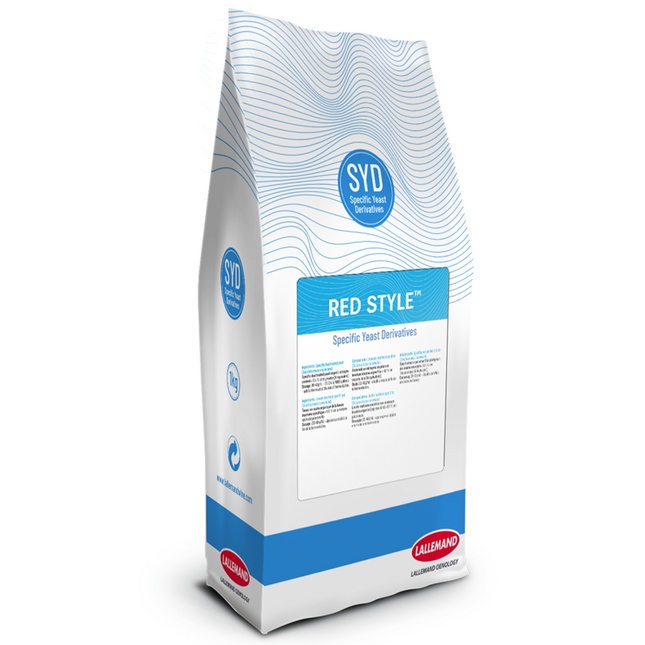
RedStyle – Lallemand Maceration Aid for Enhanced Color, Structure & Tannin Smoothness
Enhances color intensity and stability through polysaccharide–polyphenol complex formation
Improves tannin integration, reducing harshness and green characters
Boosts juice extraction and clarity during maceration with built-in pectinase
Builds fuller body and smoother mouthfeel without overwriting varietal character
Offers dual-action benefits (enzyme + yeast derivative), outperforming generic macerators
RedStyle combines a gentle pectinase enzyme with a specially selected and inactivated wine yeast derivative rich in soluble polysaccharides. When applied during red grape maceration, it breaks down pulp and skin walls—including pectin—enhancing juice yield and extraction. The released polysaccharides bind with anthocyanins and tannins, promoting richer color, more refined tannin structure, and a round, balanced body. The integrated enzyme also improves clarification and filterability, helping winemakers craft wines that are visually appealing, texturally complete, and varietally expressive.
Protocol
Suspend RedStyle in ten times its weight of clean must or water (e.g., 1 kg in 10 L). Stir thoroughly to ensure full dispersion. Add directly after crushing, either into the crusher, at the start of filling, or during initial pump-overs. Maintain suspension during addition to ensure even distribution.
Usage Rates
Recommended dosage: 30 g per hectoliter
= 0.3 g per liter
= 1.14 g per gallon
For dosage expressed per ton of grapes: 227 g per ton (≈ 0.5 lb/ton).
This balanced rate delivers optimal color stabilization, tannin smoothing, and maceration performance for most red wine styles.
Reduless is a new product from Lallemand that was designed to correct negative VSCs (Voltatile Sulfur Compounds) such as H2S (hydrogen sulfide, A.K.A. "rotten egg") and DMS (dimethyl sulfide, A.K.A. "cooked corn") defects in wine. Made from inactivated yeast that have been infused with copper using a proprietary process, Reduless is a much gentler H2S remedy on the wine than the traditional copper sulfate (CuSO4) treatment alone. If you have an H2S problem, then we recommend treating it with Reduless first. However, if the sulfur problem still remains after the Reduless treatment, then a bench trial with copper sulfate (CuSO4) is recommended.
Note: The sooner you catch a sulfur problem the easier it is to deal with!
To Use:
Dissolve Reduless in 10 times it's weight in water and add immediately to the wine. Stir the wine gently to ensure a thorough homogenization. Rack or filter after 72 hours.
Recommended Dosage:
0.4-0.6 g/gal. The maximum amount of copper that can be released into the wine using Reduless at the recommended dosage is 0.02 ppm.
Reskue – Yeast Derivative Nutrient for Detoxifying and Restarting Stuck Fermentations
Detoxifies fermentations by adsorbing toxic fatty acids that inhibit yeast and bacteria
Restores sugar uptake by clearing compounds that interfere with yeast membrane function
Reinvigorates both sluggish or stuck alcoholic and malolactic fermentations
Contains no measurable YAN, so it won't impact nutrient balance or promote excess yeast growth
More effective than standard yeast hulls due to its targeted high-capacity bioadsorptive properties
Reskue is a specific inactivated yeast derivative developed by Lallemand to help winemakers recover from sluggish or stuck fermentations. Unlike generic yeast hulls, which offer general detoxification support, Reskue is produced using a proprietary process that dramatically enhances its surface area and binding capacity for fermentation-inhibiting compounds—especially short- and medium-chain fatty acids. These compounds are produced by stressed yeast and can block sugar transport, stalling fermentation. Reskue removes them more efficiently than standard hulls, helping yeast and bacteria resume healthy metabolic activity. This makes Reskue particularly valuable not only in stuck alcoholic fermentations but also in challenging malolactic fermentations where similar toxins can block bacterial performance.
Protocol
Suspend Reskue in 10 times its weight of clean water at 30–37°C (86–98°F). Stir thoroughly and let sit for 20 minutes before adding to the fermentation. Mix evenly into the tank. In stuck alcoholic fermentations, allow Reskue to settle for 48 hours, then rack off before initiating the restart protocol.
Usage Rates
Recommended dosage: 30–40 grams per hectoliter
= 0.3–0.4 grams per liter
= 1.14–1.5 grams per gallon
Use 30 g/hL for moderate ferment stress and 40 g/hL when conditions are severe or when toxic byproducts are strongly suspected. Reskue is not a nutrient supplement—it provides virtually no YAN—and should be used as a detoxification tool to restore a viable fermentation environment.nd dry.
RUBY is the go-to strain for winemakers aiming to craft bold, fruit-forward red wines with exceptional color stability and structured mouthfeel
Whether you're perfecting a Cabernet Sauvignon, enhancing a bold Zinfandel, or refining a classic Bordeaux blend, RUBY brings the richness and depth that elevate your wine to world-class quality
Enhance color stability and elevate red fruit aromatics in your wines
RUBY is a specialized Saccharomyces cerevisiae strain developed to amplify red wine aromatic complexity, enhance color stability, and refine mouthfeel. Its unique metabolic profile promotes the release of varietal thiols and other aroma compounds, resulting in wines with vibrant red and black fruit notes, fine tannic structure, and a persistent finish. RUBY is particularly effective in fermentations aiming for intensity, freshness, and aromatic depth.
Aromatic Enhancement: Releases varietal thiols and other aroma compounds, intensifying notes of red fruits like raspberry and cherry, as well as blackcurrant and plum.
Color Stability: Promotes anthocyanin preservation, resulting in vibrant, long-lasting color intensity.
Structured Mouthfeel: Contributes to a full-bodied experience with smooth tannins and a balanced finish.
Alcohol Tolerance: Effective up to 16% ABV, ensuring complete fermentation even in high-sugar musts.
Temperature Range: Performs optimally between 61°F (16°C) and 82°F (28°C), providing flexibility across different fermentation strategies.
Low SO₂ Production: Delivers clean, pure fruit expression without sulfur-related off-flavors.
Applications:
Bold Red Wines: Perfect for Cabernet Sauvignon, Merlot, Syrah, and Zinfandel, emphasizing fruit intensity and structure.
Fruit-Driven Blends: Ideal for GSM (Grenache, Syrah, Mourvèdre) blends, enhancing layered complexity and mouthfeel.
Rosé Wines: Contributes vibrant color and fresh red fruit aromas to full-bodied rosés.
Barrel-Aged Reds: Holds up well to extended aging, developing deep layers of fruit and spice over time.
Flavor Profile:
Red and Black Fruits: Prominent flavors of raspberry, cherry, blackcurrant, and plum deliver a fruit-forward profile.
Spice Notes: Hints of black pepper, anise, and cinnamon complement rich fruit character.
Balanced Tannins: Enhances mouthfeel with a velvety texture and structured finish, ideal for aging.
Silky Smoothness: Promotes glycerol production for a rounded, silky palate experience.
Usage:
Rehydration: Rehydrate in 10 times its weight of chlorine-free water at 95°F (35°C) for 15–20 minutes. Stir gently to prevent clumping.
Pitch Rate: Use 1–1.5 grams per gallon (0.25–0.4 grams per liter) for optimal fermentation and color stabilization.
Nutrient Addition: Supplement with yeast nutrient to support strong fermentation and prevent sluggish behavior.
Fermentation Temperature: Maintain between 61°F and 82°F (16°C and 28°C) for maximum color extraction and aromatic retention.
Extended Maceration: Works exceptionally well with extended maceration techniques to further enhance color and tannin structure.
SAUVY is the preferred choice for winemakers aiming to produce expressive, aromatic white wines with pronounced tropical fruit and citrus characteristics
Whether crafting a signature Sauvignon Blanc or a fresh Pinot Grigio, SAUVY ensures vibrant clarity and pure fruit expression in every vintage
Enhance aromatic intensity and freshness in white wines
SAUVY is a specialized wine yeast strain developed to maximize thiol expression, particularly enhancing tropical and citrus aromas in white wines. It is especially effective in varietals like Sauvignon Blanc, Chenin Blanc, and Pinot Grigio, delivering vibrant notes of passion fruit, grapefruit, and gooseberry. This strain ensures a clean fermentation profile, preserving the wine's natural freshness and varietal character.
Thiol Release Enhancement: Promotes the release of varietal thiols such as 3MH and 4MMP, intensifying tropical and citrus aromas.
Aromatic Clarity: Accentuates flavors of passion fruit, grapefruit, and gooseberry, resulting in a crisp and lively bouquet.
Clean Fermentation Profile: Low production of volatile acidity and sulfur compounds maintains fruit purity.
Alcohol Tolerance: Effective up to 14.5% ABV, supporting complete fermentation across various musts.
Temperature Range: Performs optimally between 57°F (14°C) and 68°F (20°C), preserving aromatic freshness.
Low H₂S Production: Minimizes sulfur-related off-flavors, ensuring a clean finish.
Applications:
Sauvignon Blanc: Enhances tropical fruit and citrus zest, ideal for Marlborough-style wines.
Chenin Blanc: Boosts fresh pear, apple, and floral aromas while maintaining crisp acidity.
Grüner Veltliner: Highlights green apple and white pepper notes with a refreshing finish.
Pinot Grigio: Elevates stone fruit and citrus elements, adding clarity and freshness.
Rosé Wines: Enhances berry and citrus notes, contributing to a vibrant aromatic profile.
Flavor Profile:
Tropical Fruits: Dominant notes of passion fruit, mango, and pineapple.
Citrus & Grapefruit: Refreshing accents of grapefruit zest, lime, and lemon blossom.
Green & Herbaceous Hints: Subtle nuances of gooseberry, green apple, and fresh-cut grass.
Crisp, Clean Finish: Bright acidity and smooth mouthfeel enhance the perception of freshness.
Usage:
Rehydration: Rehydrate in 10 times its weight of chlorine-free water at 95°F (35°C) for 15–20 minutes. Stir gently to prevent clumping.
Pitch Rate: Use 1–1.5 grams per gallon (0.25–0.4 grams per liter) for optimal thiol expression and flavor development.
Nutrient Addition: Supplement with yeast nutrient to enhance fermentation strength and maintain aromatic intensity.
Fermentation Temperature: Maintain between 57°F and 68°F to optimize tropical ester formation and aromatic clarity.
Cold Fermentation: Ideal for cool fermentation techniques to preserve fresh aromatics and crisp mouthfeel.
UVAFERM 43 Restart™ is the premier solution for winemakers aiming to rescue stuck fermentations without compromising flavor integrity
Its robust performance and clean aromatic profile make it an essential tool for achieving complete, high-quality fermentations
Rescue stuck fermentations with robust restart performance and clean aromatics
UVAFERM 43 Restart™ is a pre-acclimated, fructophilic yeast strain specifically engineered to efficiently restart stuck fermentations. Developed by Lallemand Oenology in collaboration with Inter-Rhône, this Saccharomyces cerevisiae bayanus strain is optimized to thrive under challenging conditions, ensuring complete fermentation while preserving the wine's sensory integrity.
High Alcohol Tolerance: Effective up to 18% ABV, enabling complete fermentation in high-sugar musts.
Temperature Range: Performs optimally between 55°F (13°C) and 95°F (35°C), suitable for various fermentation conditions.
Fructophilic Nature: Efficiently consumes residual fructose and glucose, common in stuck fermentations.
Robust Fermentation Kinetics: Pre-acclimated cells adapt quickly, reducing mortality rates and ensuring reliable fermentation restart.
Low Nutrient Requirements: Thrives in nutrient-deficient musts, minimizing the need for additional supplementation.
Clean Aromatic Profile: Produces minimal volatile acidity and sulfur compounds, maintaining the wine's varietal character.
Applications:
Stuck Fermentation Recovery: Effective in reviving fermentations in red and white wines, including Cabernet Sauvignon, Merlot, Syrah, and Zinfandel.
High-Gravity Fermentations: Suitable for Amarone, Port-style, and late-harvest wines with elevated Brix levels.
Nutrient-Poor Musts: Performs well in musts with limited nutrient availability, ensuring complete fermentation.
Barrel Fermentations: Effective in completing fermentations in barrels where conditions may be less controlled.
Flavor Profile:
Neutral Sensory Impact: Preserves the wine's natural varietal characteristics without introducing off-flavors.
Clean Finish: Ensures a crisp, balanced finish, integrating seamlessly with the existing wine structure.
Usage:
Rehydration: Rehydrate in 10 times its weight of chlorine-free water at 104°F (40°C) for 15–20 minutes. Stir gently to prevent clumping.
Acclimatization: Mix rehydrated yeast with 10% of the stuck wine for 20–30 minutes to allow adaptation.
Pitch Rate: Use 1–1.5 grams per gallon (0.25–0.4 grams per liter) for effective restart.
Nutrient Addition: Supplement with yeast nutrients to optimize yeast health during recovery.
Fermentation Temperature: Maintain between 64°F and 86°F (18°C–30°C) for optimal performance and restart reliability.
Monitoring: Regularly check Brix and temperature to ensure progress and prevent re-stalling.
UVAFERM 43 is the yeast of choice for winemakers aiming to produce powerful, structured red wines with deep color and bold flavor Its resilience under challenging fermentation conditions ensures complete fermentation, making it an invaluable tool in both standard and difficult winemaking scenarios Enhance fermentation power and structure in bold red wines UVAFERM 43 is a robust wine yeast strain, selected for its exceptional ability to ferment under challenging conditions. Its fructophilic nature makes it particularly effective in high-sugar musts, ensuring complete fermentation even when fructose concentrations are elevated. This strain is ideal for crafting full-bodied red wines, offering enhanced color extraction, tannin structure, and aromatic intensity. High Alcohol Tolerance: Capable of fermenting up to 18% ABV, suitable for high-sugar musts. Temperature Resilience: Operates effectively between 55°F (13°C) and 95°F (35°C), accommodating a wide range of fermentation environments. Fructophilic Fermentation: Efficiently ferments musts with high fructose content, common in late-harvest or overripe grapes. Enhanced Color and Tannin Extraction: Promotes the extraction of anthocyanins and polyphenols, contributing to vibrant color and structured mouthfeel. Low Nutrient Requirements: Performs well with minimal nitrogen supplementation, reducing the risk of sluggish fermentation. Applications: Full-Bodied Red Wines: Optimal for varietals like Cabernet Sauvignon, Syrah, Zinfandel, and Malbec, enhancing body and color stability. Fortified Wines: Suitable for Port-style and Amarone-style wines, supporting high alcohol levels. Warm Climate Fermentations: Excels in hot climates where fermentation temperatures are elevated. Stuck Fermentation Recovery: Effective in restarting difficult or stuck fermentations due to its high heat and alcohol tolerance. Flavor Profile: Dark Fruit Intensity: Emphasizes bold notes of blackberry, black cherry, and plum. Spice and Earthiness: Introduces subtle layers of black pepper, cocoa, and leather for added complexity. Smooth Tannin Structure: Develops well-rounded tannins, contributing to a balanced mouthfeel. Deep Color Stability: Supports anthocyanin preservation, resulting in rich, vibrant hues. Usage: Rehydration: Rehydrate in 10 times its weight of chlorine-free water at 104°F (40°C) for 15–20 minutes. Stir gently to avoid clumping. Pitch Rate: Use 1–1.5 grams per gallon (0.25–0.4 grams per liter) for optimal fermentation and color development. Nutrient Addition: Supplement with yeast nutrient to optimize fermentation strength, especially in high-Brix musts. Fermentation Temperature: Maintain between 55°F and 95°F to maximize aromatic expression and color stability. Extended Maceration: Suitable for long maceration periods to deepen color and enhance tannin structure. Download the PDF Download the PDF
BDX is the yeast of choice for winemakers looking to craft bold, structured red wines with rich complexity and deep color Whether perfecting a Cabernet Sauvignon, enhancing the fruit-forward nature of Merlot, or refining a Bordeaux blend, BDX delivers consistency, elegance, and aging potential in every batch Enhanced structure and rich complexity for bold red wines BDX is a premium wine yeast strain specifically developed for full-bodied red wines that require enhanced structure, color stability, and aromatic complexity. Ideal for Bordeaux varietals, this strain excels at promoting deep color extraction and well-rounded tannin integration. Its robust fermentation capabilities ensure complete attenuation, even in high-sugar musts, while preserving the varietal characteristics and complexity of the wine. Deep Color Extraction: Promotes high anthocyanin stability for vibrant, long-lasting color. Enhanced Tannin Structure: Supports smooth tannin development and mouthfeel integration. Alcohol Tolerance: Effective up to 16% ABV, allowing for strong, full-bodied wines. Temperature Range: Performs optimally between 64°F (18°C) and 86°F (30°C), perfect for achieving rich complexity. High Flocculation: Contributes to excellent clarity post-fermentation. Minimal SO₂ Production: Reduces the risk of off-flavors, preserving natural aromatics. Applications Cabernet Sauvignon: Boosts boldness and enhances tannin structure for optimal aging. Merlot & Malbec: Promotes fruit intensity and smooth mouthfeel while enhancing complexity. Cabernet Franc: Elevates spice and berry notes with refined tannins. Bordeaux Blends: Perfect for crafting structured, age-worthy blends with balanced tannins and vibrant color. Flavor Profile Dark Fruit Expressions: Highlights blackberry, plum, and black cherry with layered depth. Spice and Tobacco Notes: Accentuates hints of black pepper, cedar, and dark chocolate. Smooth Tannin Integration: Creates a well-rounded mouthfeel with structured complexity. Aging Potential: Supports development over time, enhancing depth and smoothness. Usage Rehydration: Rehydrate in 10 times its weight of chlorine-free water at 95°F (35°C) for 15–20 minutes. Stir gently to prevent clumping. Pitch Rate: Use 1–1.5 grams per gallon (0.25–0.4 grams per liter) for optimal fermentation and tannin extraction. Nutrient Addition: Supplement with yeast nutrients, particularly in low-nitrogen musts, to avoid sluggish fermentation. Fermentation Temperature: Maintain between 64°F and 86°F to promote deep color and structured tannins. Extended Maceration: Ideal for longer maceration periods to intensify flavor and tannin complexity. Download the PDF Download the PDF
UVAFERM CEG™ is the premier choice for winemakers looking to craft elegant, fruit-driven wines with exceptional clarity and balance.
Whether perfecting a crisp Chardonnay, refining a vibrant Rosé, or producing world-class sparkling wines, CEG delivers purity, finesse, and remarkable aromatic depth
Craft elegant, aromatic wines with delicate freshness and balance
CEG is a premium wine yeast strain meticulously developed to enhance aromatic expression, mouthfeel, and fermentation stability in white wines, rosé wines, and sparkling wines. Known for its clean, consistent fermentations and ability to bring out refined floral and fruit-driven notes, this strain is the perfect choice for winemakers focused on producing crisp, vibrant wines with exceptional clarity and balance.
Aromatic Preservation: Enhances expressions of white peach, pear, and citrus blossom, maintaining freshness and delicacy.
Fine Bubble Retention: Ideal for sparkling wines, promoting tight, persistent effervescence.
Clean Fermentation Profile: Low volatile acidity and minimal SO₂ production maintain pure fruit expression.
Alcohol Tolerance: Effective up to 14% ABV, ensuring complete and reliable fermentation.
Temperature Range: Performs optimally between 57°F (14°C) and 68°F (20°C), allowing for cool fermentations that preserve aromatics.
Low Nutrient Requirement: Thrives with minimal nitrogen additions, reducing the risk of sluggish ferments.
Applications
Sparkling Wines: Perfect for Méthode Traditionnelle, Charmat Process, and Pet-Nat, contributing to clean fermentation and fine bubbles.
White Wines: Ideal for Chardonnay, Pinot Blanc, and Riesling, enhancing fruit purity and crisp acidity.
Rosé Wines: Boosts fresh berry and citrus notes with a clean, refreshing finish.
Late-Harvest Wines: Handles higher sugar concentrations gracefully, maintaining bright aromatics and balanced acidity.
Flavor Profile
Stone Fruits: Elegant notes of white peach, nectarine, and pear deliver a refined fruit character.
Citrus & Floral Notes: Accentuates citrus blossom, lemon zest, and orange peel for bright, fresh aromatics.
Delicate Mouthfeel: Promotes a smooth, refined palate with a light, crisp finish.
Persistent Effervescence: Ideal for sparkling wines, delivering fine bubbles and lasting mousse.
Usage
Rehydration: Rehydrate in 10 times its weight of chlorine-free water at 95°F (35°C) for 15–20 minutes. Stir gently to avoid clumping.
Pitch Rate: Use 1–1.5 grams per gallon (0.25–0.4 grams per liter) for optimal fermentation and flavor development.
Nutrient Addition: Supplement with yeast nutrient in low-nitrogen musts for strong, consistent fermentation.
Fermentation Temperature: Maintain between 57°F and 68°F to preserve delicate aromas and prevent off-flavors.
Secondary Fermentation: Ideal for sparkling wine production with fine bubble retention and clean aromatic lift.
UVAFERM VRB is the ideal choice for winemakers aiming to produce fruit-forward, age-worthy red wines with depth, elegance, and aromatic precision
Whether crafting a structured Cabernet, a bold Zinfandel, or a layered blend, VRB delivers clarity, color, and character in every bottle
Craft elegant, fruit-driven reds with exceptional aromatic expression
UVAFERM VRB is a premium Saccharomyces cerevisiae wine yeast strain, carefully selected for its ability to enhance fruit intensity, color stability, and aromatic complexity in red wines. Known for its consistent fermentation kinetics and low volatile acidity production, VRB is ideal for varietals where bold structure, rich fruit character, and aging potential are essential.
Enhanced Color Extraction: Promotes anthocyanin stability, delivering deep, long-lasting color intensity.
Berry-Forward Aromatics: Accentuates notes of blackberry, raspberry, and black cherry.
Structured Mouthfeel: Contributes to a smooth, full-bodied palate with well-integrated tannins.
Alcohol Tolerance: Effective up to 17% ABV, suitable for high-Brix musts and full-bodied red wines.
Temperature Range: Performs optimally between 59°F (15°C) and 82°F (28°C), offering flexibility in fermentation strategy.
Low H₂S and SO₂ Production: Ensures clean fermentation, preserving fruit purity.
MLF Compatibility: Very compatible with malolactic fermentation for seamless transitions.
Applications:
Bordeaux Varietals: Cabernet Sauvignon, Merlot, Cabernet Franc – enhances structure and aromatic depth.
Zinfandel & Sangiovese: Ideal for bold, fruit-driven profiles with layered complexity.
Tempranillo & Syrah: Enhances dark fruit notes and integrates well with oak.
Blended Reds: Perfect for GSM blends, Super Tuscans, and Meritage wines seeking balanced aromatics and structure.
Flavor Profile:
Dark Fruit Dominance: Rich expressions of blackberry, raspberry, and black cherry.
Spice & Earthiness: Subtle hints of cedar, black pepper, and tobacco.
Structured Tannins: Adds roundness and age-worthiness to the wine.
Stable Color: Supports anthocyanin retention for vibrant, long-lived color.
Usage:
Rehydration: Rehydrate in 10x its weight of chlorine-free water at 95°F (35°C) for 15–20 minutes. Stir gently to prevent clumping.
Pitch Rate: 1–1.5 grams per gallon (0.25–0.4 g/L) depending on must conditions.
Nutrient Addition: Add yeast nutrients, especially in high-Brix or low-nitrogen musts, to ensure healthy fermentation.
Fermentation Temperature: Maintain 59°F to 82°F (15°C to 28°C) for best results in color and flavor development.
Extended Maceration: Well-suited for long maceration to intensify tannin and flavor complexity.
Co-inoculation strain for fresh and fruit-forward wines
BETA CO-INOC™ is a strain of Oenococcus oeni that slowly utilizes malic acid over the course of alcoholic fermentation. Produces low levels of diacetyl and volatile acidity Slow to start but finishes fast Add BETA CO-INOC 24-48 hours post yeast inoculation. Not recommended for use in a sequential MLF Isolated from the Abruzzo region of Italy PRO-TIP: If alcoholic fermentation is sluggish or stuck, it may be necessary to add BACTILESS™ or DELVOZYME® once MLF is finished so that bacteria do not consume sugar and produce VA. This is especially important if the pH is >3.5. Alcohol Tolerance: <15% pH: >3.2 Total SO2 at crush: <60 ppm Temp: At inoculation: 18–30°C (64–86°F) During fermentation: 14–27°C (57–81°F) Last 1/4 fermentation: <75°F if malic acid is still present Frequently used in: fresh and fruity white, rosé, and red wines Usage: Add directly to pH >3.2 juice/must 24–48 hours after yeast inoculation and before alcohol reaches 5% (v/v). Once added, mix thoroughly. Storage: Dated expiration. For short term (<18 months) store at 4°C (39°F). For long term (>18 months) store at –18°C (0°F).
Enoferm Alpha will ferment at lower temperatures and at lower pH levels compared to older Viniflora strains of Oenococcus Oeni Alpha was selected as dominant strain that has the capcity to achieve reliable MLF and improve wine complexity This strain will help contribute to mouthfeel while lowering the perception of green and vegetative flavors Lallemand Oenology specializes in the development, production, and marketing of top-grade yeast and bacteria This was the first improved ML strain that we carried and still the most popular. When compared with the older Viniflora strains of Oenococcus Oeni, Enoferm Alpha (which is a different strain of Oenoccoccus Oeni) will ferment at lower temperatures and at lower pH levels. This means it is superior for both red and white wines and can be added later in the wine making process than the Viniflora strain, with the ideal time being right after the completion of primary fermentation. In addition to good performance in harsh conditions, Enoferm Alpha was preferred in blind tastings over the older Viniflora strain for its clean and fruity aromas, a decrease of vegetative and herbaceous notes and increased mouth-feel. Now we are selling multiple strains of improved ML bacteria including Beta, VP41, 31, and Baccus, giving you lots great bugs to choose from. Alpha was selected as dominant strain that has the capcity to achieve reliable MLF and improve wine complexity. Alpha will help contribute to mouthfeel while lowering the perception of green and vegetative flavors. Its low production of biogenic amines respects health concerns. For more information about ML Bacteria, please see MoreWine!'s Guide to Malolactic Fermentation. 2.5 g: good for 66 gallons 25 g: good for 660 gallons Alcohol tolerance: <15.5% v/v. SO2 tolerance: <50 ppm pH: >3.2 Temperature: >57°F You can't store malolactic bacteria once the package has been opened. Note: Malolactic bacteria added during the ferment will compete with the yeast for nutrients and are atagonistic to yeast, potentially causing higher VA levels. The best time to add an ML culture is after racking off the gross lees.
Enoferm Beta can positively contribute to the sensory profile of the wine, by enhancing spicy and red fruit aromas Delected due to it's good performance under difficult wine conditions and positive sensory contribution Able to induce MLF at temperatures as low as 55°F Lallemand Oenology specializes in the development, production, and marketing of top-grade yeast and bacteria Enoferm Beta is a single strain of Oenococcus oeni (ex Leuconostoc oenos), isolated from a Cabernet Sauvignon wine from Abbruzzi. It was selected due to it's good performance under difficult wine conditions, positive sensory contribution, and security from its low use of sugars and very low volatile acid as well as biogenic amines production. In winery trials, Enoferm Beta was able to induce MLF at temperatures as low as 55°F. Most direct inoculum preparations have difficulty completing MLF unless temperatures > 64°F, while Enoferm Beta can be used in wines with temperatures > 57°F. For more information about ML Bacteria, please see MoreWine!'s Guide to Malolactic Fermentation. 2.5 g: good for 66 gallons 25 g: good for 660 gallons Alcohol tolerance: <15% v/v. SO2 tolerance: <60 ppm pH: >3.2 Temperature: >57°F Different lactic acid bacteria strains do have an impact on the flavor profile of wine, Enoferm Beta can positively contribute to the sensory profile of the wine, by enhancing spicy and red fruit aromas, low diacetyl production, better structure and body,and less astringency and bitterness. You can't store malolactic bacteria once the package has been opened. Note: Malolactic bacteria added during the ferment will compete with the yeast for nutrients and are atagonistic to yeast, potentially resulting in higher VA levels. The best time to add an ML culture is after racking off the gross lees.
A new, advanced formulation of Go-Ferm Go-Ferm Protect is a natural yeast nutrient that is added to the yeast hydration water before adding your selected yeast strain. Its complex formula provides your yeast with the proper sterols, unsaturated fatty acids and micronutrients needed to begin fermentation in optimal shape. The great thing about Go-Ferm Protect is that the proper nutrients and vitamins are introduced BEFORE the yeast is added to the must. This way 100% of the nutrients are available to your selected yeast strain and won't be stolen away by any indigenous yeast or bacteria that may be present in the must before your yeast can become established. Go-Ferm Protect was created as a result of a multi-year study of problem fermentations by Lallemand and the National Agricultural Research Institute (INRA) in France. During this period, they looked at the adverse effects on the yeast from overripe fruit (>28 Brix), low nutrient levels, overclarification of the juice and poor fruit quality (Botrytis, rot, high bacteria count, insecticide and fungicide residue). Their research showed that musts deficient in sterols and unsaturated fatty acids made yeast more susceptible to ethanol toxicity (high alcohol), osmotic shock (high sugar), temperature and others stress factors. In response to this data they created the NATSTEP (NATural STErol Protection) process that incorporated sterols, unsaturated fatty acids, as well as vitamins and minerals into an advance yeast hydration nutrient: Go-Ferm Protect. Go-Ferm Protect provides a combination of protective and nutritional benefits that ensure your yeast begins your fermentation in peak form! The best part is that if your fruit is in great shape then Go-Ferm Protect will simply help your yeast out that much more! Go-Ferm Protect does not contain any DAP, as DAP is harmful to the yeast during the rehydration process. GO-Ferm is usually used in conjunction with our Fermaid K yeast nutrient; where Go-Ferm Protect is used at yeast hydration then Fermaid K is added at the first signs of fermentation and again after 1/3 sugar depletion. Use: Use at a rate of 1.25 g Go-Ferm Protect per 1 g of yeast. A rough approximate of weight is 1 tsp = 3.2 grams. We highly recommend using a scale to weigh the product for an accurate dose. We do not recommend relying on these rough conversions for accurate dosage rates. Download the PDF Like Go Ferm Protect? Then you will love CellarScience® FermStart!
Due to high demand, the 10 kg is currently out of stock. Be the first to receive your items by placing a pre-order today. We will automatically ship this to you when we receive more inventory. Improves fermentation kinetics and aroma production Allows yeast to be rehydrated in cool water (60°F) without any loss of viability or vitality Eliminates the need for acclimatization steps—rehydrated yeast can be added directly to juice or must after 15 minutes Requires 50% less water than Go-Ferm™ or Go-Ferm Protect Evolution™ Non-clumping, instantly disperses in cool water Go-Ferm Sterol Flash™ is a revolutionary new yeast rehydration nutrient that is fast, simple to use, and saves time, labor, and water without compromising on yeast viability and vitality. Derived from autolyzed yeast, Go-Ferm Sterol Flash™ provides optimized levels of micronutrients (vitamins and minerals) and extremely high levels of survival factors including sterols and unsaturated fatty acids. Go-Ferm Sterol Flash™ has the highest bioavailability of sterols and is produced with a specific Lallemand micro agglomerated process, for instant dispersion during the rehydration step. When suspended in cool water, the high content of sterols are quickly released and integrated in the yeast membrane within 15 minutes. The high content of sterols reinforces the permeability and fluidity of the yeast membrane. Go-Ferm Sterol Flash™ increases yeast viability, yeast vitality, and optimizes wine yeast aroma precursors assimilation under any conditions in red, rose, and white wine fermentation. With Go-Ferm Sterol Flash™, no yeast acclimatization steps are required before inoculation in must. Go-Ferm Sterol Flash™ is a revolutionary yeast rehydration protector with instant dispersion in cool water for a more reliable alcoholic fermentation and wine yeast sensory impact. Use: Use at a rate of 1.25 g Go-Ferm Protect per 1 g of yeast. A rough approximate of weight is 1 tsp = 3.2 grams. We highly recommend using a scale to weigh the product for an accurate dose. We do not recommend relying on these rough conversions for accurate dosage rates. Download the PDF Store in a cool and dry environment at 65°F. Once opened, keep tightly sealed and dry.
LalBrew Abbaye™ is an ale yeast of Belgian origin selected for its ability to ferment Belgian style beers ranging from low to high alcohol
Produces the spiciness and fruitiness typical of Belgian and Trappist style ales
When fermented at higher temperatures, typical flavors and aromas include tropical, spicy and banana
When fermented at lower temperatures, typical flavors and aromas include darker fruit, raisin, date, and fig
Lallemand premium brewing yeast offers brewers unmatched consistency, reliability and purity from one batch of beer to the next
Abbaye is a Belgian ale yeast known for its abitlity to ferment Belgian style beers that can range from low to high alcohol levels. Abbaye produces spicy and fruity flavors, making it the perfect dry yeast to make beers of the Trappist variety, such as Dubbel, Tripel and Quad. When fermenting at higher temperatures, Abbaye will impart tropical, spicy and banana flavors and aromas. When fermenting at lower temperatures, the flavors and aromas become that of darker fruits, such as raisin, date and fig.
Beer Styles: Belgian
Aroma: Spicy, fruity, tropical, banana
Attenuation: High
Fermentation Range: 63-77°F
Flocculation: Medium to High
Alcohol Tolerance: 14% ABV
*See the technical data sheet below for information on rehydration, usage and storage.