WLP351 produces a classic German-style wheat beer, with medium to high spicy phenolic overtones reminiscent of cloves Flavor and aroma are highly affected by pitching rate and fermentation temperature PurePitch® Next Generation offers a precise cell count across all strains so you can calculate the exact pitch rate you need for every batch Scan the barcode on the back of the package and enter your wort stats into the Pitch Rate Calculator
White Labs Yeast has been producing high-quality brewer's yeast since 1995 and continues to raise the bar in the art of fermentation Don't need a full package? Put the lid back on and store in the refrigerator for your next batch! WLP351 is a traditional Bavarian weizen yeast. This strain produces a classic German-style wheat beer, with moderately high, spicy, phenolic overtones reminiscent of cloves. A wonderful yeast strain for traditional hefeweizens, wheat beers, and roggenbiers. Pitching rate and temperature will dramatically affect the flavor and aroma of this strain. Traditional brewing techniques suggest underpitching to produce more classic characteristics of the style. PurePitch® Next Generation—now with more yeast, get a foolproof fermentation without a starter! Just twist the cap & pitch! Why PurePitch Next Gen versus other options? Typically yeast manufacturers use a range for how many yeast cells are going into each package. This can vary widely, especially from strain to strain. Next Gen offers a far more precise cell count across all strains allowing you to use the Whitelabs exclusive pitch calculator. Simply scan the barcode on the back of each package to be taken to their online calculator. Enter the volume, strength, and pitching temperature of the wort you are fermenting and the calculator tells you exactly how much yeast to pitch. You will be fermenting like a professional brewer, using the same concentration of yeast every time and enjoying more consistent results. Don't need a full package? Put the lid back on and store in the refrigerator for your next batch. Whitelabs has also increased the viability (the number of living cells in the package) over the shelf life of the yeast. Next Gen strains are grown in their unique, small-batch reactors to assure freshness and then packaged in a special film that allows for off-gassing, assuring that their viability is absolutely industry leading. Attenuation: 73-80% Flocculation: Low Alcohol Tolerance: 5-10% ABV Optimum Fermentation Temp: 66-70°F Cell Count: 150 Billion For best results we always recommend ordering an ice pack with your liquid yeast. Please Note: When choosing an ice pack option beware that the liquid yeast will not arrive cold even when shipped together. Ice packs and insulated mailing options are designed to keep the yeast colder for longer during shipment, but they will not ensure that your yeast arrives cold. We will not replace liquid yeast that arrives warm. During warmer months we strongly recommend you choose dry yeast.
B48 is the perfect strain for your classic abbey ales, producing moderate esters with low to no phenolic characteristics
It boasts a high alcohol tolerance but may ferment slower than expected
Double pitch size with a minimum of 200 billion cells—twice the size of the standard yeast pitch
Imperial Yeast is a group of hard-working, fermentation fanatics who provide the brewing industry with the highest quality, most effective yeast possible
The perfect strain for your classic abbey ales. Triple Double produces moderate esters with low to no phenolic characteristics. This strain is tried and true and works perfectly in a production environment. Keep an eye on Triple Double, it likes to sit on top of the wort throughout fermentation which may result in a slow fermentation.
Attenuation: 74-78%
Flocculation: Medium
Alcohol Tolerance: 12% ABV
Optimum Fermentation Temp: 65-77°F
Cell Count: 200 Billion
Similar Strains: WLP530, WY3787
Please Note: For best results we Always recommend ordering an Ice Pack with your liquid yeast. Ice Packs can be found below in the "You might Also Need" section.
Please Note: When choosing an ice pack option beware that the liquid yeast will not arrive cold even when shipped together. Ice packs and insulated mailing options are designed to keep the yeast colder for longer during shipment, but they will not ensure that your yeast arrives cold. We will not replace liquid yeast that arrives warm. During warmer months we strongly recommend you choose dry yeast.
Specially formulated for Scotch‑style whisky fermentation, excelling at metabolizing complex sugars like maltotriose for deeper grain character
Delivers a soft, full mouthfeel and complex, fruity esters making it ideal for single malt and other refined grain spirits
Recommended for Scotch-Style Single Malt Whisky, Bourbon, and Grain-Based Distillates with Complex Esters
Ferment between 72-90°F
Angel Yeast AM‑1 is specially formulated for Scotch‑style whisky fermentation, excelling at metabolizing complex sugars like maltotriose for deeper grain character. It delivers a soft, full mouthfeel and complex, fruity esters making it ideal for single malt and other refined grain spirits.
Fast fermentation with strong maltotriose assimilation and high wort utilization rate
Soft taste profile enriched with fruity esters
Robust performance in whisky washes, including Scotch and bourbon-style grains
Fermentation temperature range: 22–32 °C (72–90 °F)
Alcohol tolerance up to ~15% v/v
Living yeast cells ≥ 10 billion cfu/g; moisture ≤ 7%; apparent fermentation > 90%
Fermentation Range
72–90 °F (22–32 °C)
Usage Rate
0.5–1.0 g per liter (0.5–1.0 kg per 1000 kg) of wash/mash
Instructions
Rehydrate in 5–10× its weight in lukewarm water or low-strength wort at 22–30 °C for ~7–15 minutes. Gently stir and let rest 10–15 minutes before pitching into the fermenter
Applications
Scotch-Style Single Malt Whisky • Bourbon • Grain-Based Distillates with Complex Esters
L09 creates refreshing light to dark lagers with very clean, low ester aromatic profiles and nice crisp and dry finishes
Perfect strain to ferment your Mexican lager, Vienna lager, Maibock, and many more
Double pitch size with a minimum of 200 billion cells—twice the size of the standard yeast pitch
Imperial Yeast is a group of hard-working, fermentation fanatics who provide the brewing industry with the highest quality, most effective yeast possible
Que Bueno creates refreshing light to dark lagers with very clean, low ester aromatic profiles and nice crisp and dry finishes. This strain is not just a great choice for Mexican lagers, but any lager where clean ester profile and dry finish is appropriate.
Attenuation: 73-77%
Flocculation: Medium
Alcohol Tolerance: 10% ABV
Optimum Fermentation Temp: 47-55°F
Cell Count: 200 Billion
Similar Strains: WLP940
Please Note: For best results we Always recommend ordering an Ice Pack with your liquid yeast. Ice Packs can be found below in the "You might Also Need" section.
Please Note: When choosing an ice pack option beware that the liquid yeast will not arrive cold even when shipped together. Ice packs and insulated mailing options are designed to keep the yeast colder for longer during shipment, but they will not ensure that your yeast arrives cold. We will not replace liquid yeast that arrives warm. During warmer months we strongly recommend you choose dry yeast.
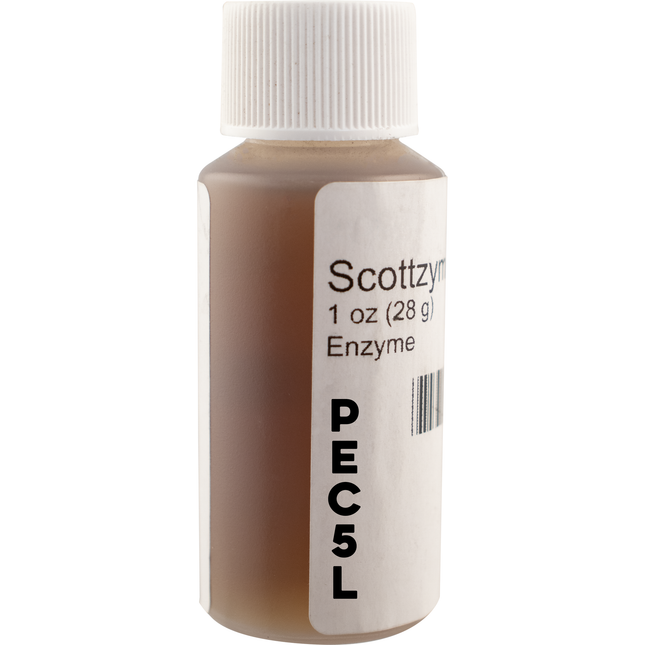
Scottzyme PEC5L – Pectinase Enzyme for Enhanced Settling and Juice Yield
Rapidly breaks down soluble pectins for faster settling and improved clarity
Increases free-run and press yield by reducing viscosity and cell wall resistance
Improves flotation efficiency and tightens lees compaction
Effective across a wide pH range and performs well at low temperatures
Ideal for white, rosé, and fruit wines requiring fast clarification and clean separation
Scottzyme PEC5L is a highly active liquid pectinase enzyme formulated to reduce pectin-related haze and increase processing efficiency in juice production. By breaking down soluble pectins, PEC5L dramatically improves juice release during pressing, reduces must viscosity, and accelerates settling or flotation. The result is clearer juice, more compact lees, and higher overall yield. Its formulation is optimized for cool-temperature performance and a broad pH range, making it a versatile tool in grape and non-grape juice clarification. Unlike general pectinases, PEC5L is designed to act quickly and cleanly, without over-extraction of phenolics or bitterness.
Protocol
Dilute Scottzyme PEC5L in 10 times its volume of chlorine-free water or juice. Add to must or juice immediately after crushing or during transfer to settling tank. Mix well to ensure even distribution. For flotation, add just before or during the flotation process. Avoid adding at the same time as SO₂ or bentonite.
Usage Rates
Recommended dosage: 1.5–4.0 mL per 1000 lb of fruit or 0.075–0.2 mL per gallon of juice
= approximately 0.02–0.05 mL per liter
Use lower rates for clean, low-pectin fruit or warmer temperatures. Use higher rates for pectin-rich grapes, low temperatures, or difficult-to-settle musts. Allow contact time of 2 to 12 hours depending on conditions and desired level of clarification.
F-2 was specifically selected for secondary fermentation in bottle and in cask
Neutral aroma profile and high alcohol resistance make it perfect for refermentation bottle conditioning
Sticks well at the bottom of the bottles/casks
Fermentis active dry yeast offers reliability, ease-of-use, and consistency to home and professional beverage makers across the world
SafAle™ F-2 is specifically selected for secondary fermentation in bottle and in cask. This yeast assimilates very little maltotriose but assimilates basic sugars (glucose, fructose, saccharose, maltose) and is characterized by a neutral aroma profile respecting the base beer character. Its neutral aroma profile, high alcohol resistance and stickiness characteristics make it a perfect match for consistent re-fermentation in bottle and cask.
SafAle™ F-2 resists to high alcohol levels (>10% v/v) and allows brewers to obtain all the properties of refermentation such as:
Beer preservation thanks to oxygen trapping
Contribution in roundness and maturation aromas
Carbonation
Sticks well at the bottom of the bottles/casks and forms a nice haze when it is resuspended
Usage:
Add 19 to 38 grams of sugar per gallon of beer (5 to 10 grams of sugar per liter) to obtain a saturation of 2.5 to 5.0 g/l of CO2
Pitch the sweetened beer, that should be at fermentation temperature (68-77°F / 20-25°C) with the rehydrated yeast. Carbonation will be achieved in 1 to 2 weeks at 68-77°F. Carbonation at 59°F can take over 2 weeks
At the end of refermentation, the beer can be cooled down and will gain in roundness after 2 to 3 weeks
Please note: Example image shows a 20g sachet. The correct size is 25g. Updated image coming soon.
WLP568 is a blend that incorporates multiple Belgian and saison strains to produce pear-like esters backed by spicy, earthy and clove-like flavors and aromas Recommended for dubbels, tripels and Belgian pale ales, saison, and witbier PurePitch® Next Generation offers a precise cell count across all strains so you can calculate the exact pitch rate you need for every batch Scan the barcode on the back of the package and enter your wort stats into the Pitch Rate Calculator
White Labs Yeast has been producing high-quality brewer's yeast since 1995 and continues to raise the bar in the art of fermentation Don't need a full package? Put the lid back on and store in the refrigerator for your next batch! WLP568 is a perfect blend of Belgian ale and saison strains working in perfect harmony to create complex, fruity aromas and flavors. The blend of yeast strains encourages complete fermentation in a timely manner. Phenolic, spicy, earthy, and clove like flavors are also created. This well-balanced blend is perfcet for Belgian Wits, Belgian table beers, Biere de Gardes, Belgian dubbels, Belgian tripels, Belgian blonds, saisons and Belgian dark strong ales. PurePitch® Next Generation—now with more yeast, get a foolproof fermentation without a starter! Just twist the cap & pitch! Why PurePitch Next Gen versus other options? Typically yeast manufacturers use a range for how many yeast cells are going into each package. This can vary widely, especially from strain to strain. Next Gen offers a far more precise cell count across all strains allowing you to use the Whitelabs exclusive pitch calculator. Simply scan the barcode on the back of each package to be taken to their online calculator. Enter the volume, strength, and pitching temperature of the wort you are fermenting and the calculator tells you exactly how much yeast to pitch. You will be fermenting like a professional brewer, using the same concentration of yeast every time and enjoying more consistent results. Don't need a full package? Put the lid back on and store in the refrigerator for your next batch. Whitelabs has also increased the viability (the number of living cells in the package) over the shelf life of the yeast. Next Gen strains are grown in their unique, small-batch reactors to assure freshness and then packaged in a special film that allows for off-gassing, assuring that their viability is absolutely industry leading. Attenuation: 70-80% Flocculation: Medium Alcohol Tolerance: 5-10% ABV Optimum Fermentation Temp: 68-85°F Cell Count: 150 Billion For best results we always recommend ordering an ice pack with your liquid yeast. Please Note: When choosing an ice pack option beware that the liquid yeast will not arrive cold even when shipped together. Ice packs and insulated mailing options are designed to keep the yeast colder for longer during shipment, but they will not ensure that your yeast arrives cold. We will not replace liquid yeast that arrives warm. During warmer months we strongly recommend you choose dry yeast.
For the ultimate spirit quality! Turbo Carbon is specifically designed for use during fermentation, and is the perfect alternative to Turbo Sugar where it is unavailable. It has a unique activated internal pore structure which removes impurities not taken out by post distillation filtration. It significantly improves the performance of all Turbo Yeasts and is essential for use with Triple Distilled Turbo Yeast.
Emphasizes red berry fruit flavors
High color extraction
Makes wines that do not require extended aging
Med-High nutrient need
Top choice for Zinfandel, Sangiovese, Pinot, Merlot
Our most popular red yeast is a perfect choice for Pinot Noir, Zinfandel, Sangiovese, Merlot and other reds where you want to emphasize red fruit flavors. When compared with BIG RED or PURPLE, RED is less about structure and body and more about fruit. Fantastic by itself if you plan to blend separately fermented lots back together. RED is a great choice to contribute red berry flavor. Also known to help produce intense color. Also a great choice for Cabernet, Syrah and other traditinoal big red varietals where you would like to emphasize fruit over structure and body. Because RED ferments cleaner than most yeast at high temperatures, it is the perfect choice if you are fermenting in a warm environment and do not have temperature control. It does not produce much SO2 so it is a great choice for easier ML fermentations
Start Time: Average
Alcohol tolerance: 16%
Nitrogen Demand: Med
Yan Requirement @ 23 Brix: 250ppm
Production of volatile acidity: low
Production of SO2: Low
Ease to Ferment with MLF: Good
Yeast Type: Cerevisiae
Killer Factor: Neutral
Malic Acid Consumption: Average
Optimal Fermentation Temp: 65–85°F
Proper yeast hydration helps ensure a healthy fermentation. For every gram of yeast, mix .25 g of FermStart yeast nutrient with 25 ml of sterilized tap water between 104–106°F/40–41°C. When water reaches 104°F/40°C, sprinkle yeast into water and stir gently. Allow the slurry to stand undisturbed for 15 minutes and then stir again. For every gram of yeast used add 25 ml of clean must to the yeast slurry and let stand 15–20 minutes. If necessary, use additional must to adjust yeast slurry to within 18°F of must temp before pitching. For a complete nutrient schedule sufficient for most fermentations, add 1.5 g of FermFed DAP Free per gallon of must at the first sign of fermentation and 1 g of FermFed per gallon of must after 1/3 sugar depletion.
Download the PDF
Big mouthfeel from high glycerol /polysaccharide /mannoproteins
Flavors of Cherries, Raspberries, Figs, Jam, Red currant
High alcohol tolerence
Low nutrient needs
Perfect for Syrah, Zinfandel, Pinot, Merlot, Malbec, Sangiovese, Grenache
Our go-to choice for those reds originating from the Cote du Rhone in France such as Syrah, Grenache, and Mouvedre. Also a top choice for Zinfandel, Sangiovese, Malbec, Merlot, and Pinot. Induces flavors of ripe cherries, raspberries, red curant, figs and jam. Due to its production of glycerol and release of mannoproteins it produces full bodied, rich red wines. PURPLE has a very low production of SO2 which is favorable for an easy malolactic fermentation (MLF) post fermentation. PURPLE is also an easy to ferment yeast with a low nutrient needs which is the opposite of our Big Red strain. It also has a "killer" quality and naturally inhibits unwanted bacterial or wild yeast growth during fermentation.
Start Time: Slower
Alcohol tolerance: 15%
Nitrogen demand: low
Production of volatile acidity: Low
Production of SO2: Low
Ease to Ferment with MLF: Average
YAN Requirement @ 23 Brix: 200 ppm
Malic Acid Consumption: Low
Yeast Type: Cerevisiae
Optimal Fermentation Temp: 65–85°F
Proper yeast hydration helps ensure a healthy fermentation. For every gram of yeast, mix .25 g of FermStart yeast nutrient with 25 ml of sterilized tap water between 104–106°F/40–41°C. When water reaches 104°F/40°C, sprinkle yeast into water and stir gently. Allow the slurry to stand undisturbed for 15 minutes and then stir again. For every gram of yeast used add 25 ml of clean must to the yeast slurry and let stand 15–20 minutes. If necessary, use additional must to adjust yeast slurry to within 18°F of must temp before pitching. For a complete nutrient schedule sufficient for most fermentations, add 1.5 g of FermFed DAP Free per gallon of must at the first sign of fermentation and 1 g of FermFed per gallon of must after 1/3 sugar depletion.
Download the PDF
L13 is an all-around solid lager strain that produces clean beers with a very low ester profile
This strain is very powdery, so long lagering times or filtration is required for bright beer
Double pitch size with a minimum of 200 billion cells—twice the size of the standard yeast pitch
Imperial Yeast is a group of hard-working, fermentation fanatics who provide the brewing industry with the highest quality, most effective yeast possible
The world’s most popular lager strain is ready for you. Global is an all-around solid lager strain that produces clean beers with a very low ester profile. This strain is very powdery, so long lagering times or filtration is required for bright beer.
Attenuation: 73-77%
Flocculation: Low-Medium
Alcohol Tolerance: 10% ABV
Optimum Fermentation Temp: 46-56°F
Cell Count: 200 Billion
Similar Strains: WLP830, WY2124
Please Note: For best results we Always recommend ordering an Ice Pack with your liquid yeast. Ice Packs can be found below in the "You might Also Need" section.
Please Note: When choosing an ice pack option beware that the liquid yeast will not arrive cold even when shipped together. Ice packs and insulated mailing options are designed to keep the yeast colder for longer during shipment, but they will not ensure that your yeast arrives cold. We will not replace liquid yeast that arrives warm. During warmer months we strongly recommend you choose dry yeast.
WLP653 produces a high intensity of the traditional Brettanomyces characters in beer, such as horsey, smoky and spicy flavors Most often used in lambic style beers, Flanders, or sour brown ales PurePitch® Next Generation offers a precise cell count across all strains so you can calculate the exact pitch rate you need for every batch Scan the barcode on the back of the package and enter your wort stats into the Pitch Rate Calculator
White Labs Yeast has been producing high-quality brewer's yeast since 1995 and continues to raise the bar in the art of fermentation Don't need a full package? Put the lid back on and store in the refrigerator for your next batch! WLP653 Brettanomyces lambicus offers high intensity Brett character of horsey, smoky and spicy flavors. As the name suggests, this strain is found most often in Lambic style beers, which are spontaneously fermented beers. Also found in Flanders and sour brown style beers. Use WLP653 for Lambic, Flanders Brown (Oud bruin), Flanders Red, Gose, Geuze and Berliner Weisse beers. PurePitch® Next Generation—now with more yeast, get a foolproof fermentation without a starter! Just twist the cap & pitch! Why PurePitch Next Gen versus other options? Typically yeast manufacturers use a range for how many yeast cells are going into each package. This can vary widely, especially from strain to strain. Next Gen offers a far more precise cell count across all strains allowing you to use the Whitelabs exclusive pitch calculator. Simply scan the barcode on the back of each package to be taken to their online calculator. Enter the volume, strength, and pitching temperature of the wort you are fermenting and the calculator tells you exactly how much yeast to pitch. You will be fermenting like a professional brewer, using the same concentration of yeast every time and enjoying more consistent results. Don't need a full package? Put the lid back on and store in the refrigerator for your next batch. Whitelabs has also increased the viability (the number of living cells in the package) over the shelf life of the yeast. Next Gen strains are grown in their unique, small-batch reactors to assure freshness and then packaged in a special film that allows for off-gassing, assuring that their viability is absolutely industry leading. Attenuation: N/A Flocculation: Low Alcohol Tolerance: 8-12% ABV Optimum Fermentation Temp: 85°F Cell Count: 150 Billion For best results we always recommend ordering an ice pack with your liquid yeast. Please Note: When choosing an ice pack option beware that the liquid yeast will not arrive cold even when shipped together. Ice packs and insulated mailing options are designed to keep the yeast colder for longer during shipment, but they will not ensure that your yeast arrives cold. We will not replace liquid yeast that arrives warm. During warmer months we strongly recommend you choose dry yeast.
WLP518 is a Kveik strain isolated from a mixed culture which belonged to Harald Opshaug, a farmhouse brewer from Stranda, Norway Ideal for IPAs and Pale Ales due to its hop-forward character and clean fermentation even at higher temperatures PurePitch® Next Generation offers a precise cell count across all strains so you can calculate the exact pitch rate you need for every batch Scan the barcode on the back of the package and enter your wort stats into the Pitch Rate Calculator
White Labs Yeast has been producing high-quality brewer's yeast since 1995 and continues to raise the bar in the art of fermentation Don't need a full package? Put the lid back on and store in the refrigerator for your next batch! Sourced Lars Marius Garshol, this Kveik strain was isolated from a mixed culture which belonged to Harald Opshaug, a farmhouse brewer in Stranda, Norway. This strain was originally used in the 1990s to produce several kornøl-style beers. It is a clean fermenting yeast and has tolerated temperatures up to 95°F (35°C) while finishing fermentation within three to four days. The hop-forward, clean characteristics of this strain make it ideal for IPAs and pale ales. PurePitch® Next Generation—now with more yeast, get a foolproof fermentation without a starter! Just twist the cap & pitch! Why PurePitch Next Gen versus other options? Typically yeast manufacturers use a range for how many yeast cells are going into each package. This can vary widely, especially from strain to strain. Next Gen offers a far more precise cell count across all strains allowing you to use the Whitelabs exclusive pitch calculator. Simply scan the barcode on the back of each package to be taken to their online calculator. Enter the volume, strength, and pitching temperature of the wort you are fermenting and the calculator tells you exactly how much yeast to pitch. You will be fermenting like a professional brewer, using the same concentration of yeast every time and enjoying more consistent results. Don't need a full package? Put the lid back on and store in the refrigerator for your next batch. Whitelabs has also increased the viability (the number of living cells in the package) over the shelf life of the yeast. Next Gen strains are grown in their unique, small-batch reactors to assure freshness and then packaged in a special film that allows for off-gassing, assuring that their viability is absolutely industry leading. Attenuation: 69-80% Flocculation: Medium to High Alcohol Tolerance: 15%+ ABV Optimum Fermentation Temp: 77-95°F Cell Count: 150 Billion For best results we always recommend ordering an ice pack with your liquid yeast. Please Note: When choosing an ice pack option beware that the liquid yeast will not arrive cold even when shipped together. Ice packs and insulated mailing options are designed to keep the yeast colder for longer during shipment, but they will not ensure that your yeast arrives cold. We will not replace liquid yeast that arrives warm. During warmer months we strongly recommend you choose dry yeast.
Recomended for aged red wines High color extraction Significant polysaccaride and glycerol production for huge mouthfeel High alcohol tolerence High nutrient need Top choice for Bordeaux varietals Cabernet, Cab Franc, Petite Verdot and Merlot Also excelletnt for Sangiovese, Nebbiolo and some Pinot The name kind of says it all. BIG RED is ideal for producing big, complex red wines with lasting fruit. Depending on the grape varietal used it can emphasize complex berry fruit and spice flavors. This strain is very efficient at breaking down and extracting tannins and anthocyanins from grape skin walls, making wines with dark inky color and a tannin profile suitable for extended aging. BIG RED also produces a great mouthfeel due to the significant production of polysaccharides and glycerol. It is also tolerant to higher alcohol levels making it ideal for those grapes that need to stay on the vine just a little longer to get full phenolic ripes with smooth tannin profiles. So lets recap... emphasizes berry fruit with many varietals, produces dark color, extracts a full array of tannins suitable for extended aging, makes wines with great mouthfeel, and is resistant to higher alcohols. Is there a catch? No, but to get all that done BIG RED does love nutrients and you will need to feed it and pay attention to it during fermenation. This is a strain where you would ideally know your Free Available Nitrogen levels that you could base a nutrient schedule around. Absent those numbers or a history with the grapes you are fermentiing, we would suggest you start with hydrating with Fermstart, feeding with FermFed DAP free at the onset of fermentation and feeding again with regular Fermfed after 1/3 sugar depletion. BIG RED is a very low producer of H2S when nutrient demands are met. The perfect strain if you want to make amazing reds. Not the perfect strain if you have a vacation planned during the middle of fermentation and are going to ask your neighbor to punch down...we hear it all!. Because this strain respects varietal character it can be used for a broad spectrum of red grape varietals. Perfect of courese for those Bordeaux varietals ilke Cabernet Sauvignon, Cabernet Franc, Petit Verdot and even Merlot. Also our first choice for Nebbiolo and some bigger style Sangiovese and Pinot Noir. Start Time: Fast Alcohol tolerance: 16%+ Nitrogen demand: high Yan Requirement @ 23 Brix: 270ppm Production of volatile acidity: Low Production of SO2: Low Ease to Ferment with MLF: Average Yeast type: Cervisiae Killer Factor: Neutral Malic Acid Consumption: Average Optimal Fermentation Temp: 65–85°F Proper yeast hydration helps ensure a healthy fermentation. For every gram of yeast, mix .25 g of FermStart yeast nutrient with 25 ml of sterilized tap water between 104–106°F/40–41°C. When water reaches 104°F/40°C, sprinkle yeast into water and stir gently. Allow the slurry to stand undisturbed for 15 minutes and then stir again. For every gram of yeast used add 25 ml of clean must to the yeast slurry and let stand 15–20 minutes. If necessary, use additional must to adjust yeast slurry to within 18°F of must temp before pitching. For a complete nutrient schedule sufficient for most fermentations, add 1.5 g of FermFed DAP Free per gallon of must at the first sign of fermentation and 1 g of FermFed per gallon of must after 1/3 sugar depletion. Download the PDF
Enoferm Beta can positively contribute to the sensory profile of the wine, by enhancing spicy and red fruit aromas Delected due to it's good performance under difficult wine conditions and positive sensory contribution Able to induce MLF at temperatures as low as 55°F Lallemand Oenology specializes in the development, production, and marketing of top-grade yeast and bacteria Enoferm Beta is a single strain of Oenococcus oeni (ex Leuconostoc oenos), isolated from a Cabernet Sauvignon wine from Abbruzzi. It was selected due to it's good performance under difficult wine conditions, positive sensory contribution, and security from its low use of sugars and very low volatile acid as well as biogenic amines production. In winery trials, Enoferm Beta was able to induce MLF at temperatures as low as 55°F. Most direct inoculum preparations have difficulty completing MLF unless temperatures > 64°F, while Enoferm Beta can be used in wines with temperatures > 57°F. For more information about ML Bacteria, please see MoreWine!'s Guide to Malolactic Fermentation. 2.5 g: good for 66 gallons 25 g: good for 660 gallons Alcohol tolerance: <15% v/v. SO2 tolerance: <60 ppm pH: >3.2 Temperature: >57°F Different lactic acid bacteria strains do have an impact on the flavor profile of wine, Enoferm Beta can positively contribute to the sensory profile of the wine, by enhancing spicy and red fruit aromas, low diacetyl production, better structure and body,and less astringency and bitterness. You can't store malolactic bacteria once the package has been opened. Note: Malolactic bacteria added during the ferment will compete with the yeast for nutrients and are atagonistic to yeast, potentially resulting in higher VA levels. The best time to add an ML culture is after racking off the gross lees.
WLP675 is a direct pitch liquid Malolactic culture for 6 gallons of wine
Tolerant of a wide range of temperatures and pH—perfect for home winemakers
Leaves no significant impact on flavor, aroma or mouthfeel
WLP675 is a direct pitch liquid Malolactic culture for 6 gallons of wine. This ML culture from White Labs is specially designed to meet the needs of home winemakers. It is tolerant of a wide range of temperatures and pHs and will not have a significant impact on flavor, aroma or mouthfeel.
Vital Stats:
pH tolerant down to 3.0
Low temperature tolerant down to 55°F
Alcohol tolerant to 15% ABV
Free SO2 should be less than 10ppm
Please Note: White Labs recommends pitching this strain at around 5 Brix remaining sugar in your primary fermentation. MoreWine! recommends that you follow the manufacturer's suggestion in this regard, but that you still rack off your gross lees withing 48hr of pressing and that you continue to stir the fine lees twice a week until the end of MLF.
Fast, formerly known as Express, is the fastest Turbo on the planet, fermenting out 6kg of sugar in less than 24 hours and producing very good distillate quality. It is important that water start temperature is correct and only 6kg of sugar is used to get maximum speed.
Characteristics: Fastest Performing
Max Sugar Quantity: 13.2 lbs (6 kg)
Ideal Water Start Temp: 104° F (40° C)
Ferment Temp Range: 68 - 86° F (20 - 30° C)
Ideal Ferment Temp: 77° F (25° C)
Approx. Ethanol %: 12.5%
Eliminate Diacetyl: Prevents buttery off-flavors from forming by converting precursors into flavorless acetoin.
Faster Grain-to-Glass: Skip the diacetyl rest and safely shave up to two weeks off your lager maturation schedule.
Stop Hop-Creep: Neutralize frustrating secondary diacetyl spikes by dosing directly alongside your dry hops.
Nobody wants an accidental butterscotch bomb. Say goodbye to diacetyl off-flavors and drastically speed up your pipeline with White Labs Brewzyme-D. Formulated with the highly effective enzyme Alpha Acetolactate Decarboxylase (ALDC), this powerhouse additive is your ultimate insurance policy for brewing exceptionally clean beer.
Instead of waiting around for your yeast to naturally clean up diacetyl at the end of fermentation, Brewzyme-D stops it before it even starts. When added alongside your yeast pitch, the enzyme actively breaks down alpha acetolactate—the direct precursor to diacetyl—and converts it into flavorless acetoin. Because the precursor is removed, diacetyl literally never gets the chance to form.
Why Choose Brewzyme-D?
Banish Diacetyl Off-Flavors: Eliminate the risk of buttery notes in your glass and drastically improve the overall quality and crispness of your beer.
Stop Hop-Creep in Its Tracks: Heavily dry-hopped IPAs are notorious for secondary diacetyl spikes. Dosing Brewzyme-D during your dry-hop addition completely neutralizes this frustrating "hop-creep" effect.
Lightning-Fast Turnarounds: Save crucial time and money. By skipping the lengthy diacetyl rest, you can safely shave up to two full weeks off your lager maturation schedule, getting your beer from grain to glass faster than ever.
Specs:
Dosage: One 10 mL pitch treats 5 gallons
Activity Range: pH: 4.0-7.0
Temperature: 50-104°F (10-40°C)
Storage: Temperature: 32-50°F(0-10°C) Do not freeze.
Shelf Life: 18 months from manufacture date, when stored as recommended.
Frequently Asked Questions:
My pH and temperature are out of spec for the enzyme?
While not optimal, the enzyme will is still active within fermentation temperatures, and dosage rates have been accounted for that.
Will there be zero diacetyl in my beer?
Due to enzyme kinetics, the amount of diacetyl will rarely be zero but will be far below flavor and aroma thresholds when used properly.
How does it work?
Brewzyme-D converts diacetyl precursor(Alpha Acetolactate) to acetoin, a flavorless and odorless compound, and skips the diacetyl pathway.
When do I add it?
At yeast pitching and/or at dry hopping
Can I add it when the beer is cold?
The enzyme works within the range of 50-104°F (10-40°C)
Is it GMO?
No
Are there different dosage rates for ales vs lagers?
No, the dosage rate is developed to cover all types of fermentations.
Will I need a new dose if I'm reusing my yeast?
Yes, recommend a new dose for every batch of beer.
Can't I just double the dosage for fermentation and dry hop?
Potentially, but for best results, add once during initial fermentation and another for dry hopping as it will ensure the best enzyme performance.
What happens if my product wasn't stored warm?
Typically the product should still be active. It will likely lose some activity rate over a year. If you are worried about enzymatic activity, increasing the dosage rate can ensure adequate conversion.
Will I need to perform a diacetyl rest when using the enzyme?
With proper dosing, a diacetyl rest isn't required.
What is the difference between adding Brewzyme-D, an exogenous enzyme, versus using a GMO strain engineered to produce ALDC?
By adding the Brewzyme-D it can be dosed consistently rather than relying on the yeast to make the correct conversion rate.
Can I add this to finished beer to remove diacetyl?
No, Brewzyme-D does not work on free diacetyl.
A classic yeast strain for Kölsch & Altbier beer styles. A neutral ester profile allows the beer to better express noble hops & malt character. Finishes dry with low levels of diacetyl.
Every batch is PCR tested to ensure quality.
Dosage:
Use at a rate of 50-95 grams per barrel, depending on wort temperature and gravity.
Direct Pitch or Rehydrate:
KÖLSCH yeast is designed to be sprinkled directly onto the surface of your wort with no oxygenation required in the initial fermentation. Our aerobic growth process makes this possible by creating dry yeast with high viability and high sterol levels. KÖLSCH yeast is pre-loaded with essential nutrients to ensure a successful, complete fermentation. While not required, some brewers prefer to rehydrate yeast. To hydrate yeast, first, sanitize the yeast brick and scissors. Use 10 grams of sterilized tap water between 85-95°F (29-35°C) mixed with 0.25 grams of FermStart per gram of yeast. Sprinkle yeast on the water. Allow the slurry to stand undisturbed for 20 minutes, then swirl. Use small amounts of wort to adjust to within 10°F (6°C) of wort temperature before pitching. Ferment between 60-73°F (16-23°C).
Optimum Fermentation Temp: 60-73°F
Flocculation: Medium
Alcohol Tolerance: 10-11% ABV
Attenuation: 75-80%
Similar Strains: WLP029, WY2565
Gluten-free
B44 is perfect for Belgian Wit style beers, producing an excellent balance of spicy phenolic character and esters
Produces an impressive amount of acidity making it ideal for wits as well as other light colored Belgian ales
Double pitch size with a minimum of 200 billion cells—twice the size of the standard yeast pitch
Imperial Yeast is a group of hard-working, fermentation fanatics who provide the brewing industry with the highest quality, most effective yeast possible
B44 Whiteout is perfect for Belgian Wit style beers, producing an excellent balance of spicy phenolic character and esters. Beside the necessary aromatics, Whiteout produces an impressive amount of acidity making it quintessential for wits as well as other light colored Belgian ales. Whiteout has shown to be flocculent during fermentation, then become non-flocculent towards the end, leading to a possible slow down of normal fermentation.
Attenuation: 72-76%
Flocculation: Low-Medium
Alcohol Tolerance: 10% ABV
Optimum Fermentation Temp: 62-72°F
Cell Count: 200 Billion
Similar Strains: WLP400, WY3944
Please Note: For best results we Always recommend ordering an Ice Pack with your liquid yeast. Ice Packs can be found below in the "You might Also Need" section.
Please Note: When choosing an ice pack option beware that the liquid yeast will not arrive cold even when shipped together. Ice packs and insulated mailing options are designed to keep the yeast colder for longer during shipment, but they will not ensure that your yeast arrives cold. We will not replace liquid yeast that arrives warm. During warmer months we strongly recommend you choose dry yeast.
Produces ß-glucosidase to cleave terpenes Floral, Rose, Citrus flavors Will not produce volatile phenols Best choice for Muscat/Moscato & Gewurztraminer. Also great for Sauvignon Blanc, Riesling and Viognier Those floral, rose, citrus, and stone fruit aromatics are bound all up in terpense in your grape skins and you know, they would really like to get out. It's your job to free them, package them in a bottle, and eventually let them waft out of a wine glass and into the nasal cavity of someone who appreciates excellence. We can help you do this. If you are making a higly aromatic white such as Muscat, Gewürztraminer, Viognier, Sauvignon Blanc or Riesling this is the ideal yeast. BOUQUET is known for its production of the enzyme ß-glucosidase which liberates aromatic compounds by cleaving terpenes from the sugars that bind them and releasing their goodness. This yeast will turn these certain grape varietals from ordinary white wines to highly aromatic, very special white wines that smell and taste amazing. The type of wine where 'stuff' wafts out of the glass! Also interesting is that most yeasts have the potential to produce phenolic off flavors, which in high quantities produce a paint like aroma (yuck!), if the conditions are less than ideal. However, BOUQUET is POF (phenolic off flavors) negative and will synthesize phenolic off flavors, eliminating that risk. This is a great yeast to co-ferment with Luscious for added complexity. Additional Fermfed nutrient is recommended at the start of fermentation due to the short lag phase of this strain. Due to such a rapid period of growth, the yeast cells require higher levels of nutrients to ensure a healthy fermentation. If you have had your wine tested and know your Yeast Available Nitrogen (YAN) follow our CellarScience nutrient feeding schedule accordingly. If you don't know your YAN we recommend hydrating with Fermstart, feeding with FermFed at the onset of fermentation and feeding again with regular Fermfed after 1/3 sugar depletion. Normally the feeding at the onset of fermentation would be with Fermfed DAP free but in this case BOUQUET can use the extra DAP kick that Fermfed provides. Start Time: Fast Alcohol tolerance: 14% Nitrogen demand: Very High Yan Requirement @ 23 Brix: 340 ppm Production of Volatile Acidity: Low Production of SO2: Average Cap/Foaming: Average Ease to Ferment with MLF: Low Malic Acid Consumption: Average Killer Factor: Positive (though is able to coferment with Luscious) Yeast Type: Cerevisiae Optimal Fermentation Temp: 50–80°F Proper yeast hydration helps ensure a healthy fermentation. For every gram of yeast, mix .25 g of FermStart yeast nutrient with 25 ml of sterilized tap water between 104–106°F/40–41°C. When water reaches 104°F/40°C, sprinkle yeast into water and stir gently. Allow the slurry to stand undisturbed for 15 minutes and then stir again. For every gram of yeast used add 25 ml of clean must to the yeast slurry and let stand 15–20 minutes. If necessary, use additional must to adjust yeast slurry to within 18°F of must temp before pitching. For a complete nutrient schedule sufficient for most fermentations, add 1.5 g of FermFed DAP Free per gallon of must at the first sign of fermentation and 1 g of FermFed per gallon of must after 1/3 sugar depletion. Download the PDF
A31 is a traditional strain that accentuates the malt character of Scottish and other malt forward styles
Can also be used for other styles and works well in IPAs due to its clean fermentation character
Double pitch size with a minimum of 200 billion cells—twice the size of the standard yeast pitch
Imperial Yeast is a group of hard-working, fermentation fanatics who provide the brewing industry with the highest quality, most effective yeast possible
Tartan is a traditional strain that accentuates the malt character of Scottish and other malt forward styles. But don't put it in a corner, it can also be used for other styles and works well in IPAs due to its clean fermentation character. For a higher ester profile, use this ale yeast at the top end of the temperature range.
Attenuation: 70-75%
Flocculation: Medium
Alcohol Tolerance: 10% ABV
Optimum Fermentation Temp: 65-70°F
Cell Count: 200 Billion
Please Note: For best results we Always recommend ordering an Ice Pack with your liquid yeast. Ice Packs can be found below in the "You might Also Need" section.
Please Note: When choosing an ice pack option beware that the liquid yeast will not arrive cold even when shipped together. Ice packs and insulated mailing options are designed to keep the yeast colder for longer during shipment, but they will not ensure that your yeast arrives cold. We will not replace liquid yeast that arrives warm. During warmer months we strongly recommend you choose dry yeast.
The only Turbo to use when the ambient temperature is above 91° F (33° C). Delivers excellent quality alcohol in hot conditions. Heat Wave is also the only yeast we recommend for `stacking`. Up to a 200 litre volume can be fermented using 8 sachets (providing the start liquid temperature and air temperature are both 68° F).
Characteristics: Excellent quality alcohol in hot conditions.
Max Sugar Quantity: 13.2 lbs (6 kg)
Ideal Water Start Temp: 68° F (20° C)
Ferment Temp Range: 68 - 104° F (20 - 40° C)
Ideal Ferment Temp: 86° F (30° C)
Approx. Ethanol %: 13.0%
cottzyme KS – High-Power Enzyme for Complex Pectin Breakdown in Red, White, and Problem Wines
Breaks down complex, highly esterified pectins that standard pectinases cannot
Enhances clarification, settling, and filterability in challenging juices and wines
Boosts juice and wine yield by improving extraction from thick-skinned or high-pectin fruit
Ideal for problem fermentations or hazy wines that resist fining and filtration
Performs well at low temperatures and in a broad pH range
Scottzyme KS is a specialized pectolytic enzyme designed to break down complex pectin structures found in high-pectin varietals and difficult ferments. While standard enzymes like PEC5L target simple soluble pectins, KS is formulated with enhanced side-chain cleaving activity that attacks esterified pectins and heavily branched structures. This makes it particularly effective on cultivars like Pinot Gris, Riesling, Gewürztraminer, Muscat, and in juice or wine where haze persists despite prior enzymatic treatment. KS improves clarification, tightens lees, increases press and wine yields, and boosts filtration efficiency—especially in wines that defy typical settling protocols.
Comparison to Scottzyme PEC5L:
Scottzyme PEC5L is a fast-acting general-purpose pectinase for typical clarification tasks, such as settling and flotation of white and rosé juices. It’s ideal for clean juice production from standard grapes and most fruit wines. In contrast, KS is the go-to choice when PEC5L isn’t enough—it’s stronger on stubborn, esterified pectins and delivers better results with problematic varieties or ferments that remain hazy even after PEC5L. While PEC5L is excellent for fast juice prep, KS excels in the most difficult cases, including post-fermentation haze and challenging press fractions.
Protocol
Dilute Scottzyme KS in 10 times its volume of chlorine-free water or juice. Add to must, juice, or wine and mix well. Suitable for use before or after fermentation. Do not add simultaneously with bentonite or high SO₂. Works effectively at 10–20°C.
Usage Rates
Recommended dosage: 1.5–4.0 mL per 1000 lb of fruit or 0.075–0.2 mL per gallon
= approximately 0.02–0.05 mL per liter
Use lower rates for moderate haze and extended contact time. Use higher rates in cold settling, high-pectin juices, or persistent post-fermentation hazes. Allow 4–24 hours of contact time depending on application.
SH-45 is the ideal lager yeast to enhance hop thiol release
Expect enhanced levels of fruitiness and intensified citrus and tropical notes
Fermentis active dry yeast offers reliability, ease-of-use, and consistency to home and professional beverage makers across the world
SafLager™ SH-45 is a carefully selected lager yeast, ideal for expressing some of the aromatic compounds coming from the raw materials in beer, more specifically the hops. This strain possesses the capability to release and esterify thiols. As a result, beers crafted with SafLagerTM SH-45 may present enhanced levels of fruitiness with intensified citrus and tropical notes.
This yeast can be pitched directly, but if you prefer to rehydrate, the instructions are below.
Sprinkle the yeast in a minimum of 10 times its weight of sterile water or wort (we suggest 4 oz) at 70°F to 77°F (21 to 25 °C). Do not stir. Leave to rest 15 to 30 minutes. Gently stir for 30 minutes, and pitch the resultant cream into the fermentation vessel.
Attenuation: 77-82%
Sedimentation Time: Medium
Alcohol Tolerance: 9-11% ABV
Optimum Fermentation Temp: 54-64°F
Due to high demand, the 500 g is currently out of stock. Be the first to receive your items by placing a pre-order today. We will automatically ship this item to you when we receive more in mid October.
Autolyzing, quick release of polysaccarides such as mannoproteins
Top choice for sur lie aging
Ability to ferment cold for clean flavor with emphasis on mouthfeel and toastiness of sur lie aging
When fermented warmer exoctic tropical flavors shine
Frequently used to make luscious Chardonnays and similar white wines
Luscious Chardonnays with creamy mouthfeel and deep complexity... if that is your end point, LUSCIOUS is your starting point. LUSCIOUS can be fermented at different temps depending on your style preference. Ferment it cooler, it can handle it, and put the emphasis on the creaminess and the toasted champagne-like complexity of sur lie ageing. Or crank it up a bit warmer and add in some more tropical notes, your choice. However the magic of LUSCIOUS really happens after fermentation when this yeast goes naturally goes nuclear, implodes and breaks open its cell walls, during a process called autolysis. Polysaccharides such as mannoproteins are released into the wine... and man, it's all about those mannoproteins creating that rich, creamy mouthfeel that so many Chardonnay drinkers seek out. The silky richness is emphasized even futher by sur lie aging, aging on clean lees for a period of time, in either tank or barrel. Being a low producer of SO2 it is naturally great candiate for later malo-lactic fermentations. Now that we have painted a picture try putting this marketing wizardry on your next label "The 10-40w viscosity of this wine is due to it being loaded with mannoproteins from the guts of exploded yeast cells". Maybe leave us out of the wine marketing department but we do know a winning yeast when we taste it. #1 for this style of Chardonnay but also a top choice for Viognier and other whites.
Optimal Fermentation Temp: 55–68°F
Start Time: Average
Alcohol Tolerance: 14%+
Nitrogen Demand: Average
YAN Requirement @ 23 Brix: 245 ppm
Production of volatile acidity: Average
Production of SO2: Low
Cap/Foaming: Low
Ease to Ferment with MLF: Good
Lees Aging: Best Choice
Proper yeast hydration helps ensure a healthy fermentation. For every gram of yeast, mix .25 g of FermStart yeast nutrient with 25 ml of sterilized tap water between 104–106°F/40–41°C. When water reaches 104°F/40°C, sprinkle yeast into water and stir gently. Allow the slurry to stand undisturbed for 15 minutes and then stir again. For every gram of yeast used add 25 ml of clean must to the yeast slurry and let stand 15–20 minutes. If necessary, use additional must to adjust yeast slurry to within 18°F of must temp before pitching. For a complete nutrient schedule sufficient for most fermentations, add 1.5 g of FermFed DAP Free per gallon of must at the first sign of fermentation and 1 g of FermFed per gallon of must after 1/3 sugar depletion.
Download the PDF
L05 can produce clean pseudo lagers at ale temperatures but also works as a traditional lager strain down in the mid-50s
Works well in a variety of fermentations, keeping flavor profiles clean and crisp
Double pitch size with a minimum of 200 billion cells—twice the size of the standard yeast pitch
Imperial Yeast is a group of hard-working, fermentation fanatics who provide the brewing industry with the highest quality, most effective yeast possible
Cablecar can produce clean pseudo lagers at ale temperatures but is also willing to work as a traditional lager strain down to the mid-50s. Not just limited to steam beers/California commons, this strain works well in a variety of fermentations, keeping flavor profiles clean and crisp.
Attenuation: 71-75%
Flocculation: Medium-High
Alcohol Tolerance: 10% ABV
Optimum Fermentation Temp: 55-65°F
Cell Count: 200 Billion
Similar Strains: WLP810, WY2112
Please Note: For best results we Always recommend ordering an Ice Pack with your liquid yeast. Ice Packs can be found below in the "You might Also Need" section.
Please Note: When choosing an ice pack option beware that the liquid yeast will not arrive cold even when shipped together. Ice packs and insulated mailing options are designed to keep the yeast colder for longer during shipment, but they will not ensure that your yeast arrives cold. We will not replace liquid yeast that arrives warm. During warmer months we strongly recommend you choose dry yeast.
Enological tannins offer the winemaker the possibility to add refined, highly-bindable tannin to your wine at any stage during the process. Benefits can include increased structure and mouthfeel, color stabilization, stability, anti-oxidative qualities, and overall complexity. Tannins can reduce vegetal/herbaceous characteristics and perceived astringency.
New Liquid Oak Tannins produced by Toasted Oak Inc. are water based, French Oak Tannin concentrates, designed to easily integrate smooth and flavorful oak character into a wine, without the cost or hassle of traditional oak barrels. While powdered tannins are similarly cost effective, there will be some loss of flavor and texture due to the high temperatures necessary to evaporate all liquid out. Liquid Oak Tannins are the perfect balance of oak barrel flavor, and pure tannin cost.
Aside from the beneficial flavor impact of these products, they are also easier to add to the wine and assure even dilution. These Liquid Oak Tannins are for red and white wines. Please do bench trials carefully when considering their use in white wines. Additions may cause filterability(and stability) changes. Do not exceed 30% of normal red wine dosing for white wines.
Fruit Enhancer Plus has more proanthocyanidic tannin components to emphasize a ripe berry character and a fruity, aromatic style. It has to be carefully dosed as it will have a strong influence on the existing character of the wine. Works best on red wine to accentuate a ripe berry character (Black Cherry character).
A 4 oz bottle of Fruit Enhancer Plus will treat 125 gallons of wine with a low dosage, or 47 gallons at a high dosage. Please see the Documents tab above for additional information as well as Bench Trial procedure.
Scottzyme HC is a blend of assorted enzymes designed to increase yield in apple, pear, stone fruits, and wetter grapes (such as concords). This enzyme will assist in breaking down the fruit you work with to help extract more flavor and juice, as well as improving filterability and overall clarity. This Scottzyme works best in conjunction with PEC5L.
High‑performance distiller's yeast specially selected for producing wheat, corn, and other grain whiskies
Delivers rapid fermentation with a short lag phase, robust attenuation, and a clean body balanced for traditional spirit character
Recommended for Corn & Wheat Whisky, Grain-Based Spirit Fermentations, Turbo Distillation Washes, and Hybrid Grain Beers
Ferment between 77-95°F
Angel Yeast AG‑2 is a high‑performance distiller's yeast specially selected for producing wheat, corn, and other grain whiskies. It delivers rapid fermentation with a short lag phase, robust attenuation, and a clean body balanced for traditional spirit character. AG‑2 offers high tolerance to glucose, ethanol, temperature, and fermentation stress, allowing excellent maltotriose and dextrin utilization. Ideal for hybrid whiskey projects, turbo fermentations, and grain-based spirits.
Short lag time and fast, powerful fermentation
Clean flavor profile—letting grain character shine
High attenuation (>80%) for efficient sugar conversion
Fermentation at 77–95 °F (25–35 °C)
Alcohol tolerance up to 18% ABV
High glucose/ethanol resistance and maltotriose utilization
Fermentation Range
77–95°F (25–35°C)
Usage Rate
0.5–1.0 g/L (50–100 g/hL)
Rehydration Instructions
Rehydrate in 5–10× its weight in lukewarm water or diluted mash (approx. 22–30 °C / 72–86 °F) for 7–15 minutes. Gently stir, rest another 10–15 minutes, then pitch.
Applications
Corn & Wheat Whisky • Grain-Based Spirit Fermentations • Turbo Distillation Washes • Hybrid Grain Beers
G01 is the traditional German strain used to produce world class weizen beers where big banana aroma is required
Will create a slightly higher level of acidity to give your beer a very crisp finish
Double pitch size with a minimum of 200 billion cells—twice the size of the standard yeast pitch
Imperial Yeast is a group of hard-working, fermentation fanatics who provide the brewing industry with the highest quality, most effective yeast possible
This is the traditional German strain used to produce world class weizen beers where big banana aroma is required. Balanced with mild clove, depending on your wort profile, this strain will produce amazing beers. Stefon will create a slightly higher level of acidity to give your beer a very crisp finish. Slightly underpitching will help increase the banana character.
Attenuation: 73-77%
Flocculation: Low
Alcohol Tolerance: 10% ABV
Optimum Fermentation Temp: 63-73°F
Cell Count: 200 Billion
Similar Strains: WLP300, WY3068
Please Note: For best results we Always recommend ordering an Ice Pack with your liquid yeast. Ice Packs can be found below in the "You might Also Need" section.
Please Note: When choosing an ice pack option beware that the liquid yeast will not arrive cold even when shipped together. Ice packs and insulated mailing options are designed to keep the yeast colder for longer during shipment, but they will not ensure that your yeast arrives cold. We will not replace liquid yeast that arrives warm. During warmer months we strongly recommend you choose dry yeast.
G02 is a traditional alt strain ready to produce an array of German style beers
Produces a clean beer that allows for delicate malt flavors and aromas to shine through
Double pitch size with a minimum of 200 billion cells—twice the size of the standard yeast pitch
Imperial Yeast is a group of hard-working, fermentation fanatics who provide the brewing industry with the highest quality, most effective yeast possible
A traditional alt strain, Kaiser is ready to produce an array of German style beers. It will keep the beer clean and allow the delicate malt flavors and aromas to shine through. Characteristics of this strain make it a good choice for traditional Berliner weisse fermentations. Kaizer is a low flocking strain, so expect long clarification times, but very low diacetyl levels.
Attenuation: 73-77%
Flocculation: Low
Alcohol Tolerance: 10% ABV
Optimum Fermentation Temp: 56-65°F
Cell Count: 200 Billion
Similar Strains: WLP036, WY1007
Please Note: For best results we Always recommend ordering an Ice Pack with your liquid yeast. Ice Packs can be found below in the "You might Also Need" section.
Please Note: When choosing an ice pack option beware that the liquid yeast will not arrive cold even when shipped together. Ice packs and insulated mailing options are designed to keep the yeast colder for longer during shipment, but they will not ensure that your yeast arrives cold. We will not replace liquid yeast that arrives warm. During warmer months we strongly recommend you choose dry yeast.
Tough, high-performance alcohol yeast designed for high-temperature, high-gravity fermentations using starch or sugar-based substrates
Fast, reliable performance in challenging conditions ideal for spirits, turbo washes, rum production, and alcohol production under thermal stress
Recommended for starch-based mashes, high-temp/distillation washes, potable spirit fermentation, high-gravity alcohol production, Rum fermentation
Ferment between 82-108°F
Angel Yeast TT (also known as Red Label) is a tough, high-performance alcohol yeast designed for high-temperature, high-gravity fermentations using starch or sugar-based substrates. It offers fast, reliable performance in challenging conditions ideal for spirits, turbo washes, rum production, and alcohol production under thermal stress.
Neutral flavor profile suitable for clean spirit and light rum production
High flocculation enables clear separation
Strong attenuation in high-gravity worts and mashes
Fermentation range: 82–108 °F (28–42 °C)
Alcohol tolerance up to 17% ABV
High resistance to acid and osmotic pressure (up to 60% glucose)
Rapid fermentation with minimal cell usage
Fermentation Range
82–108 °F (28–42 °C)
Usage Rate
0.25–0.3 g/L (25–30 g/hL) – aim for ~5 × 10⁶ cells/mL
Rehydration Instructions
Direct-pitch capable, but for optimal vitality rehydrate in 5–10× its weight of warm water at 90–95 °F (32–35 °C) for 10–20 minutes before pitching.
Applications
Starch-based mashes • High-temp/distillation washes • Potable spirit fermentation • High-gravity alcohol production • Rum fermentation (molasses or cane sugar)
A44 thrives in hot fermentations when big complex ester profiles are desired
Use this blend for anything from new school hazy IPAs to traditional Norwegian farmhouse brews
Double pitch size with a minimum of 200 billion cells—twice the size of the standard yeast pitch
Imperial Yeast is a group of hard-working, fermentation fanatics who provide the brewing industry with the highest quality, most effective yeast possible
The Kveiking blend thrives in hot fermentations when big complex ester profiles are desired. A low pitch rate can be used to drive these aromatics even higher but the brewer should ensure this low pitch rate can be combined with a continuously high fermentation temperature. If the temperature drops too low, the corresponding level of attenuation can be low, with high terminal gravities. This blend contains flocculent and non-flocculent yeast strains, therefore the clarity of the final beers produced can be variable. Use this blend for anything from new school hazy IPAs to traditional Norwegian farmhouse brews. The Kveiking blend also works well when fermenting kettle soured worts for a strong tropical fruit character.
Attenuation: 75-85%
Flocculation: Low
Alcohol Tolerance: 12% ABV
Optimum Fermentation Temp: 75-97°F
Cell Count: 200 Billion
Please Note: For best results we Always recommend ordering an Ice Pack with your liquid yeast. Ice Packs can be found below in the "You might Also Need" section.
Please Note: When choosing an ice pack option beware that the liquid yeast will not arrive cold even when shipped together. Ice packs and insulated mailing options are designed to keep the yeast colder for longer during shipment, but they will not ensure that your yeast arrives cold. We will not replace liquid yeast that arrives warm. During warmer months we strongly recommend you choose dry yeast.
Norwegian kveik strain renowned for extremely rapid fermentations at elevated temperatures
Delivers a clean, neutral ale profile with subtle orange and citrus nuances
Recommended for Norwegian Farmhouse Ale, NEIPA, IPA, American Ale, Cream Ale, Saison, and Fruited Ales
Ferment between 77-104°F
Angel Yeast Voss is a high-performance Norwegian kveik strain renowned for extremely rapid fermentations at elevated temperatures. It delivers a clean, neutral ale profile with subtle orange and citrus nuances. With very high flocculation and strong attenuation, Voss offers brilliant beer clarity and fast turnaround—ideal for farmhouse ales, IPAs, and other modern styles. POF-negative and non-diastatic, it’s a versatile powerhouse with exceptional alcohol tolerance.
Clean, neutral flavor with delicate orange/citrus notes
Very high flocculation for clear beer without filtration
Strong attenuation (~76–82%) for a dry finish
Rapid fermentation: full attenuation in 2–3 days at 95–104 °F (35–40 °C)
Wide temperature range: 77–104 °F (25–40 °C); optimal at 95–104 °F (35–40 °C)
Alcohol tolerance up to 12% ABV
POF-negative and non-diastatic
Fermentation Range:
77–104°F (25–40°C)
Ideal for fastest, most expressive fermentations: 95–104°F (35–40°C)
Usage Rate:
0.5–1.0 g/L (50–100 g/hL); adjust to 1.5–2.0 g/L (150–200 g/hL) for high-gravity or high-stress worts
Rehydration Instructions:
Direct pitch is supported, but rehydrate in 5–10× its weight of clean water at 85–95 °F (29–35 °C) for 10–20 minutes if preferred. Pitch within 30 minutes to ensure vitality.
Applications:
Norwegian Farmhouse Ale • NEIPA • IPA • American Ale • Cream Ale • Saison • Fruited Ales
LalBrew® Aurora™ Northern IPA Yeast is in stock and ready to ship. This is a special release yeast strain from Lallemand so available quantities are limited. Place your order today!
Achieve the signature clean and crisp profile of Northern IPAs thanks to Aurora's high attenuation at cooler fermentation temperatures
Unlock a balanced IPA experience with Aurora, combining the drinkability of West Coast styles with a modern, subtly fruity yeast character
Experience reliable and robust fermentation, allowing you to focus on crafting the perfect hop-forward character in your Northern IPA
Explore the evolution of IPA with LalBrew Aurora™ and discover the Northern IPA style. This yeast combines the clean drinkability of West Coast IPAs, with the modern yeast character of East Coast styles. LalBrew Aurora™ offers robust fermentation and a fruity, crisp aroma, making it perfect for your next IPA journey.
Northern IPA
The Northern IPA utilizes a high attenuation ale strain fermented at cooler temperatures to achieve a flavor profile that clean, crisp and dry. Compared to WCIPA or New England IPAs, the Northern IPA presents as dryer and more drinkable with the low specialty malt usage. The resulting beer character should be refreshing.
Malt profiles should be stripped back, with dominantly pale base malts to be sued, and avoiding high-kilned specialty malts altogether. Hop profile tends towards the juicy sweetness and biotransformation character of hazy IPAs, but to finish with a firm bitterness. May use hops from any origin but should showcase modern and hop=-forward hop characteristics not seen in traditional styles.
Overall impression to be a well-integrated hop-forward IPA style with clean but present yeast character which elevates with modern varietals.
See below for the Northern IPA style guidelines.
Beer Styles: Northern IPA
Attenuation: 74-82%
Fermentation Range: 54-86°F (12-30°C)
Flocculation: High
Enological tannins offer the winemaker the possibility to add refined, highly-bindable tannin to your wine at any stage during the process. Benefits can include increased structure and mouthfeel, color stabilization, stability, anti-oxidative qualities, and overall complexity. Tannins can reduce vegetal/herbaceous characteristics and perceived astringency.
New Liquid Oak Tannins produced by Toasted Oak Inc. are water based, French Oak Tannin concentrates, designed to easily integrate smooth and flavorful oak character into a wine, without the cost or hassle of traditional oak barrels. While powdered tannins are similarly cost effective, there will be some loss of flavor and texture due to the high temperatures necessary to evaporate all liquid out. Liquid Oak Tannins are the perfect balance of oak barrel flavor, and pure tannin cost.
Aside from the beneficial flavor impact of these products, they are also easier to add to the wine and assure even dilution. These Liquid Oak Tannins are for red and white wines. Please do bench trials carefully when considering their use in white wines. Additions may cause filterability(and stability) changes. Do not exceed 30% of normal red wine dosing for white wines.
Mocha has 10 g of tannin / liter of concentrate. It brings out the character of a heavy toast barrel, slightly smoky with chocolate-coffee undertones
A 4 oz bottle of Mocha Liquid Tannin will treat 47 gallons of wine with a low dosage, or 32 gallons at a high dosage. Please see the Documents tab above for additional information as well as Bench Trial procedure.
Built for grain-based whisky fermentations that demand strength and reliability
Exceptional tolerance to alcohol, heat, and acidic conditions, ensuring fast, complete fermentation while producing a clean and neutral spirit base
Recommended for Bourbon, Corn Whisky, Wheat Whisky, Neutral Grain Spirits, and High-Gravity Ferments
Ferment between 72-90°F
Angel Yeast AW-19 is built for grain-based whisky fermentations that demand strength and reliability. With exceptional tolerance to alcohol, heat, and acidic conditions, AW-19 ensures fast, complete fermentation while producing a clean and neutral spirit base. Perfect for bourbon, corn whisky, or high-gravity neutral washes where yield and consistency are critical.
High alcohol tolerance with strong stress resistance
Clean, low-ester profile for neutral or light grain spirits
Fast attenuation and robust kinetics, even in high-gravity or hot ferments
Performs well in corn, wheat, or mixed-grain mashes
Living yeast cells ≥ 10 billion cfu/g; moisture ≤ 7%; high apparent fermentation rate
Fermentation Range
72–90 °F (22–32 °C)
Usage Rate
0.5–1.0 g per liter (0.5–1.0 kg per 1000 kg mash/wash)
Instructions
Rehydrate in 5–10× its weight of clean water or low-strength wort at 22–30 °C for 7–15 minutes. Stir gently, rest for another 10–15 minutes, then pitch into the fermenter at 28–32 °C. Typical fermentation completes in 3–7 days depending on substrate and gravity.
Applications
Bourbon • Corn Whisky • Wheat Whisky • Neutral Grain Spirits • High-Gravity Ferments
M is recommended for malt-based fermentations for the production of whisky
Rapidly consumes maltose and produces a flavorful spirit
Performs well when pitched directly in the fermenter
Pinnacle Distillers Yeast (M) is an active dry yeast well-suited for malt-based fermentations. It rapidly consumes maltose and produces a flavorful spirit. This traditional M-type strain has been around for nearly three decades and is typically used for traditional Scotch style spirits.
Has a high cell count (>1 x 10¹⁰ cells/g)
Rehydrates well in direct pitch applications
Is noted for its resulting spirit having high organoleptic qualities
Application:
This yeast product can be applied in a variety of malt mashes. Pinnacle Distillers Yeast (M) can withstand a wide range of starting fermentation temperatures with an optimum range of 82-90°F (28-32°C). Yeast can be either pitched directly to the attemperated mash or rehydrated.
Directions for Use:
Yeast can be added directly to a fermenter at a dose rate of between 4.17-7.5 lbs per 1,000 gallons of wort (0.5-0.9 kg per 1,000L of wort).
Storage:
Store in a cool, dry place. Product should be used within three years of its production date for best performance. Packages which have lost their vacuum seal should not be used. Opened packages can be stored cool and used within 3-4 days.
Regulatory:
All yeast conforms to current local regulations.
Pinnacle Distillers Yeast began its life more than 30 years ago within the Scotch whisky sector. Over time, their yeast has become a well-established essential ingredient in the making of some of the finest award-winning malt and grain whiskies we are drinking today – not only in Scotland but around the world. In response to the growth of global spirits using many different substrates and a variety of multiple-sized, challenging processes, the family of Pinnacle Distillers Yeast has grown and is still increasing to meet future market demands.
G is recommended for neutral alcohol applications
Well-suited for use in simultaneous saccharification fermentations of starch substrates from grain
Performs well when pitched directly in the fermenter
Pinnacle Distillers Yeast (G) is an active dry yeast well-suited for use in simultaneous saccharification fermentations of starch substrates from grain. It has a high tolerance to liberated glucose. A relatively simple, straight-forward strain for neutral spirits. Commonly used for vodka or gin but could be used to bourbon as well.
Has a high cell count (>20 x 10⁹ cells/g)
Rehydrates well in direct pitch applications
Has high ethanol and temperature tolerance
Has organic acid tolerance
Can be used in conjunction with glucoamylase and alpha amylase enzyme systems
Application:
This yeast product has optimal performance within a pH range of 4.0 to 5.0 but can ferment well in the range of 3.5 to 6.0. Optimal fermentation temperature is dependent on other stresses present (i.e. organic acid, ethanol and pH) but generally ferments well in the range of 92-98°F (33-37°C). Under various process conditions, this yeast can produce high ethanol up to and beyond 16% w/v.
Directions for Use:
Yeast can be added directly to a fermenter at a dose rate of between 1.67-4.17 lbs per 1,000 gallons of wort (0.2-0.5 kg per 1,000L of wort).
Storage:
Store in a cool, dry place. Product should be used within two years of its production date for best performance. Packages which have lost their vacuum seal should not be used. Opened packages can be stored cool and used within 3-4 days.
Regulatory:
All yeast conforms to current local regulations.
Pinnacle Distillers Yeast began its life more than 30 years ago within the Scotch whisky sector. Over time, their yeast has become a well-established essential ingredient in the making of some of the finest award-winning malt and grain whiskies we are drinking today – not only in Scotland but around the world. In response to the growth of global spirits using many different substrates and a variety of multiple-sized, challenging processes, the family of Pinnacle Distillers Yeast has grown and is still increasing to meet future market demands.
S is recommended for neutral alcohol applications
Well-suited for batch and continuous fermentations of molasses and pure sugars
Performs well when pitched directly in the fermenter
Pinnacle Distillers Yeast (S) is an active dry yeast well-suited for use in batch and continuous fermentations of molasses and pure sugars. It has a high tolerance to early residual sugars. This workhorse strain has a neutral profile and ferments very quickly. In addition to rum, it works quite well for hard seltzer.
Has a high cell count (>1 x 10¹⁰ cells/g)
Rehydrates well in direct pitch applications
Has high ethanol and temperature tolerance
Has organic acid tolerance
Can be used in conjunction with nutritional and vitamin supplementations
Application:
This yeast product has optimal performance within a pH range of 4.0 to 5.0 but can ferment well in the range of 3.5 to 6.0. Optimal fermentation temperature is dependent on other stresses present (i.e. organic acid, ethanol and pH) but generally ferments well in the range of 92-98°F (33-37°C). Under various process conditions, this yeast can produce high ethanol titres under a broad range of applications and substrate type.
Directions for Use:
Yeast can be added directly to a fermenter at a dose rate of between 1.67-4.17 lbs per 1,000 gallons of wort (0.2-0.5 kg per 1,000L of wort).
Storage:
Store in a cool, dry place. Product should be used within three years of its production date for best performance. Packages which have lost their vacuum seal should not be used. Opened packages can be stored cool and used within 3-4 days.
Regulatory:
All yeast conforms to current local regulations.
Pinnacle Distillers Yeast began its life more than 30 years ago within the Scotch whisky sector. Over time, their yeast has become a well-established essential ingredient in the making of some of the finest award-winning malt and grain whiskies we are drinking today – not only in Scotland but around the world. In response to the growth of global spirits using many different substrates and a variety of multiple-sized, challenging processes, the family of Pinnacle Distillers Yeast has grown and is still increasing to meet future market demands.
Authentic Witbier Flavor: Delivers classic clove, mild pepper, and subtle fruit notes.
Lets Adjuncts Shine: Restrained profile perfectly highlights orange peel and coriander additions.
Enhanced Mouthfeel: Leaves trace maltotriose unfermented for a richer, more satisfying body.
Classic Witbier Haze: Rouses beautifully to create a stable, traditional powdery haze in the glass.
Looking to brew the perfect Belgian Witbier? SafAle™ BW-20 from Fermentis is the ideal choice for crafting authentic, flavor-forward wheat beers. This specialized dry strain delivers a balanced profile of subtle fruitiness paired with the signature clove and black pepper phenols that define the style. Because this yeast character remains pleasantly restrained, it provides an excellent foundation to let traditional witbier adjuncts—like sweet orange peel and crushed coriander—truly take center stage.
On the technical side, BW-20 intentionally leaves a fraction of maltotriose unfermented, which translates to a richer, more satisfying body and mouthfeel in your finished beer. You can also expect medium, clump-free sedimentation that rouses beautifully, creating the classic powdery haze that looks absolutely perfect in the glass.
Key Characteristics:
Ideal Styles: Belgian Witbier and traditional wheat beers
Flavor Profile: Subtle fruit, distinct clove, and mild pepper
Mouthfeel: Enhanced body (due to residual maltotriose)
Appearance: Pours with a traditional, stable powdery haze
This yeast can be pitched directly, but if you prefer to rehydrate, the instructions are below.
Sprinkle the yeast in a minimum of 10 times its weight of sterile water or wort (we suggest 4 oz) at 70°F to 77°F (21 to 25 °C). Do not stir. Leave to rest 15 to 30 minutes. Gently stir for 30 minutes, and pitch the resultant cream into the fermentation vessel.
Apparent Attenuation: 77-83%
Sedimentation: Medium
Alcohol Tolerance: 9-11% ABV
Optimum Fermentation Temp: 64-78°F
*See the technical data sheet below for more information on rehydration, usage and storage.
B64 is a classic strain to produce French Saison where a balance of fruit esters and spicy phenols are necessary
Produces very dry, crisp beers with nice citrus aromas
Double pitch size with a minimum of 200 billion cells—twice the size of the standard yeast pitch
Imperial Yeast is a group of hard-working, fermentation fanatics who provide the brewing industry with the highest quality, most effective yeast possible
This yeast is an insane wort attenuator. Napoleon will destroy the sugars in your saison and farmhouse beers – even the ones in which most brewer’s strains have no interest. When all is said and done, Napoleon produces very dry, crisp beers with nice citrus aromas. Yeast settling times can be long, usually requiring filtration for bright beers.
Attenuation: 77-83%
Flocculation: Low
Alcohol Tolerance: 12% ABV
Optimum Fermentation Temp: 65-78°F
Cell Count: 200 Billion
Similar Strains: WY3711
Please Note: For best results we Always recommend ordering an Ice Pack with your liquid yeast. Ice Packs can be found below in the "You might Also Need" section.
Please Note: When choosing an ice pack option beware that the liquid yeast will not arrive cold even when shipped together. Ice packs and insulated mailing options are designed to keep the yeast colder for longer during shipment, but they will not ensure that your yeast arrives cold. We will not replace liquid yeast that arrives warm. During warmer months we strongly recommend you choose dry yeast.
Clean-fermenting American ale strain ideal for a wide range of hop-forward and malt-balanced styles
Crisp, neutral profile with low ester production, allowing hops and specialty malts to take center stage
Recommended for American Pale Ale, IPA, Blonde Ale, Amber, Brown, Porter, and Stout
Ferment between 59-77°F
Angel Yeast A01 is a clean-fermenting American ale strain ideal for a wide range of hop-forward and malt-balanced styles. It delivers a crisp, neutral profile with low ester production, allowing hops and specialty malts to take center stage. With strong attenuation and medium-to-high flocculation, A01 produces bright, well-finished beers that require little intervention to clarify.
A01 performs well across a broad temperature range and is suitable for a variety of ales including American Pale Ale, IPA, Amber, Blonde, Brown, and even Stout. It is POF-negative, non-diastatic, and offers fast, consistent fermentation—making it a highly reliable choice for both commercial and home brewers.
Clean American ale profile with minimal ester production
Medium-to-high flocculation for improved clarity
Strong attenuation (~75–83%) with a dry, crisp finish
Excellent for a wide range of American ale styles
POF-negative and non-diastatic
Alcohol tolerance up to 10% ABV
Fermentation Range:
59–77°F (15–25°C)
Recommended range for cleanest profile: 59–68°F (15–20°C)
Usage Rate:
0.5–1.0 g/L depending on wort gravity and fermentation temperature
Typical pitch rate: 50–100 g/hL for standard-strength ales
Rehydration Instructions:
For best results, rehydrate yeast in clean water at 86°F (30°C) for 15 minutes before pitching. While direct pitching is possible, rehydration is strongly recommended for high-gravity fermentations or when yeast health is critical.
Applications:
American Pale Ale • IPA • Blonde Ale • Amber • Brown • Porter • Stout
ProElif QA23 is a double encapsulated yeast product developed by Proenol for secondary fermentations. The yeast cells are double encapsulated in an alginate bead. The beads can be directly inoculated into the bottle (eliminating the need to prepare a starter culture). This helps ensure control of the number of cells per bottle. Upon fermentation completion, the beads have a greater density than the wine and will quickly drop to the neck of the bottle when inverted. The beads accumulate more tightly than traditional riddling, therefore less wine is lost during disgorging. Traditional freezing and disgorging methods are used to finish the process. The use of ProElif QA23 results in a fresh sparkling wine. If greater yeast character is desired, you may make changes to the base wine with this in mind. For example, ProElif QA23 has been used with Opti-WHITE treated base wine with good results.
The base wine must be stable to avoid agglomeration of the beads which could cause subsequent difficulty during disgorging. All of these parameters act in synergy with one another. It is critical to manage them together. If one parameter is over the limit, try to compensate with the others or ferment at a higher temperature.
Use at a rate of 2g/L. For full directions see the handout in the documents tab above.
FOR PROELIF QA23 TO BE SUCCESSFUL, THE BASE WINE SHOULD FALL WITHIN THESE PARAMETERS:
Alcohol
≤
11.5% (v/v)
Free SO2
≤
15 mg/L
pH
≥
3.0
Free Assimilable Nitrogen
≥
100 mg/L
Calcium
≤
80 mg/L
Protein Stability
=
stable
Tartrate Stability
=
stable
Fermentation Temperature
>
12°C(54°F)
Recommended Dosage
1.5-2 g/L
1.0-1.5g/750 mL bottle
LB1 is a kettle-souring bacteria that respects the yeast flavor expression
Selected specifically for its ability to provide a precise acidity related to the combined production of lactic and acetic acids
Recommended for Gose, Berliner Weisse and other balanced sour beers
Fermentis active dry yeast offers reliability, ease-of-use, and consistency to home and professional beverage makers across the world
SafSour LB 1™ is an excellent choice for producing consistent, repeatable Goses, Berliner Weisses and other sour ales. A heterofermentative lactic acid bacteria (L. brevis), SafSour LB 1™ has been selected by Fermentis specifically for its ability to provide a precise acidity related to the combined production of lactic and acetic acids. SafSour LB 1™ also reveals a neutral aromatic profile, respecting the aromatic signature of the yeast in the final product.
Acidifies non-hopped wort within 30h–48h at a temperature of 89.6°F +/- 9°F (32°C +/-5°C) .
As a heterofermentative lactic acid bacteria, SafSour LB 1™ produces lactic acid and acetic acid.
SafSour LB 1™ presents a low tolerance towards iso alpha acids (half of growth is inhibited, IC50 of 10 ppm).
Typically reaches a final pH of 3.6–3.9
Usage:
It is recommended to pitch directly into the non-hopped wort at the temperature of 32°C (+/- 5°C).
An oxygenation rate of 13 ppm helps achieve a balanced acetic/lactic profile.
Dosage:
The optimum dosing rate is 10 g/hL
Storage:
Product may be transported at ambient temperatures, ideally not more than 30°C for prolonged periods of time, i.e. a maximum of 14 days. Peaks of up to 40°C are allowed.
Must be stored in a cool and dry conditions (< 4°C/39.2°F).Peaks of up to 40°C are allowed.
Storage must be done under cool temperatures (< 4°C/39.2°F) and in dry conditions.
Shelf Life:
Best if used within 36 months after production date when stored under cool temperatures (< 4°C/39.2°F). Refer to the packaging for “Use Best Before Date.” Do not use soft or damaged sachets.
Points of Attention:
SafSour LB 1™ is sensitive to all clinically relevant antibiotics and presents no risk of antibiotic resistance genes diffusion.
Biogenic amines-free.
Due to high demand, this item is currently out of stock. Be the first to receive your items by placing a pre-order today. We will automatically ship this to you when we receive more inventory.
High-performance lager strain designed to deliver bright, crisp beers with a subtle floral and fruity character
Ideal for brewers seeking premium lager quality with aroma depth
Recommended for Czech Pale Lager, Munich Helles, Pilsner, Vienna Lager, American Lager, International Pale Lager, Festbier, Märzen, and Dunkel
Ferment between 50-77°F
Angel Yeast BF27 is a high-performance lager strain designed to deliver bright, crisp beers with a subtle floral and fruity character. With vigorous attenuation and high flocculation, BF27 produces clear, balanced lagers with a refined profile. POF-negative and non-diastatic, it offers reliable performance for both traditional and modern lager styles.
Ideal for brewers seeking premium lager quality with aroma depth, BF27 brings a touch of elegance to every batch
Clean, crisp lager profile with subtle fruity/floral esters
High flocculation for polished clarity
Strong attenuation (~85%) for a dry finish
Ferments well across a broad range: 50–77 °F (10–25 °C)
Recommended range for clean character: 50–68 °F (10–20 °C)
POF‑negative and non-diastatic
Alcohol tolerance up to 10% ABV
Fermentation Range:
50–77 °F (10–25 °C)
Optimal for clean, refined flavor: 50–68 °F (10–20 °C)
Usage Rate:
0.8–1.5 g/L depending on wort strength and fermentation temp
Typical pitch: 80–150 g/hL; increase to 300 g/hL for high-gravity or stressed fermentations
Rehydration Instructions:
Rehydrate in clean water or diluted wort at 72–86 °F (22–30 °C) for 10–20 minutes before pitching. Adjust to fermentation temp and pitch within 30 minutes to maximize viability .
Applications:
Czech Pale Lager • Munich Helles • Pilsner • Vienna Lager • American Lager • International Pale Lager • Festbier • Märzen • Dunkel
LP 652 is a highly reliable bacteria to create balanced sour beers
Selected for its capabilities to provide tropical, citrus and fruity notes when used in kettle souring
Ideal for kettle sour recipes
Fermentis active dry yeast offers reliability, ease-of-use, and consistency to home and professional beverage makers across the world
The preferred Fermentis dry strain for producing kettle sour beers with tropical, citrus, and fruity notes. SafSour LP 652™ is a homofermentative lactic acid bacteria specifically selected by Fermentis for its incredible performance in kettle souring and ability to give the beer a beautiful freshness. Recommended for golden sour ales or fruited kettle sours.
Dosage:
An optimum dosing rate of 10 g/hL provides a lactic fermentation within 24h – 36h.
Usage:
It is recommended to pitch directly into the non-hopped wort at the temperature of 37°C.
Storage:
Storage must be done in cool temperatures (< 4°C/39.2°F) and in dry conditions.
Shelf Life:
18 Months from production date (see printed information on the sachet).