
Wine Yeast
-


CellarScience® BUBBLY Dry Wine Yeast | Premium Wine Yeast
Really strong and fast fermentations Best strain to ferment out in touch conditions One of the most popular, classic Champagne strains Low nutrient requrements The classic Champagne yeast. With a fast fermentation rate, high alcohol tolerance, and low nutritional requirment it is one of the easiest yeasts to ferment. Allows varietal character to shine through while accentuating stone fruit and citrus. Able to ferment under higher pressures. Does not ferment Malic acid so natrually produces fresh wines with crisp acidity. This makes it a classic choice for fruit wines, meads and ciders. Top choice for doing secondary fermenation in the bottle for natural carbonation. One of the most popular yeast strains in the world. Can handle lower fermentation temperatures. Start Time: Fast Alcohol tolerance: 15% Nitrogen Demand: low Yan Requirement @ 23 Brix: 220 ppm Production of volatile acidity: Low Production of SO2: Low Ease to Ferment with MLF: Good Yeast type: Bayanus Killer Factor: Neutral Optimal Fermentation Temp: 45–90°F Proper yeast hydration helps ensure a healthy fermentation. For every gram of yeast, mix .25 g of FermStart yeast nutrient with 25 ml of sterilized tap water between 104–106°F/40–41°C. When water reaches 104°F/40°C, sprinkle yeast into water and stir gently. Allow the slurry to stand undisturbed for 15 minutes and then stir again. For every gram of yeast used add 25 ml of clean must to the yeast slurry and let stand 15–20 minutes. If necessary, use additional must to adjust yeast slurry to within 18°F of must temp before pitching. For a complete nutrient schedule sufficient for most fermentations, add 1.5 g of FermFed DAP Free per gallon of must at the first sign of fermentation and 1 g of FermFed per gallon of must after 1/3 sugar depletion. Download the PDF
$1.49 - $39.99
-


CellarScience® FRESH Dry Wine Yeast | Premium Wine Yeast
Producer of fresh fruit aromas/flavors Best choice for fruit forward wines Best choice for ciders Best choice for Roses Ability for ferment cooler Strong fermenter FRESH—well the name says it all. The perfect choice for fermenting fruit forward whites, roses, ciders, and meads. Because FRESH is a Bayanus strain it is able to ferment at lower temperatures, a nice option for producing cleaner more focused fruit flavors. Emphasizes stone fruit flavors. We almost named it Beauty and the Beast because once it starts fermenting it doesn't stop. Super easy to ferment with lower nutrient needs and a a very high alochol tolerance up to 16%. Many cider producers like this yeast for its ability to add those fresh and fruity flavors. Although easy to ferment, we still recommend our CellarScience nutrient regimen of Fermstart, FermFed DAP Free, and FermFed to increase fruit and floral flavors, while avoiding H2S production that can mask fruit. Start Time: Fast Alcohol tolerance: 16% Nitrogen demand: low YAN Requirement @ 23 Brix: 225 ppm Production of volatile acidity: Very Low Production of SO2: Low Cap/Foaming: Very low Ease to Ferment with MLF: Average Malic Consumption: High Yeast Type: Bayanus Optimal Fermentation Temp: 50–80°F Proper yeast hydration helps ensure a healthy fermentation. For every gram of yeast, mix .25 g of FermStart yeast nutrient with 25 ml of sterilized tap water between 104–106°F/40–41°C. When water reaches 104°F/40°C, sprinkle yeast into water and stir gently. Allow the slurry to stand undisturbed for 15 minutes and then stir again. For every gram of yeast used add 25 ml of clean must to the yeast slurry and let stand 15–20 minutes. If necessary, use additional must to adjust yeast slurry to within 18°F of must temp before pitching. For a complete nutrient schedule sufficient for most fermentations, add 1.5 g of FermFed DAP Free per gallon of must at the first sign of fermentation and 1 g of FermFed per gallon of must after 1/3 sugar depletion. Download the PDF
$1.79 - $53.69
-


CellarScience® CITRUS Dry Wine Yeast | Premium Wine Yeast
Cleaves (Chops!) thiols releasing citrus, passionfruit, grapefruit, floral flavors Ferment at 58-61 for maximum enzymatic activity #1 Choice for Sauvinon Blanc. Also good for Viognier Oh thiols, you elusive magical compound. Nice try hiding behind Cysteine-4mmp, but CITRUS sees you. Cleaving thiols from other compounds is what CITRUS does, releasing the classic citrus, lime, passionfruit, and floral flavors that help separate styles like Sauvignon Blanc and Viognier from ordinary white table wine. Also can be used with Chardonnay , other whites, and is great for Rose. CITRUS can ferment at cooler temperatures but the enzymatic cleaving activity is highest at around 56-60F. So if you like Zesty Grapefruit, lime, lemon peel, floral, and passionfruit flavors, CITRUS may be your yeast. This yeast is good and perserving acidity so if you are working with whites from a warmer region that can be particularly helpful. More on Thiols: Thiols are organic sulphur compounds that are resonsible for the most prized flavors in many white wines. 4mmp (black current), 3MH (Passion fruit, Grapefruit and Citrus) and 3MHA (Tropical Passionfruit, Rose) Start Time: Average Alcohol tolerance: 14%+ Nitrogen Demand: low Production of volatile acidity: Average Production of H2S: Average Production of SO2: Low Ease to Ferment with MLF: Good Optimal Fermentation Temp: 53–73°F (Ideal for enzymatic activity: 56–60°F) Proper yeast hydration helps ensure a healthy fermentation. For every gram of yeast, mix .25 g of FermStart yeast nutrient with 25 ml of sterilized tap water between 104–106°F/40–41°C. When water reaches 104°F/40°C, sprinkle yeast into water and stir gently. Allow the slurry to stand undisturbed for 15 minutes and then stir again. For every gram of yeast used add 25 ml of clean must to the yeast slurry and let stand 15–20 minutes. If necessary, use additional must to adjust yeast slurry to within 18°F of must temp before pitching. For a complete nutrient schedule sufficient for most fermentations, add 1.5 g of FermFed DAP Free per gallon of must at the first sign of fermentation and 1 g of FermFed per gallon of must after 1/3 sugar depletion. Download the PDF
$1.79 - $49.19
-
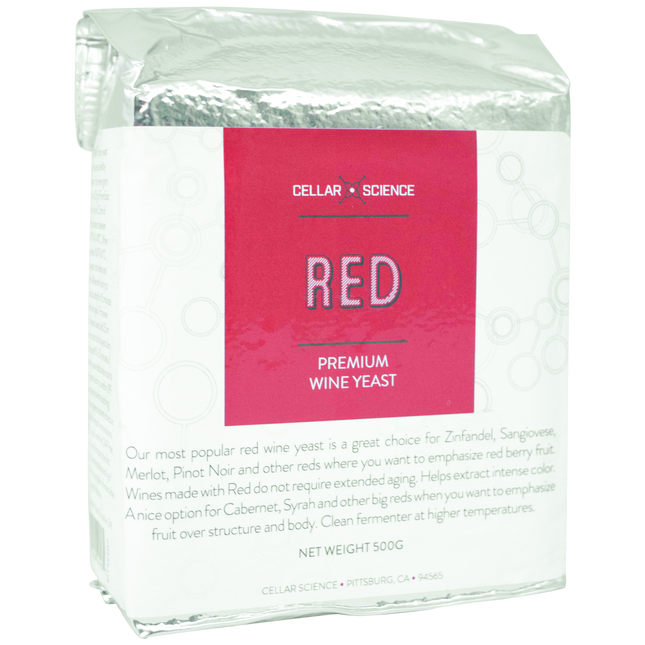

CellarScience® RED Dry Wine Yeast | Premium Wine Yeast
Emphasizes red berry fruit flavors High color extraction Makes wines that do not require extended aging Med-High nutrient need Top choice for Zinfandel, Sangiovese, Pinot, Merlot Our most popular red yeast is a perfect choice for Pinot Noir, Zinfandel, Sangiovese, Merlot and other reds where you want to emphasize red fruit flavors. When compared with BIG RED or PURPLE, RED is less about structure and body and more about fruit. Fantastic by itself if you plan to blend separately fermented lots back together. RED is a great choice to contribute red berry flavor. Also known to help produce intense color. Also a great choice for Cabernet, Syrah and other traditinoal big red varietals where you would like to emphasize fruit over structure and body. Because RED ferments cleaner than most yeast at high temperatures, it is the perfect choice if you are fermenting in a warm environment and do not have temperature control. It does not produce much SO2 so it is a great choice for easier ML fermentations Start Time: Average Alcohol tolerance: 16% Nitrogen Demand: Med Yan Requirement @ 23 Brix: 250ppm Production of volatile acidity: low Production of SO2: Low Ease to Ferment with MLF: Good Yeast Type: Cerevisiae Killer Factor: Neutral Malic Acid Consumption: Average Optimal Fermentation Temp: 65–85°F Proper yeast hydration helps ensure a healthy fermentation. For every gram of yeast, mix .25 g of FermStart yeast nutrient with 25 ml of sterilized tap water between 104–106°F/40–41°C. When water reaches 104°F/40°C, sprinkle yeast into water and stir gently. Allow the slurry to stand undisturbed for 15 minutes and then stir again. For every gram of yeast used add 25 ml of clean must to the yeast slurry and let stand 15–20 minutes. If necessary, use additional must to adjust yeast slurry to within 18°F of must temp before pitching. For a complete nutrient schedule sufficient for most fermentations, add 1.5 g of FermFed DAP Free per gallon of must at the first sign of fermentation and 1 g of FermFed per gallon of must after 1/3 sugar depletion. Download the PDF
$1.79 - $49.39
-


CellarScience® PURPLE Dry Wine Yeast | Premium Wine Yeast
Big mouthfeel from high glycerol /polysaccharide /mannoproteins Flavors of Cherries, Raspberries, Figs, Jam, Red currant High alcohol tolerence Low nutrient needs Perfect for Syrah, Zinfandel, Pinot, Merlot, Malbec, Sangiovese, Grenache Our go-to choice for those reds originating from the Cote du Rhone in France such as Syrah, Grenache, and Mouvedre. Also a top choice for Zinfandel, Sangiovese, Malbec, Merlot, and Pinot. Induces flavors of ripe cherries, raspberries, red curant, figs and jam. Due to its production of glycerol and release of mannoproteins it produces full bodied, rich red wines. PURPLE has a very low production of SO2 which is favorable for an easy malolactic fermentation (MLF) post fermentation. PURPLE is also an easy to ferment yeast with a low nutrient needs which is the opposite of our Big Red strain. It also has a "killer" quality and naturally inhibits unwanted bacterial or wild yeast growth during fermentation. Start Time: Slower Alcohol tolerance: 15% Nitrogen demand: low Production of volatile acidity: Low Production of SO2: Low Ease to Ferment with MLF: Average YAN Requirement @ 23 Brix: 200 ppm Malic Acid Consumption: Low Yeast Type: Cerevisiae Optimal Fermentation Temp: 65–85°F Proper yeast hydration helps ensure a healthy fermentation. For every gram of yeast, mix .25 g of FermStart yeast nutrient with 25 ml of sterilized tap water between 104–106°F/40–41°C. When water reaches 104°F/40°C, sprinkle yeast into water and stir gently. Allow the slurry to stand undisturbed for 15 minutes and then stir again. For every gram of yeast used add 25 ml of clean must to the yeast slurry and let stand 15–20 minutes. If necessary, use additional must to adjust yeast slurry to within 18°F of must temp before pitching. For a complete nutrient schedule sufficient for most fermentations, add 1.5 g of FermFed DAP Free per gallon of must at the first sign of fermentation and 1 g of FermFed per gallon of must after 1/3 sugar depletion. Download the PDF
$1.99 - $54.49
-


CellarScience® BIG RED Dry Wine Yeast | Premium Wine Yeast
Recomended for aged red wines High color extraction Significant polysaccaride and glycerol production for huge mouthfeel High alcohol tolerence High nutrient need Top choice for Bordeaux varietals Cabernet, Cab Franc, Petite Verdot and Merlot Also excelletnt for Sangiovese, Nebbiolo and some Pinot The name kind of says it all. BIG RED is ideal for producing big, complex red wines with lasting fruit. Depending on the grape varietal used it can emphasize complex berry fruit and spice flavors. This strain is very efficient at breaking down and extracting tannins and anthocyanins from grape skin walls, making wines with dark inky color and a tannin profile suitable for extended aging. BIG RED also produces a great mouthfeel due to the significant production of polysaccharides and glycerol. It is also tolerant to higher alcohol levels making it ideal for those grapes that need to stay on the vine just a little longer to get full phenolic ripes with smooth tannin profiles. So lets recap... emphasizes berry fruit with many varietals, produces dark color, extracts a full array of tannins suitable for extended aging, makes wines with great mouthfeel, and is resistant to higher alcohols. Is there a catch? No, but to get all that done BIG RED does love nutrients and you will need to feed it and pay attention to it during fermenation. This is a strain where you would ideally know your Free Available Nitrogen levels that you could base a nutrient schedule around. Absent those numbers or a history with the grapes you are fermentiing, we would suggest you start with hydrating with Fermstart, feeding with FermFed DAP free at the onset of fermentation and feeding again with regular Fermfed after 1/3 sugar depletion. BIG RED is a very low producer of H2S when nutrient demands are met. The perfect strain if you want to make amazing reds. Not the perfect strain if you have a vacation planned during the middle of fermentation and are going to ask your neighbor to punch down...we hear it all!. Because this strain respects varietal character it can be used for a broad spectrum of red grape varietals. Perfect of courese for those Bordeaux varietals ilke Cabernet Sauvignon, Cabernet Franc, Petit Verdot and even Merlot. Also our first choice for Nebbiolo and some bigger style Sangiovese and Pinot Noir. Start Time: Fast Alcohol tolerance: 16%+ Nitrogen demand: high Yan Requirement @ 23 Brix: 270ppm Production of volatile acidity: Low Production of SO2: Low Ease to Ferment with MLF: Average Yeast type: Cervisiae Killer Factor: Neutral Malic Acid Consumption: Average Optimal Fermentation Temp: 65–85°F Proper yeast hydration helps ensure a healthy fermentation. For every gram of yeast, mix .25 g of FermStart yeast nutrient with 25 ml of sterilized tap water between 104–106°F/40–41°C. When water reaches 104°F/40°C, sprinkle yeast into water and stir gently. Allow the slurry to stand undisturbed for 15 minutes and then stir again. For every gram of yeast used add 25 ml of clean must to the yeast slurry and let stand 15–20 minutes. If necessary, use additional must to adjust yeast slurry to within 18°F of must temp before pitching. For a complete nutrient schedule sufficient for most fermentations, add 1.5 g of FermFed DAP Free per gallon of must at the first sign of fermentation and 1 g of FermFed per gallon of must after 1/3 sugar depletion. Download the PDF
$1.99 - $54.49
-


CellarScience® BOUQUET Dry Wine Yeast | Premium Wine Yeast
Produces ß-glucosidase to cleave terpenes Floral, Rose, Citrus flavors Will not produce volatile phenols Best choice for Muscat/Moscato & Gewurztraminer. Also great for Sauvignon Blanc, Riesling and Viognier Those floral, rose, citrus, and stone fruit aromatics are bound all up in terpense in your grape skins and you know, they would really like to get out. It's your job to free them, package them in a bottle, and eventually let them waft out of a wine glass and into the nasal cavity of someone who appreciates excellence. We can help you do this. If you are making a higly aromatic white such as Muscat, Gewürztraminer, Viognier, Sauvignon Blanc or Riesling this is the ideal yeast. BOUQUET is known for its production of the enzyme ß-glucosidase which liberates aromatic compounds by cleaving terpenes from the sugars that bind them and releasing their goodness. This yeast will turn these certain grape varietals from ordinary white wines to highly aromatic, very special white wines that smell and taste amazing. The type of wine where 'stuff' wafts out of the glass! Also interesting is that most yeasts have the potential to produce phenolic off flavors, which in high quantities produce a paint like aroma (yuck!), if the conditions are less than ideal. However, BOUQUET is POF (phenolic off flavors) negative and will synthesize phenolic off flavors, eliminating that risk. This is a great yeast to co-ferment with Luscious for added complexity. Additional Fermfed nutrient is recommended at the start of fermentation due to the short lag phase of this strain. Due to such a rapid period of growth, the yeast cells require higher levels of nutrients to ensure a healthy fermentation. If you have had your wine tested and know your Yeast Available Nitrogen (YAN) follow our CellarScience nutrient feeding schedule accordingly. If you don't know your YAN we recommend hydrating with Fermstart, feeding with FermFed at the onset of fermentation and feeding again with regular Fermfed after 1/3 sugar depletion. Normally the feeding at the onset of fermentation would be with Fermfed DAP free but in this case BOUQUET can use the extra DAP kick that Fermfed provides. Start Time: Fast Alcohol tolerance: 14% Nitrogen demand: Very High Yan Requirement @ 23 Brix: 340 ppm Production of Volatile Acidity: Low Production of SO2: Average Cap/Foaming: Average Ease to Ferment with MLF: Low Malic Acid Consumption: Average Killer Factor: Positive (though is able to coferment with Luscious) Yeast Type: Cerevisiae Optimal Fermentation Temp: 50–80°F Proper yeast hydration helps ensure a healthy fermentation. For every gram of yeast, mix .25 g of FermStart yeast nutrient with 25 ml of sterilized tap water between 104–106°F/40–41°C. When water reaches 104°F/40°C, sprinkle yeast into water and stir gently. Allow the slurry to stand undisturbed for 15 minutes and then stir again. For every gram of yeast used add 25 ml of clean must to the yeast slurry and let stand 15–20 minutes. If necessary, use additional must to adjust yeast slurry to within 18°F of must temp before pitching. For a complete nutrient schedule sufficient for most fermentations, add 1.5 g of FermFed DAP Free per gallon of must at the first sign of fermentation and 1 g of FermFed per gallon of must after 1/3 sugar depletion. Download the PDF
$1.79 - $49.39
-


CellarScience® LUSCIOUS Dry Wine Yeast | Premium Wine Yeast
Autolyzing, quick release of polysaccarides such as mannoproteins Top choice for sur lie aging Ability to ferment cold for clean flavor with emphasis on mouthfeel and toastiness of sur lie aging When fermented warmer exoctic tropical flavors shine Frequently used to make luscious Chardonnays and similar white wines Luscious Chardonnays with creamy mouthfeel and deep complexity... if that is your end point, LUSCIOUS is your starting point. LUSCIOUS can be fermented at different temps depending on your style preference. Ferment it cooler, it can handle it, and put the emphasis on the creaminess and the toasted champagne-like complexity of sur lie ageing. Or crank it up a bit warmer and add in some more tropical notes, your choice. However the magic of LUSCIOUS really happens after fermentation when this yeast goes naturally goes nuclear, implodes and breaks open its cell walls, during a process called autolysis. Polysaccharides such as mannoproteins are released into the wine... and man, it's all about those mannoproteins creating that rich, creamy mouthfeel that so many Chardonnay drinkers seek out. The silky richness is emphasized even futher by sur lie aging, aging on clean lees for a period of time, in either tank or barrel. Being a low producer of SO2 it is naturally great candiate for later malo-lactic fermentations. Now that we have painted a picture try putting this marketing wizardry on your next label "The 10-40w viscosity of this wine is due to it being loaded with mannoproteins from the guts of exploded yeast cells". Maybe leave us out of the wine marketing department but we do know a winning yeast when we taste it. #1 for this style of Chardonnay but also a top choice for Viognier and other whites. Optimal Fermentation Temp: 55–68°F Start Time: Average Alcohol Tolerance: 14%+ Nitrogen Demand: Average YAN Requirement @ 23 Brix: 245 ppm Production of volatile acidity: Average Production of SO2: Low Cap/Foaming: Low Ease to Ferment with MLF: Good Lees Aging: Best Choice Proper yeast hydration helps ensure a healthy fermentation. For every gram of yeast, mix .25 g of FermStart yeast nutrient with 25 ml of sterilized tap water between 104–106°F/40–41°C. When water reaches 104°F/40°C, sprinkle yeast into water and stir gently. Allow the slurry to stand undisturbed for 15 minutes and then stir again. For every gram of yeast used add 25 ml of clean must to the yeast slurry and let stand 15–20 minutes. If necessary, use additional must to adjust yeast slurry to within 18°F of must temp before pitching. For a complete nutrient schedule sufficient for most fermentations, add 1.5 g of FermFed DAP Free per gallon of must at the first sign of fermentation and 1 g of FermFed per gallon of must after 1/3 sugar depletion. Download the PDF
$1.99 - $54.49
-

Angel Yeast | PM16 Dry Wine Yeast | 500 g
High Tolerance: Withstands up to 18% alcohol and high SO₂ levels, making it ideal for secondary fermentation or restarting stuck batches. Neutral Flavor Profile: Low H₂S and minimal ester production deliver clean, true-to-fruit aromas in wines, ciders, and meads. Vigorous & Efficient: Fast-fermenting with low nutrient requirements, performing reliably in low temperatures (50-86°F). PM16 is a typical Prise de Mousse yeast from Champagne region (France). This yeast is robust, low-nutrient-requirement and high-alcohol-tolerance strain for white wine, sparkling wine, late-harvest wine, also cider and mead. The H₂S production of PM16 is low, and the fermentation is vigorous to produce a dry wine with clean and neutral aroma, especially for Chardonnay with subtle pear, citrus like flavors. PM16 has a good tolerance for SO₂ and high alcohol level, so it is very recommended for restarting stuck fermentation. With the good characteristic of fermenting in low temperature, it also used in sparkling secondary fermentation. PM16 has rapid fermentation rate with short lag time. PM16 has neutral contribution to wine's organoleptic profile (low production of esters), makes it ideal for producing different types of red, white and fruit wines. Fermentation Characteristics - Fermentation temperature range: 50-86°F (10-30°C) - Alcohol tolerance: around 18%vol - Nitrogen requirement: low - Fermentation speed: fast - Production of volatile acidity: low - High tolerance of SO₂ - Production of SO₂: moderate - Production of H₂S: low - Production of foam: low - Production of glycerol: moderate - Flocculation: very good Application A wide range of applications for different types drinks, including wine, cider, mead and other fruits. Suitable for secondary fermentation for sparkling wine with short lag phase. Suitable for restarting fermentations, low temperature fermentations, and high clarified, low nitrogen and growth factors musts. A pure yeast selected for medium aromatic characters and robust fermentations. The fermentation kinetics of PM16 is complete and robust with clean varietal aromas without undesirable compounds. Good fermentation activity in the conditions of nutrient deficiency or high potential alcohol content. Low production of H₂S makes wine clean. Neutral sensory for wines to preserves the varietal properties. Protocol for Use 1. Rehydration Without Yeast Nutrition Dosage: 20 to 40 g/hL Rehydrate the yeast using water at 10 times its weight, with a temperature range of 95°F to 104°F (35°C to 40°C). Resuspend the yeast by gently stirring, and wait for 20 minutes. Blend the rehydrated yeast with a bit of juice/must, gradually acclimating the yeast suspension temperature to within 5-10 degrees of the juice/must temperature. Inoculate into the juice/must. 2. Rehydration with Nutri-Rehyd In the situations of tough fermentation conditions (high potential alcohol, over clarified must, low temperature), rehydrating yeast with Nutri-Rehyd is recommended. Carry out the rehydration procedure according to the selected Nutri-Rehyd product's instructions. Storage and Shelf Life Store in original sealed packages, in a cool and dry environment. Shelf life at the recommended conditions is 42 months. After opening the yeast must be used as soon as possible. Avoiding long-term storage at temperature above 86°F (30°C). Tips The difference between the yeast and must temperatures should not exceed 10 degrees during inoculation. Fermentations using active dry yeast can reduce the risk of contamination by wild yeast and harmful microorganisms. The rehydration process must not exceed 30 minutes.
$8.99
-

Angel Yeast | NX16 Dry Wine Yeast | 500 g
Robust Fermentation: Offers a fast start, high alcohol tolerance (≥16% vol), and stable performance across a wide temperature range (50-89°F). Aromatic Enhancement: Maximizes aromatic intensity, making it ideal for classic white wines like Chardonnay and Riesling. Clean Profile: Ensures smooth vinification with minimal foam, volatile acidity, and H₂S production. NX16 is isolated from Ningxia by the research group leading by Professor Yanlin Liu at Northwest A&F University in China. NX16 exhibits a short lag phase, excellent fermentation capacity, and robust tolerance to poor fermentation conditions, where it demonstrates smooth and stable performance during alcoholic fermentation. NX16 is recommended for classic white wines such as Chardonnay and Riesling. When used for vinification of neutral or aromatic grape varieties, NX16 produces white wines with high aromatic intensity. Fermentation Characteristics - Fermentation temperature range: 50-89°F (10-32°C) - Alcohol tolerance: ≥16%vol - Nitrogen requirement: moderate - Production of volatile acidity: low - Production of H₂S: low - Production of foam: low - Competitive factor: negative Protocol for Use 1. Rehydration Without Yeast Nutrition Dosage: 20 to 40 g/hL Rehydrate the yeast using water at 10 times its weight, with a temperature range of 95°F to 104°F (35°C to 40°C). Resuspend the yeast by gently stirring, and wait for 20 minutes. Blend the rehydrated yeast with a bit of juice/must, gradually acclimating the yeast suspension temperature to within 5-10 degrees of the juice/must temperature. Inoculate into the juice/must. 2. Rehydration with Nutri-Rehyd In the situations of tough fermentation conditions (high potential alcohol, over clarified must, low temperature), rehydrating yeast with Nutri-Rehyd is recommended. Carry out the rehydration procedure according to the selected Nutri-Rehyd product's instructions. Storage and Shelf Life Store in original sealed packages, in a cool and dry environment. Shelf life at the recommended conditions is 42 months. After opening the yeast must be used as soon as possible. Avoiding long-term storage at temperature above 86°F (30°C). Tips The difference between the yeast and must temperatures should not exceed 10 degrees during inoculation. Fermentations using active dry yeast can reduce the risk of contamination by wild yeast and harmful microorganisms. The rehydration process must not exceed 30 minutes.
$8.99
-

Angel Yeast | CECA Dry Wine Yeast | 500 g
Robust Fermentation: Features high alcohol tolerance (up to 16% vol) and a wide temperature range (50-85°F) with low foam and H₂S production. Enhanced Sensory Profile: Builds a strong wine body with fine tannins and complex aromas of dark berries, spice, and coffee. Ideal for Aged Reds: Expresses authentic varietal characteristics perfectly suited for Cabernet Sauvignon, Cabernet Franc, Merlot, and Syrah. CECA was isolated by Enology college of Northwest A&F University from Cabernet Sauvignon spontaneous fermentation in Ningxia province, China. With short lag phase, excellent fermentation kinetics and high alcohol tolerance, CECA is in favor of wine color and structure expression with high quality tannin and strong wine body. It can be very good to excavate and express "authentic" typical characteristics of grape varieties. Wine fermented by CECA presents fine tannins and complex aroma, such as dark berries, spice and coffee. CECA is an excellent choice for making aged red wines, especially for Cabernet Sauvignon, Cabernet Franc, Syrah, Merlot. Fermentation Characteristics - Fermentation temperature range: 50-85°F (10-35°C) - Alcohol tolerance: up to 16%vol - Nitrogen requirement: low - moderate - Fermentation spped: moderate - Production of volatile acidity: low - Production of H₂S: low - Production of foam: low - Competitive factor: negative - Tolerance and flocculation: good - Production of glycerol: moderate - high Protocol for Use 1. Rehydration Without Yeast Nutrition Dosage: 20 to 40 g/hL Rehydrate the yeast using water at 10 times its weight, with a temperature range of 95°F to 104°F (35°C to 40°C). Resuspend the yeast by gently stirring, and wait for 20 minutes. Blend the rehydrated yeast with a bit of juice/must, gradually acclimating the yeast suspension temperature to within 5-10 degrees of the juice/must temperature. Inoculate into the juice/must. 2. Rehydration with Nutri-Rehyd In the situations of tough fermentation conditions (high potential alcohol, over clarified must, low temperature), rehydrating yeast with Nutri-Rehyd is recommended. Carry out the rehydration procedure according to the selected Nutri-Rehyd product's instructions. Storage and Shelf Life Store in original sealed packages, in a cool and dry environment. Shelf life at the recommended conditions is 42 months. After opening the yeast must be used as soon as possible. Avoiding long-term storage at temperature above 86°F (30°C). Tips The difference between the yeast and must temperatures should not exceed 10 degrees during inoculation. Fermentations using active dry yeast can reduce the risk of contamination by wild yeast and harmful microorganisms. The rehydration process must not exceed 30 minutes.
$8.99
-

Angel Yeast | CEC01 Dry Wine Yeast | 500 g
Aroma Enhancement: Boosts complex ester aromas and varietal character while masking green flavors in elegant reds like Merlot and Pinot Noir. Robust Performance: Features a short lag phase, high alcohol tolerance (up to 16%), and a wide fermentation temperature range (50-85°F). Clean & Low Maintenance: Requires minimal nitrogen and produces extremely low levels of foam, H₂S, and volatile acidity. CEC01 was isolated by Enology college of Northwest A&F University from Merlot spontaneous fermentation in Xinjiang province, China. This yeast has a good tolerance to ethanol, a short lag phase and an excellent fermentation capacity. CEC01 enhances aromas complexity (especially ester aroma compounds expression) and varietal character of grapes, masks the green flavor compounds. Suitable for red grape varieties with elegant and complex aroma and round mouthfeel, such as Merlot, Pinot Noir, Cabernet Franc. Fermentation Characteristics - Fermentation temperature range: 50-85°F (10-35°C) - Alcohol tolerance: up to 16%vol - Nitrogen requirement: low - Fermentation spped: moderate - Production of volatile acidity: low - Production of H₂S: low - Production of foam: low - Competitive factor: active - Tolerance and flocculation: good - Production of glycerol: moderate - high Protocol for Use 1. Rehydration Without Yeast Nutrition Dosage: 20 to 40 g/hL Rehydrate the yeast using water at 10 times its weight, with a temperature range of 95°F to 104°F (35°C to 40°C). Resuspend the yeast by gently stirring, and wait for 20 minutes. Blend the rehydrated yeast with a bit of juice/must, gradually acclimating the yeast suspension temperature to within 5-10 degrees of the juice/must temperature. Inoculate into the juice/must. 2. Rehydration with Nutri-Rehyd In the situations of tough fermentation conditions (high potential alcohol, over clarified must, low temperature), rehydrating yeast with Nutri-Rehyd is recommended. Carry out the rehydration procedure according to the selected Nutri-Rehyd product's instructions. Storage and Shelf Life Store in original sealed packages, in a cool and dry environment. Shelf life at the recommended conditions is 42 months. After opening the yeast must be used as soon as possible. Avoiding long-term storage at temperature above 86°F (30°C). Tips The difference between the yeast and must temperatures should not exceed 10 degrees during inoculation. Fermentations using active dry yeast can reduce the risk of contamination by wild yeast and harmful microorganisms. The rehydration process must not exceed 30 minutes.
$8.99
-

Angel Yeast | CVE-7 Dry Yeast | Lactic Acid Producing Yeast for Wine & Beer | 500 g
Natural Acidification & Flavor: Converts sugar into lactic acid while imparting vibrant tropical fruit aromas, including grapefruit, pineapple, and mango. Wine & Beer Versatility: Ideal for enhancing aroma and balance in red and white wines, as well as brewing naturally soured or fruit-forward beers without the need for bacteria. Flexible Pitching: Can complete fermentation independently or be co-pitched (simultaneously or sequentially) with Saccharomyces cerevisiae to add complexity and subtly reduce final alcohol content. Robust Performance: Features strong yeast flocculation, low nitrogen requirements, a wide fermentation temperature range (53-95°F), and alcohol tolerance up to 15% ABV. CVE-7 is a pure culture of Lachancea thermotolerans, selected from natural fermentation of grape juice by Angel and China Agricultural University, and can convert part of the sugar into lactic acid. It has good physiological tolerance, outstanding ability to start fermentation, and shows smoothness and stableness during alcohol fermentation. The yeast can complete alcohol fermentation independently, and ferment with Saccharomyces cerevisiae combination is recommended, which achieves perfect complementarity in aroma and taste, and can reduce the alcohol content of high-sugar fermentation raw materials appropriately. It contains typical aroma of tropical fruits such as grapefruit, pineapple, and mango, and can be used in various red and white wines and other alcoholic beverages. Fermentation Characteristics - Pure natural strain - Fermentation temperature range: 53-95°F (12-35°C) - Alcohol tolerance: up to 15%vol - Yield of lactic acid: 2 - 7 g/L - Nitrogen requirement: low - pH reduction: 0.2 - 0.5 - Focculation: strong Inoculation 1. Simultaneous Inoculation Simultaneous inoculation of CVE-7 and Saccharomyces cerevisiae in a 1:1 ratio for fermentation. Rehydrate the yeast using water at 10 times its weight, with a temperature range of 95°F to 104°F (35°C to 40°C). Gently stir the yeast to resuspend it, then allow it to stand for 20 minutes. Blend the rehydrated yeast with a bit of juice/must, gradually acclimating the yeast suspension temperature to within 5-10 degrees of the juice/must temperature. Inoculate into the must. 2. Sequential Inoculation 1st: INOCULATION: CVE-7 Inoculate at 15-40 g/hL: rehydrate the yeast using water at 10 times its weight, with a temperature range of 68°F to 86°F (20°C to 30°C). After 15 minutes, stir very gently. Blend the rehydrated yeast with a bit of juice/must, gradually acclimating the yeast suspension temperature to within 5-10 degrees of the juice/must temperature. Inoculate into the must. Total rehydration time should not exceed 45 minutes. 2nd: INOCULATION: Saccharomyces cerevisiae After 24 hours to 48 hours, proceed to the 2nd inoculation of selected Saccharomyces cerevisiae yeast at 15-40 g/hL, using Nutri-Rehyd during the rehydration following recommended protocol. Storage and Shelf Life Store in original sealed packages, in a cool and dry environment. Shelf life at the recommended conditions is 42 months. After opening the yeast must be used as soon as possible. Avoiding long-term storage at temperature above 86°F (30°C).
$34.99
-

Angel Yeast | RV100 Dry Wine Yeast | 500 g
Aroma-Enhancing: Produces high levels of esters to deliver fresh, aromatic profiles in neutral and high-yield grapes. Highly Resilient: Thrives in harsh conditions—including low temperatures and low nutrients—with an impressive 18% alcohol tolerance. Clean & Efficient: Fast-fermenting with low foam, low volatile acidity, and a proven track record for ice wine production. RV100 is screened by natural fermentation. RV100 has low nutrient requirements and produces more esters, such as isoamyl acetate, hexyl acetate, and phenethyl acetate. These esters bring a fresh aroma to the mouth in neutral or high-yielding grapes. Among the high-ester producing strains, RV100 is the most resistant strain under fermentation conditions such as low turbidity, low temperature, and low fatty acid content. RV100 is also a mature strain for ice wine fermentation. Fermentation Characteristics - Fermentation temperature range: 50-85°F (10-35°C) - Alcohol tolerance: up to 18%vol - Fermentation speed: fast - Production of volatile acidity: low - Production of H₂S: moderate - Production of foam: low - Glycerol production: ≥ 6 g/L Protocol for Use 1. Rehydration Without Yeast Nutrition Dosage: 20 to 40 g/hL Rehydrate the yeast using water at 10 times its weight, with a temperature range of 95°F to 104°F (35°C to 40°C). Resuspend the yeast by gently stirring, and wait for 20 minutes. Blend the rehydrated yeast with a bit of juice/must, gradually acclimating the yeast suspension temperature to within 5-10 degrees of the juice/must temperature. Inoculate into the juice/must. 2. Rehydration with Nutri-Rehyd In the situations of tough fermentation conditions (high potential alcohol, over clarified must, low temperature), rehydrating yeast with Nutri-Rehyd is recommended. Carry out the rehydration procedure according to the selected Nutri-Rehyd product's instructions. Dosage 20 to 40 g/hL Reds Roses Whites Sparklings Ferm Speed Nitrogen Need Sensory Effect ★★★ ★★★ ★★★ ★★★★ Moderate Medium EVC Note: ★★★★=Best Recommendation EVC=Enhances Varietal Character Storage and Shelf Life Store in original sealed packages, in a cool and dry environment. Shelf life at the recommended conditions is 42 months. After opening the yeast must be used as soon as possible. Avoiding long-term storage at temperature above 86°F (30°C). Tips The difference between the yeast and must temperatures should not exceed 10 degrees during inoculation. Fermentations using active dry yeast can reduce the risk of contamination by wild yeast and harmful microorganisms. The rehydration process must not exceed 30 minutes.
$8.49
-

Angel Yeast | RV002 Dry Wine Yeast | 500 g
Superior Color & Aroma: Maximizes tannin extraction and elevates aromatic compounds for vibrant, full-bodied wines with clean fruit expression. Robust Performance: Ferments reliably up to 18% ABV (50-85°F) while keeping volatile acidity, H₂S, and foam production exceptionally low. Enhanced Mouthfeel & Structure: Generates abundant polysaccharides and glycerol (≥ 8 g/L), naturally optimizing conditions for subsequent malolactic fermentation. RV002 is a natural fermentation strain, this yeast demonstrates reliable safety, consistent performance and complete fermentation characteristics. It exhibits outstanding tannin and color extraction capacity while generating abundant polysaccharides. The strain significantly enhances wine coloration, particularly in red wines, contributing to well-structured, full-bodied wines with pronounced fruit expression, clean varietal character and harmonious palate. Its remarkable aroma-enhancing properties elevate diverse aromatic compounds. The yeast displays favorable flocculation behavior during late fermentation with stable pigment retention. The higher alcohols and amino acids released through autolysis provide optimal conditions for subsequent malolactic fermentation while minimizing exogenous interference. Fermentation Characteristics - Fermentation temperature range: 50-85°F (10-35°C) - Alcohol tolerance: up to 18%vol - Nitrogen requirement: moderate - Production of polysaccharides: high - Production of volatile acidity: low - Production of H₂S: low - Potential for SO₂ production: low - Production of foam: low - Competitive factor: neutral - Glycerol production: ≥ 8 g/L Application Features This yeast can be used to produce high-quality red wine. It has killer activity and extraction of anthocyanins and tannins is high. It helps produce wines with typicality, intense aroma and stable pigment, especially the famous red grape varieties such as Cabernet Sauvignon, Cabernet Franc, Cabernet Sauvignon and Pinot Noir. It is a preferred strain in brewing of high-grade red wines. Protocol for Use 1. Rehydration Without Yeast Nutrition Dosage: 20 to 40 g/hL Rehydrate the yeast using water at 10 times its weight, with a temperature range of 95°F to 104°F (35°C to 40°C). Resuspend the yeast by gently stirring, and wait for 20 minutes. Blend the rehydrated yeast with a bit of juice/must, gradually acclimating the yeast suspension temperature to within 5-10 degrees of the juice/must temperature. Inoculate into the juice/must. 2. Rehydration with Nutri-Rehyd In the situations of tough fermentation conditions (high potential alcohol, over clarified must, low temperature), rehydrating yeast with Nutri-Rehyd is recommended. Carry out the rehydration procedure according to the selected Nutri-Rehyd product's instructions. Dosage 20 to 40 g/hL Reds Roses Whites Sparklings Ferm Speed Nitrogen Need Sensory Effect ★★★ ★★★ ★★★ ★★★★ Moderate Medium EVC Note: ★★★★=Best Recommendation EVC=Enhances Varietal Character Storage and Shelf Life Store in original sealed packages, in a cool and dry environment. Shelf life at the recommended conditions is 42 months. After opening the yeast must be used as soon as possible. Avoiding long-term storage at temperature above 86°F (30°C). Tips The difference between the yeast and must temperatures should not exceed 10 degrees during inoculation. Fermentations using active dry yeast can reduce the risk of contamination by wild yeast and harmful microorganisms. The rehydration process must not exceed 30 minutes.
$8.49
-

Angel Yeast | RV171 Dry Wine Yeast | 500 g
Enhances Aromatics: Produces high levels of esters to significantly boost fruitiness in neutral grape varieties. Softens Mouthfeel: Absorbs polyphenols to reduce harsh tannins and naturally metabolizes malic acid for smoother, early-drinking wines. Versatile Application: Ideal for fresh reds, whites, rosés, and late harvest wines, performing well with high-acid grapes and alcohol levels up to 14%. RV171 was naturally isolated and chosen for its ability to produce large quantities of esters (like isoamyl esters), it can enhance the aromatic features of wines produced from neutral grape varieties. This particular yeast strain is capable of adsorbing polyphenolic compounds from its cell walls, thus lessening the tannic structure in young and fresh red wines. Grape juice inoculated with RV171 is likely to undergo malolactic fermentation since this yeast strain is able to metabolize malic acid during the primary fermentation stage. RV171 is the perfect option for making young, fresh, fruity and easily drinkable red, rosé and white wines, and also a fitting choice for late harvest wines. Fermentation Characteristics - It is particularly suited for high-acid grapes or varieties that will undergo acid adjustment. - Fermentation temperature range: 57-86°F (14-30°C) - Alcohol tolerance: up to 14%vol - Production of volatile acidity: low - Production of H₂S: moderate - high - No harmful sulfide - Competitive factor: sensitive - Glycerol production: ≥7 g/L Protocol for Use 1. Rehydration Without Yeast Nutrition Dosage: 20 to 40 g/hL Rehydrate the yeast using water at 10 times its weight, with a temperature range of 95°F to 104°F (35°C to 40°C). Resuspend the yeast by gently stirring, and wait for 20 minutes. Blend the rehydrated yeast with a bit of juice/must, gradually acclimating the yeast suspension temperature to within 5-10 degrees of the juice/must temperature. Inoculate into the juice/must. 2. Rehydration with a Yeast Nutrition In the situations of tough fermentation conditions (high potential alcohol, over clarified must, low temperature), rehydrating yeast with Nutri-Rehyd is recommended. Carry out the rehydration procedure according to the selected Nutri-Rehyd product's instructions. Dosage 20 to 40 g/hL Reds Roses Whites Ferm Speed Nitrogen Need Sensory Effect ★★★ ★★★★ ★★★ Moderate Medium EVC Note: ★★★★=Best Recommendation EVC=Enhances Varietal Character Storage and Shelf Life Store in original sealed packages, in a cool and dry environment. Shelf life at the recommended conditions is 42 months. After opening the yeast must be used as soon as possible. Avoiding long-term storage at temperature above 86°F (30°C). Tips The difference between the yeast and must temperatures should not exceed 10 degrees during inoculation. Fermentations using active dry yeast can reduce the risk of contamination by wild yeast and harmful microorganisms. The rehydration process must not exceed 30 minutes.
$8.49
-

Angel Yeast | BV818 Dry Wine Yeast | 500 g
Neutral Sensory Profile: Highlights the natural aromas of white grape varieties like Chardonnay and Riesling without altering flavor. Robust Fermentation: Delivers strong, reliable kinetics with a wide temperature range (50-86°F) and high alcohol tolerance (up to 18% vol). Clean Production: Ensures efficient processing with low nitrogen requirements and minimal production of foam, H₂S, and volatile acidity. BV818 was selected from natural wine fermentation with strong and reliable fermentation kinetics. Its sensory contribution is considered neutral because it makes very little contribution to the sensory characteristics of wine, thus highlighting the aroma characteristics of famous white grape varieties such as Italian Riesling, Chardonnay, and Sauvignon Blanc. It is widely used around the world in the production of white wine and secondary fermentation. Fermentation Characteristics - Fermentation temperature range: 50-86°F (10-30°C) - Alcohol tolerance: up to 18%vol - Nitrogen requirement: low - Production of volatile acidity: low - Production of H₂S: low - Production of foam: low - Sulfur dioxide resistance: good - Competitive factor: active Protocol for Use 1. Rehydration Without Yeast Nutrition Dosage: 20 to 40 g/hL Rehydrate the yeast using water at 10 times its weight, with a temperature range of 95°F to 104°F (35°C to 40°C). Resuspend the yeast by gently stirring, and wait for 20 minutes. Blend the rehydrated yeast with a bit of juice/must, gradually acclimating the yeast suspension temperature to within 5-10 degrees of the juice/must temperature. Inoculate into the juice/must. 2. Rehydration with Nutri-Rehyd In the situations of tough fermentation conditions (high potential alcohol, over clarified must, low temperature), rehydrating yeast with Nutri-Rehyd is recommended. Carry out the rehydration procedure according to the selected Nutri-Rehyd product's instructions. Dosage 20 to 40 g/hL Reds Roses Whites Sparklings Ferm Speed Nitrogen Need Sensory Effect ★★ ★★★ ★★★★ ★★★★ Fast Low EVC Note: ★★★★=Best Recommendation EVC=Enhances Varietal Character Storage and Shelf Life Store in original sealed packages, in a cool and dry environment. Shelf life at the recommended conditions is 42 months. After opening the yeast must be used as soon as possible. Avoiding long-term storage at temperature above 86°F (30°C). Notes It has good performance in low temperature, high concentration of SO₂ or in the shortage of nutrient fermentation; enhance famous white grape aroma such as Italian Riesling, Chardonnay, Sauvignon Blanc. It can restart the end fermentation, and smooth sparkling wine second fermentation. Tips The difference between the yeast and must temperatures should not exceed 10 degrees during inoculation. Fermentations using active dry yeast can reduce the risk of contamination by wild yeast and harmful microorganisms. The rehydration process must not exceed 30 minutes.
$8.49


