Lallzyme EX-V – Enzyme for Structured Red Wines with Enhanced Color and Tannin Stability
Extracts color and tannins with improved integration for wines destined for aging
Promotes stable anthocyanin-tannin bonding for long-lasting color
Enhances mouthfeel, midpalate weight, and structural balance
Improves juice yield and reduces solids through efficient cell wall degradation
Balanced enzyme activity supports both extraction and finesse in premium red wines
Lallzyme EX-V is a precision enzyme blend developed by Lallemand for red wine fermentations where structure, balance, and ageability are desired. It combines strong pectolytic activity with targeted cellulase and hemicellulase functions to break down grape skin cell walls, facilitating the release of anthocyanins and seed-derived tannins in a controlled, integrative manner. EX-V is ideal for varietals with moderate to firm skins or when crafting red wines intended for barrel aging, as it enhances phenolic complexity without over-extracting bitterness or astringency. Wines fermented with EX-V tend to show refined texture, vivid color, and excellent long-term stability.
Comparison to Other Lallemand Maceration Enzymes:
Compared to EX, which is best for early-drinking, fruit-forward reds, EX-V is designed for more structured, age-worthy styles with higher tannin and color stability.
EX = softer, fruit-driven reds for early release
EX-V = structured, balanced reds with aging potential
Protocol
Dilute Lallzyme EX-V in 10 times its weight of chlorine-free water. Add to crushed grapes or must at the beginning of fermentation. Mix thoroughly for even dispersion. Optimal temperature range: 20–30°C. Avoid adding below 10°C or after alcoholic fermentation begins.
Usage Rates
Recommended dosage: 30–40 grams per ton of grapes
= 0.66–0.88 grams per hectoliter (assuming 450 L/ton)
= 0.0066–0.0088 grams per liter
= 0.025–0.033 grams per gallon
Use the lower end of the range for moderately structured fruit or extended maceration. Use the higher range for tighter-skinned grapes, shorter fermentations, or when greater phenolic extraction and color stability are required for barrel-aged or long-lived reds.
Lallzyme EX – Enzyme for Enhanced Color and Juice Release in Early-Drinking Red Wines
Improves color extraction while preserving soft, approachable tannins
Increases free-run and press juice yield by breaking down cell wall pectins
Enhances clarification and reduces solids for easier pressing and settling
Supports smooth mouthfeel in red wines intended for early consumption
Balanced enzyme activity preserves varietal fruit while aiding extraction efficiency
Lallzyme EX is a gentle maceration enzyme developed by Lallemand for red wine fermentations where balance, early drinkability, and clean extraction are key. Its primary function is to degrade grape skin cell walls through pectinase and hemicellulase activity, improving juice yield and the release of color compounds without promoting aggressive tannin extraction. This makes it particularly well-suited for light- to medium-bodied red wines or warm-climate varietals where managing tannin levels is critical. EX helps clarify must, improve press efficiency, and support the production of soft, fruit-driven wines that are ready for market sooner.
Comparison to Other Lallemand Maceration Enzymes:
Compared to EX-V, which targets tannin structure and aging potential, EX is better for fresh, youthful styles that prioritize fruit expression and roundness. In summary:
EX = best for early-release reds, softer tannins, moderate color
EX-V = ideal for structure and age-worthines
Protocol
Dilute Lallzyme EX in 10 times its weight of chlorine-free water. Add to crushed grapes or must at the start of fermentation. Mix well to ensure even distribution. Best activity between 20–30°C. Avoid use below 10°C or after fermentation is complete.
Usage Rates
Recommended dosage: 20–30 grams per ton of grapes
= 0.44–0.66 grams per hectoliter (assuming 450 L/ton)
= 0.0044–0.0066 grams per liter
= 0.017–0.025 grams per gallon
Use the lower range for softer grapes or longer macerations. Use higher rates when working with firmer-skinned varieties or short fermentations where improved extraction and juice yield are needed.
Enhances clarification and static settling of white and rosé musts under extreme conditions
Active and fast depectinisation at low temperature, low pH, or high total pectin content
Produces rapid, compact lees and improves juice quality consistently
Requires lower dosage for effective results compared to standard enzymes
Cinnamyl-esterase-free pectinase blend minimizes ethylphenol precursor release
Lallzyme C-MAX™ is a micro-granulated pectolytic enzyme derived from Aspergillus niger, formulated for use in white and rosé wine production where settling conditions may be difficult. With high activities of pectin lyase, pectin methyl esterase, and polygalacturonase, it provides fast, efficient breakdown of pectin, even at low temperatures (as low as 8 °C / 46 °F) or low pH. Its action reduces must viscosity, speeds up clarification, and generates compact, easy-to-rack lees. Because it contains no cinnamyl esterase, Lallzyme C-MAX™ also limits the formation of ethylphenol precursors, contributing to cleaner, more varietally expressive wines.
Protocol for Use:
Add after pressing or directly into the settling tank. Dilute the enzyme in 10 times its weight in water or juice before use. Mix thoroughly for uniform distribution. Do not add bentonite during enzyme treatment. Clarification typically completes within 24 hours depending on temperature and juice conditions.
Usage Rates:
Standard conditions (>12 °C / 54 °F): 0.5–1.0 g/hL = 0.005–0.01 g/L = 0.019–0.038 g/gal
Cold or high-pectin conditions (8–12 °C / 46–54 °F): 1.0–2.0 g/hL = 0.01–0.02 g/L = 0.038–0.076 g/gal
Store in original sealed packaging at 5–15 °C (41–59 °F) in a dry place. Suitable for organic and vegan wine production.
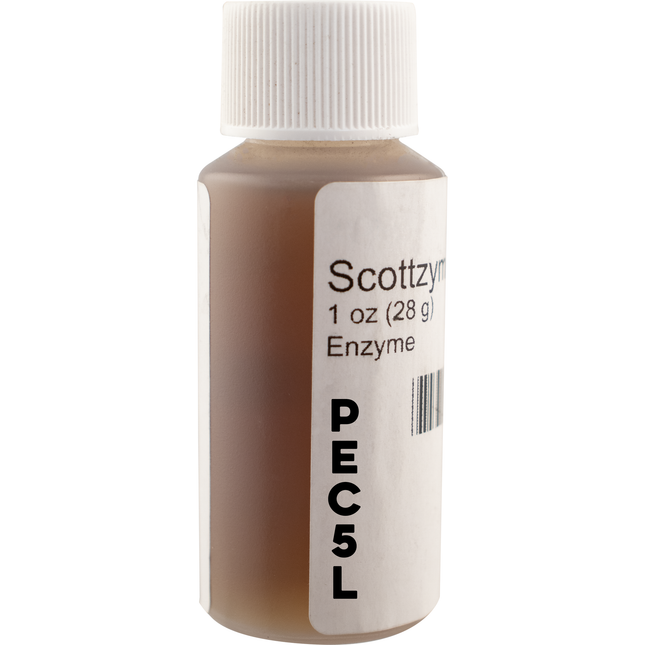
Scottzyme PEC5L – Pectinase Enzyme for Enhanced Settling and Juice Yield
Rapidly breaks down soluble pectins for faster settling and improved clarity
Increases free-run and press yield by reducing viscosity and cell wall resistance
Improves flotation efficiency and tightens lees compaction
Effective across a wide pH range and performs well at low temperatures
Ideal for white, rosé, and fruit wines requiring fast clarification and clean separation
Scottzyme PEC5L is a highly active liquid pectinase enzyme formulated to reduce pectin-related haze and increase processing efficiency in juice production. By breaking down soluble pectins, PEC5L dramatically improves juice release during pressing, reduces must viscosity, and accelerates settling or flotation. The result is clearer juice, more compact lees, and higher overall yield. Its formulation is optimized for cool-temperature performance and a broad pH range, making it a versatile tool in grape and non-grape juice clarification. Unlike general pectinases, PEC5L is designed to act quickly and cleanly, without over-extraction of phenolics or bitterness.
Protocol
Dilute Scottzyme PEC5L in 10 times its volume of chlorine-free water or juice. Add to must or juice immediately after crushing or during transfer to settling tank. Mix well to ensure even distribution. For flotation, add just before or during the flotation process. Avoid adding at the same time as SO₂ or bentonite.
Usage Rates
Recommended dosage: 1.5–4.0 mL per 1000 lb of fruit or 0.075–0.2 mL per gallon of juice
= approximately 0.02–0.05 mL per liter
Use lower rates for clean, low-pectin fruit or warmer temperatures. Use higher rates for pectin-rich grapes, low temperatures, or difficult-to-settle musts. Allow contact time of 2 to 12 hours depending on conditions and desired level of clarification.
Lallzyme Cuvee Blanc – Enzyme for Aroma Release and Finesse in White and Sparkling Wines
Enhances aroma expression by unlocking bound terpene and thiol precursors
Improves clarification and filterability through efficient pectin breakdown
Increases finesse and texture by gently releasing polysaccharides
Ideal for varietal whites and sparkling base wines where delicacy is key
Balanced glycosidase activity preserves freshness without compromising stability
Lallzyme Cuvee Blanc is a highly specific enzyme developed by Lallemand for the production of elegant, aromatic white and sparkling wines. It offers a delicate balance of pectinase and glycosidase activity that breaks down grape cell walls to improve clarification while simultaneously releasing aroma precursors trapped in glycosidic form. This selective activity enhances varietal expression—especially in terpene- and thiol-rich varieties—without producing off-flavors or excessive bitterness. The result is a wine with lifted aromatics, better mouthfeel, and improved stability, ideal for styles requiring precision and finesse.
Protocol
Dilute Lallzyme Cuvee Blanc in 10 times its weight of chlorine-free water. Add to juice or wine at the preferred stage—either pre-fermentation for aroma release and settling, or post-fermentation for finishing and clarification. Ensure even distribution by mixing thoroughly. Optimal temperature range is 12–20°C. Avoid use below 10°C or in combination with bentonite or SO₂ during addition.
Usage Rates
Recommended dosage: 2–4 grams per hectoliter
= 0.02–0.04 grams per liter
= 0.076–0.151 grams per gallon
Use 2 g/hL for lighter aromatics or wines already showing good varietal character. Increase to 4 g/hL in more neutral juices or when maximizing aromatic potential is desired. Allow adequate contact time—typically 24 to 48 hours—depending on the winemaking stage and style.
cottzyme KS – High-Power Enzyme for Complex Pectin Breakdown in Red, White, and Problem Wines
Breaks down complex, highly esterified pectins that standard pectinases cannot
Enhances clarification, settling, and filterability in challenging juices and wines
Boosts juice and wine yield by improving extraction from thick-skinned or high-pectin fruit
Ideal for problem fermentations or hazy wines that resist fining and filtration
Performs well at low temperatures and in a broad pH range
Scottzyme KS is a specialized pectolytic enzyme designed to break down complex pectin structures found in high-pectin varietals and difficult ferments. While standard enzymes like PEC5L target simple soluble pectins, KS is formulated with enhanced side-chain cleaving activity that attacks esterified pectins and heavily branched structures. This makes it particularly effective on cultivars like Pinot Gris, Riesling, Gewürztraminer, Muscat, and in juice or wine where haze persists despite prior enzymatic treatment. KS improves clarification, tightens lees, increases press and wine yields, and boosts filtration efficiency—especially in wines that defy typical settling protocols.
Comparison to Scottzyme PEC5L:
Scottzyme PEC5L is a fast-acting general-purpose pectinase for typical clarification tasks, such as settling and flotation of white and rosé juices. It’s ideal for clean juice production from standard grapes and most fruit wines. In contrast, KS is the go-to choice when PEC5L isn’t enough—it’s stronger on stubborn, esterified pectins and delivers better results with problematic varieties or ferments that remain hazy even after PEC5L. While PEC5L is excellent for fast juice prep, KS excels in the most difficult cases, including post-fermentation haze and challenging press fractions.
Protocol
Dilute Scottzyme KS in 10 times its volume of chlorine-free water or juice. Add to must, juice, or wine and mix well. Suitable for use before or after fermentation. Do not add simultaneously with bentonite or high SO₂. Works effectively at 10–20°C.
Usage Rates
Recommended dosage: 1.5–4.0 mL per 1000 lb of fruit or 0.075–0.2 mL per gallon
= approximately 0.02–0.05 mL per liter
Use lower rates for moderate haze and extended contact time. Use higher rates in cold settling, high-pectin juices, or persistent post-fermentation hazes. Allow 4–24 hours of contact time depending on application.
Scottzyme HC is a blend of assorted enzymes designed to increase yield in apple, pear, stone fruits, and wetter grapes (such as concords). This enzyme will assist in breaking down the fruit you work with to help extract more flavor and juice, as well as improving filterability and overall clarity. This Scottzyme works best in conjunction with PEC5L.
Break down yeast cells and glucans from Botrytis
LALLZYME MMX™ breaks down filter-clogging glucans that can be present due to the activity of Botrytis or other glucan-producing microorganisms.
Can be added to wine aging on lees to increase yeast autolysis rates, leading to rounder, fuller-bodied wines
Can integrate mouthfeel components by releasing “sweet” peptides
Recommended contact time is 6-8 weeks
Pectinase and glucanase act synergistically to improve the clarity and filterability of wines containing glucans from Botrytis
Add to: Difficult to settle/filter wines post-fermentation
Impact: Improved filtration and yeast autolysis
Format: Granular
Frequently used in: Reds, whites, rosés
Recommended Dosage - Bench trials recommended
Wine >15°C (59°F): 2.5–3 g/hL (95–114 g/1000 gal)
Wine <15°C (59°F): 3.5–4 g/hL (135–156 g/1000 gal)
Usage: Dissolve LALLZYME MMX in 10 times its weight of water, gently stir, allow to sit for a few minutes then add to wine.
Storage: Dated expiration. Store dry enzyme at 25°C (77°F). Once rehydrated use within a few hours.
Lallzyme KP-CLAR – Liquid Enzyme for Fast, Clean Juice and Wine Clarification
Breaks down pectins to improve settling, flotation, and clarification
Increases juice yield during pressing by reducing viscosity and colloid content
Produces compact, tight lees for cleaner racking and better wine stability
Fast-acting at low temperatures, with peak performance between 10–20°C
Liquid format offers precise dosing and easy integration into juice or wine
Lallzyme KP-CLAR is a liquid pectolytic enzyme preparation from Aspergillus niger, designed specifically for clarification of white and rosé juice and wine. Its carefully balanced enzymatic activity rapidly breaks down pectin chains, allowing for more efficient settling, flotation, and filtration. KP-CLAR improves press efficiency, reduces turbidity, and creates tight, easily separated lees—making it ideal for use before fermentation or after, depending on the winemaker’s goals. Unlike some powdered enzymes, its liquid format ensures fast dispersion and accurate dosing, reducing variability and simplifying cellar workflow.
KP-CLAR is also well-suited for cider production. Its ability to break down apple pectins results in clearer juice, improved press yields, and faster settling—whether you're clarifying before fermentation or polishing a finished cider. Its activity profile works well with the high pectin content typical of apples, making it a reliable tool for both commercial and craft cider makers.
Protocol
Dilute KP-CLAR in approximately 10 times its weight (or volume) of chlorine-free water or juice. Mix thoroughly and add to must or wine before settling, flotation, or clarification. Distribute evenly by pumping over or mixing gently. Ideal working temperature: 10–20°C. Do not use at temperatures below 8°C. Avoid concurrent additions of bentonite or high SO₂.
Usage Rates
Recommended dosage: 1–4 mL per hectoliter
= 0.01–0.04 mL per liter
= 0.038–0.151 mL per gallon
Use lower rates for clean, easily settling juices and higher rates for difficult-to-clarify musts or cider with high pectin content. Allow appropriate contact time based on clarification method (flotation or static settling). For wine or cider polishing, perform bench trials to determine the optimal dose.