Detecting your location...
SPRING CLEANING SALE: 20% OFF STAR SAN No Code Needed. Ends 3/8
Shop Now

Wine Making

Our huge selection of wine making supplies will provide you with everything you need for making wine at home.  All of our wine making equipment like Speidel bladder presses and wine tanks, or Enoitalia crusher destemmers, are some of the highest quality and available at great prices.  We also have close to 100 different wine recipe kits that make high quality wine and time of year!  And wiith dozens of different wine yeasts to choose from, you are able to get the exact flavor, aroma, and body profiles you like in your wines.

Looking for More! information on how to make Wine at home? Check out our MoreWine! Guide to Red Winemaking

Shop by collection
1020 products

  • pH 7 Buffer (500 mL)  (Hanna# HI7007L)

    Hanna pH 7.01 Buffer - 500 mL (Hanna# HI7007L)

    HI7007L is a premium quality pH 7.01 buffer solution. With lot number and expiration date clearly marked on the label and an air tight, tamper-proof seal to ensure the quality of the solution, Hanna’s line of pH calibration solutions are an easy way to get great pH measurements every time. Air tight bottle with tamper-proof seal for quality. Color coded label for easy identification of ph 7 buffer value. Perfect for routine maintenance to ensure accurate readings while extending the life of the electrode. Our pH Technical Buffer Solutions are dedicated to measurements that require extremely accurate pH monitoring, and come with a certificate of analysis prepared by comparison against NIST standards. Our pH Technical Buffer Solutions are dedicated to measurements that require extremely accurate pH monitoring, and come with a certificate of analysis prepared by comparison against NIST standards. Air tight bottle with tamper-proof seal Ensures quality and freshness of solution Each bottle marked with lot number and expiration date. Hanna buffers are specially formulated to have an expiration of 5 years from manufacture for an unopened bottle. Color coded label for easy pH buffer value identification Easy to identify different buffer values    

    $22.00

  • Vinmetrica - TA Titrant for MT565 & MT570 - 130mL (0.13N Sodium Hydroxide)

    TA Titrant for MT565 & MT570 - 130mL (0.13N Sodium Hydroxide)

    9 reviews

    This reagent bottle replenishes the TA titrant (0.133N NaOH) found in the SC-200 and the SC-300 Analyzer kits. To avoid cross-contamination with other reagents, use a dedicated syringe to dispense the NaOH reagent. Store reagents in a dark, cool place with the bottle tightly sealed to maximize shelf life. Good for about 12 tests. Guaranteed for 6 months. To avoid cross-contamination with other reagents & solutions, use a dedicated pipette or pour the TA titrant into another container. Store solution in a dark, cool place with the bottle tightly sealed to maximize shelf life. Please note: some bottles of TA Titrant may show 100mL as the volume. This is a misprint. The true volume is 130mL.

    $20.00

  • Wine Kit - VineCo - Original Series - Viognier, CAL Wine Kit - VineCo - Original Series - Viognier, CAL

    California Viognier Wine Making Kit - VineCo Original Series™

    2 reviews

    Perhaps the most ostentatious wine grape in the world, Viognier is known for its intoxicating perfume in the glass and its prudish yield on the vine. The sparse downstream production per acre of plantings can make Viognier a prohibitive prospect for some vineyards, but it is nonetheless revered as one of the finest grapes to come from France. Although some speculate that this grape made its way to Rhone by way of Croatia thanks to the Roman emperor, Probus, in the modern age it is considered to be decisively French and singularly responsible for the famous varietal Condrieu. Often compared to Chardonnay but with more celebrated aromatics of peach, honeysuckle, pear, and gingerbread. Second only to the Rhone Valley, California’s Central Coast is noted for producing exceptional Viognier. A finicky grape, to be sure, but it excels in the warm California sun, which promotes ripeness and ultimately boosts the aromatics of the finished wine. Compared to the French example, it can sometimes be lower in acidity but with more intense fruit character. Our California Viognier bursts with gorgeous aromas of tangerine, peach, and rose. This dry white wine saunters on the palate with a light-medium body and stimulating alcohol level of 12% by volume. The VineCo Original Viognier is an incredibly expressive wine that demands your attention. One pour can easily suspend you in time as you struggle to process the preposterous symphony of armotics emanating from the glass. As such, you’d do well to pair this wine with food that is no less outgoing, such as a spicy Pad Thai or a creamy mushroom dish. Viognier, California Tangerine, peach, rose Sweetness: Dry Oak: None Body: Light-Medium ABV: 12% Kit Volume: 8 L Approximate Yield: 23 L Ready to bottle in 4 weeks    

    $91.99

  • Wood Barrel Spigot #0 (5 1/4 in Long)

    Wood Barrel Spigot #0 (5 1/4 in Long)

    11 reviews

    Replacement spigots for the maintenance of your cherished wooden aging barrel.   A wooden barrel spigot is something that will need to be replaced from time to time. This wooden barrel spigot features a wooden spout and a plastic valve insert. Spigots are sold individually, with no packaging.    The #0 spigot is approximately 5-1/2" long. The shaft tapers from 16 mm (11/16") at the small end, up to 24 mm (15/32") wide.      

    $8.79

  • 375mL Antique Green Bellissima Farro Glass Wine Bottles - Case of 12 - PLACEHOLDER 375mL Antique Green Bellissima Farro Glass Wine Bottles - Case of 12 - PLACEHOLDER

    Farro Glass | Premium Wine Bottles | Bellissima | Antique Green | 375mL | Case of 12

    A slim, elegant bottle design ideal for dessert wines and ice wines Bellissima bottles are typically made in smaller volumes to package wines that are consumed in smaller pours Antique green glass color is often preferred for red wines to protect them from light during long term storage Farro Glass offers a full lineup of the most essential and commonly used bottles in winemaking Bellissima wine bottles are most commonly used for dessert wines and ice wines. The slim design lends an elegant appearance when this bottle appears at the end of your meal. They are typically half the volume of standard bottles, as a Bellissima's contents are often pricey and consumed in smaller pours. Volume: 375 mL Style: Bellissima Use: Sweet Red, Dessert Wine Color: Antique Green Finish: Cork Bottom: Punted Case QTY: 12 Pallet QTY: 150 cases Our Farro Glass Wine Bottles offers a full lineup of the most essential and commonly used bottles in winemaking. We scoured the world to find a bottle source that could provide a quality product consistently and at a fair price that we can pass on to our customers. If you've been searching for reasonably priced bottles that are reliably in stock, look no further.

    $22.99 - $2,809.99

  • Hydrometer - Brix (-5 to 5)

    Brix Hydrometer (-5 to 5) With Correction Scale

    4 reviews

    Very precise hydrometer for measuring the completion of a wine fermentation. Comes in brix scale with thermometer/correction scale built in.

    $67.99

  • Gasket for 3 and 5 spout filler Gasket for 3 and 5 spout filler

    Gasket for 3 and 5 spout filler

    4 reviews

    Gasket/Seal for the back end of the fill spouts in our WE602 and WE610 3 and 5 Spout Siphon Fillers. This is the gasket which seals the fill spout against the inner wall of the filler's reservoir when a bottle is not on the spout.

    $2.19

  • WineStix - Light Toast American Oak Carboy 2 Pack WineStix - Light Toast American Oak Carboy 2 Pack

    WineStix American Oak Carboy Sticks - Light Toast (Pack of 2)

    2 reviews

    WineStix are a new form of oak integration for wine, designed to give new barrel flavors with an extraction time similar to cubes. The combination of Short and Long grains result in amazing gradience of flavor similar to barrels, while extracting significantly quicker! These are Light toast North American Oak staves, and depending on the wine, will impart flavors of light vanillin, almonds, coconut, and fresh oak. This is a two pack of WineStix, sized specifically for a 5-6 gallon carboy of wine. WineStix will easily fit through the mouth of a glass carboy, and can be attached to a string via the drilled hole for easy removal! One carboy Winestix will treat 5-6 gallons of wine.

    $12.99

  • Plastic Cork for Sparkling Wines (100)

    Plastic Cork for Sparkling Wines (100)

    4 reviews

    These plastic corks are a great looking and economically cheap way to bottle up those sparkling wines you want to put away for the next big event. Dimensions: Height: 42 mm Stem Diameter: 19 mm Head Diameter: 32.7 mm    

    $10.99

  • Wax Beads - Blue - PLACEHOLDER Wax Beads - Blue - PLACEHOLDER

    Bottle Sealing Wax - Blue Beads

    Bottle Sealing Wax is a sealing wax for any type of wine, liquor or bottled liquid. In all applications, Bottle Sealing Wax provides a tough, moisture resistant coating, which preserves freshness, flavor and fragrance. Bottle Sealing Wax adheres on both natural and synthetic corks. It provides tamper evident protection for your product. Bottle Sealing Wax can be applied by capping the top of the recessed cork or by dipping the corked bottle into the wax. Wax beads are easier to measure and melt than wax blocks. Sold in 1 pound bags and 50 pound boxes. 1 pound will cover approximately 30 bottles, depending on usage. DIPPING INSTRUCTIONS: The wax should be melted in a double boiled or crock pot. Maintain wax temperature at 180°F to 190°F. The ideal temperature may vary, depending on ambient temperature and humidity as well as the temperature of the bottle and cork. Invert the bottle and carefully lower the cork end into the melted wax to the desired depth. Leave the top immersed for 10 to 15 seconds. Carefully lift bottle straight up and allow the excess wax to run off the inverted bottle top. When excess wax slows or stops, turn bottle upright and allow to cool.  

    $17.99 - $599.99

  • Eno24 Flow Meter - L/Gal Eno24 Flow Meter - L/Gal

    Digital Flow Meter - Liters/Gallons

    4 reviews

    Digital flow-meter perfect for winemaking, beer making, cider making and more. Equipped with reset function, a cumulative totalizer reset, and a non-resettable totalizer. Calibration function to adapt the instrument to fill by gravity, or to fill with transfer pumps. Features: Capacity from 30L/7.9G to 130L/34.3G per minute Display changeable from liters to gallons Minimum pressure 0,3 bar, maximum pressure 16 ba 1" BSPP (straight thread) outlets (includes 1" barbs) Accuracy + -1% of indicated value after calibration Repeatability + – 0.3% Battery Powered Rated to a maximum temperature of 85 C°(185 f°) The 50C rating in the manual is a typo.

    $319.99

  • 750 mL Dead Leaf Green Burgundy Wine Bottles, Punted - Case of 12

    Burgundy Wine Bottles | Dead Leaf Green | 750mL | Case of 12

    16 reviews

    A fantastic price on a "Rhone/Burgundy" style bottle that has been traditionally used for Syrah, Petite Syrah, Pinot Noir, Grenache, Mourvedre, Chardonnay, Sauvignon Blanc in the Loire tradition ("Fume Blanc"), Viognier, Gewurztraminer, and Roussanne. You can use it for any wine you make. 12 per case. Bottle Specifications: Capacity: 750 ml Weight: 1 lb Height: 11.65 inches Outside Diameter: 3.2 inches  

    $18.99

  • Sale -25%Low stock! Hanna Digital Refractometer (HI 96811)

    Hanna Digital Refractometer (HI 96811)

    21 reviews

    Brewers love using refractometers for their ability to give quick, accurate readings with a small sample.   The HI 96811 Digital Refractometer is easy to use. Start by calibrating it with deionized or distilled water, then use a small sample from your brew to get a reading within seconds. Readings are displayed in degrees Brix, whch can easily be converted to Specifig Gravity.   Features: Temperature: (in C or F) is displayed simultaneously with measurement on the large dual level display along with other helpful message codes. Wide Range: The HI 96811 is versatile enough to fit most applications. Easy Measurement: Place a few drops of the sample in the well and press the READ key. Calibrate with Water: Fill the sample well with distilled or deionized water and press the ZERO key. Automatic temperature Compensation (ATC) Battery Operated: The HI 96811 is operated by a single 9V battery for portability. Dual-level LCD: The dual-level LCD displays the measurement as well as temperature readings simultaneously. Waterproof: The HI 96811 offers IP65 waterproof protection. Quick, Precise Results: Readings are displayed in approximately 1.5 seconds. Small Sample Size: The HI 96811 is able to read samples as small as 2 metric drops.   Range 0 to 50% Brix / 0 to 80C (32 to 176F) Resolution 0.1% Brix / 0.1C (0.1F) Accuracy 0.2 % Brix / 0.3C (0.5F) Automatic Temperature Compensation between 10 and 40C (50 - 104F) Minimum Sample Volume 2 metric drops Case Material ABS Battery Type / Life (1) 9V / 5000 readings Dimensions 19.2 cm (W) x 10.2 cm (D) x 6.7 cm (H) Weigh 420g  

    $239.99 $180.49

  • Sale -27% Pack of 50- Fastlabel Wine Label Sleeves - 750ml Pack of 50- Fastlabel Wine Label Sleeves - 750ml

    Fastlabel Beer & Wine Label Sleeves - 22 oz or 750 mL

    2 reviews

    Want to give your bottles a professional look? With Fastlabel Wine Label Sleeves your friends wont be able to tell the difference between your homemade wine and a bottle from your favorite winery! Comes with 50 sleeves. Here's how it works: Simply design and print out your label. There are a number of online services that offer free beer/wine label templates Place your bottle in the sleeve. The label should be placed in between the bottle and the sleeve. Place your bottle in hot water for half a second. A blow dryer or steamer will work as well. Trim excess sleeve material Enjoy!

    $10.99 $8.07

  • Heat Shrink Sleeves - Silver - PLACEHOLDER

    Heat Shrink Sleeves - Silver

    These PVC heat shrink capsules help to make your home made wine look classy and professional. The look is the closest we have seen to commercially used tin capsules, which must be spun on with a $2,000 machine. Conversely, these PVC capsules can be easily used at home. Features horizontal tear tab. To use, slide on to top of wine bottle and dip into hot water for a quick and even shrink. Or for faster processing with a more reliable finish try one of our Heat Shrink tools. 2 1/4" Height x 1 1/4" Diameter.

    $1.79 - $59.99

  • Wax Beads - Silver - PLACEHOLDER Wax Beads - Silver - PLACEHOLDER

    Bottle Sealing Wax - Silver Beads

    Bottle Sealing Wax is a sealing wax for any type of wine, liquor or bottled liquid. In all applications, Bottle Sealing Wax provides a tough, moisture resistant coating, which preserves freshness, flavor and fragrance. Bottle Sealing Wax adheres on both natural and synthetic corks. It provides tamper evident protection for your product. Bottle Sealing Wax can be applied by capping the top of the recessed cork or by dipping the corked bottle into the wax. Wax beads are easier to measure and melt than wax blocks. Sold in 1 pound bags and 50 pound boxes. 1 pound will cover approximately 30 bottles, depending on usage. DIPPING INSTRUCTIONS: The wax should be melted in a double boiled or crock pot. Maintain wax temperature at 180°F to 190°F. The ideal temperature may vary, depending on ambient temperature and humidity as well as the temperature of the bottle and cork. Invert the bottle and carefully lower the cork end into the melted wax to the desired depth. Leave the top immersed for 10 to 15 seconds. Carefully lift bottle straight up and allow the excess wax to run off the inverted bottle top. When excess wax slows or stops, turn bottle upright and allow to cool.  

    $17.99 - $629.99

  • Speidel Orange Airlock (100L - 910L)

    Speidel Orange Airlock (100L - 910L)

    10 reviews

    Replacement orange airlock for Speidel Variable Volume Tanks. Fits tanks from 100L through 910L in volume.

    $15.49

  • Wine Kit - VineCo - Original Series - White Zinfandel, CAL Wine Kit - VineCo - Original Series - White Zinfandel, CAL

    California White Zinfandel Wine Making Kit - VineCo Original Series™

    2 reviews

    Due to high demand, this item is currently out of stock. Be the first to receive your items by placing a pre-order today. We will automatically ship this item to you when we receive more in late February. First produced by Sutter Home winery in California, White Zinfandel was made by quickly removing the zinfandel grape skins from the wine before too much color could be imparted. This resulted in a pink-colored white wine that quickly became more popular than traditional zinfandel wines. The grape itself is one of the oldest known varieties and produces a wide range of wines that can be hearty, rustic, deep reds to the light, sweet rosé style that is White Zinfandel. The VineCo Original White Zinfandel is perky and light with notes of strawberry and raspberry. This light-medium bodied wine has no oak character. Off-dry and easily enjoyed with an alcohol content of 11.5% by volume. White Zinfandel, California Strawberry and raspberry Sweetness: Off-Dry Oak: None Body: Light-Medium ABV: 11.5% Kit Volume: 8 L Approximate Yield: 23 L Ready to bottle in 4 weeks      

    $91.99

  • Siphon Starter Bulb for Gravity Bottle Fillers

    Siphon Starter Bulb for Gravity Bottle Fillers

    5 reviews

    Replacement siphon starter bulb for 3-spout and 5-spout bottle fillers. This is included in our WE602 and WE605 stainless steel bottle fillers, and can be purchased as an option upgrade for the WE604 painted filler. This siphon starter will save you a lot of hassle, and allow you to start a siphon in the fillers tubes while maintaining sanitary conditions.  The siphon starter features a food grade plastic bulb and tubing, and a black rubber "boot" that fits tightly around the end of the bottle filler tubes. To use: Connect your bottle filler to the wine source and allow the reservoir to fill. Sanitize the siphon starter, inside and out Squeeze the bulb to remove most of the air. Fit the rubber "boot' or base around the end of the bottle filler tube. The hole in the boot must line up with the hole where the wine will come out. Gently press down on the filler tube so that the gasket is not touching the inside wall. Slowly let go of the pressure on the bulb. The bulb will suck the air out of the tube, and wine will follow. Stop when you can hear or feel wine going into the bulb siphon starter. Repeat for each filler tube you would like to use. Wash, sanitize, and dry the siphon starter bulb before storage  

    $54.99

  • White Labs Yeast - Malolactic Culture WLP675 PurePitch Next Gen HB White Labs Yeast - Malolactic Culture WLP675 PurePitch Next Gen HB

    White Labs Yeast | WLP675 Malolactic Culture | PurePitch® Next Generation | Industry Leading Viability

    WLP675 is a direct pitch liquid Malolactic culture for 6 gallons of wine Tolerant of a wide range of temperatures and pH—perfect for home winemakers Leaves no significant impact on flavor, aroma or mouthfeel WLP675 is a direct pitch liquid Malolactic culture for 6 gallons of wine. This ML culture from White Labs is specially designed to meet the needs of home winemakers. It is tolerant of a wide range of temperatures and pHs and will not have a significant impact on flavor, aroma or mouthfeel. Vital Stats: pH tolerant down to 3.0 Low temperature tolerant down to 55°F Alcohol tolerant to 15% ABV Free SO2 should be less than 10ppm Please Note: White Labs recommends pitching this strain at around 5 Brix remaining sugar in your primary fermentation. MoreWine! recommends that you follow the manufacturer's suggestion in this regard, but that you still rack off your gross lees withing 48hr of pressing and that you continue to stir the fine lees twice a week until the end of MLF.  

    $14.99

  • CellarScience - Dry Wine Yeast - Bouquet - PLACEHOLDER CellarScience - Dry Wine Yeast - Bouquet - PLACEHOLDER

    CellarScience® BOUQUET Dry Wine Yeast | Premium Wine Yeast

    Produces ß-glucosidase to cleave terpenes Floral, Rose, Citrus flavors Will not produce volatile phenols Best choice for Muscat/Moscato & Gewurztraminer. Also great for Sauvignon Blanc, Riesling and Viognier Those floral, rose, citrus, and stone fruit aromatics are bound all up in terpense in your grape skins and you know, they would really like to get out. It's your job to free them, package them in a bottle, and eventually let them waft out of a wine glass and into the nasal cavity of someone who appreciates excellence. We can help you do this. If you are making a higly aromatic white such as Muscat, Gewürztraminer, Viognier, Sauvignon Blanc or Riesling this is the ideal yeast. BOUQUET is known for its production of the enzyme ß-glucosidase which liberates aromatic compounds by cleaving terpenes from the sugars that bind them and releasing their goodness. This yeast will turn these certain grape varietals from ordinary white wines to highly aromatic, very special white wines that smell and taste amazing. The type of wine where 'stuff' wafts out of the glass! Also interesting is that most yeasts have the potential to produce phenolic off flavors, which in high quantities produce a paint like aroma (yuck!), if the conditions are less than ideal. However, BOUQUET is POF (phenolic off flavors) negative and will synthesize phenolic off flavors, eliminating that risk. This is a great yeast to co-ferment with Luscious for added complexity. Additional Fermfed nutrient is recommended at the start of fermentation due to the short lag phase of this strain. Due to such a rapid period of growth, the yeast cells require higher levels of nutrients to ensure a healthy fermentation. If you have had your wine tested and know your Yeast Available Nitrogen (YAN) follow our CellarScience nutrient feeding schedule accordingly. If you don't know your YAN we recommend hydrating with Fermstart, feeding with FermFed at the onset of fermentation and feeding again with regular Fermfed after 1/3 sugar depletion. Normally the feeding at the onset of fermentation would be with Fermfed DAP free but in this case BOUQUET can use the extra DAP kick that Fermfed provides. Start Time: Fast Alcohol tolerance: 14% Nitrogen demand: Very High Yan Requirement @ 23 Brix: 340 ppm Production of Volatile Acidity: Low Production of SO2: Average Cap/Foaming: Average Ease to Ferment with MLF: Low Malic Acid Consumption: Average Killer Factor: Positive (though is able to coferment with Luscious) Yeast Type: Cerevisiae Optimal Fermentation Temp: 50–80°F Proper yeast hydration helps ensure a healthy fermentation. For every gram of yeast, mix .25 g of FermStart yeast nutrient with 25 ml of sterilized tap water between 104–106°F/40–41°C. When water reaches 104°F/40°C, sprinkle yeast into water and stir gently. Allow the slurry to stand undisturbed for 15 minutes and then stir again. For every gram of yeast used add 25 ml of clean must to the yeast slurry and let stand 15–20 minutes. If necessary, use additional must to adjust yeast slurry to within 18°F of must temp before pitching. For a complete nutrient schedule sufficient for most fermentations, add 1.5 g of FermFed DAP Free per gallon of must at the first sign of fermentation and 1 g of FermFed per gallon of must after 1/3 sugar depletion. Download the PDF

    $1.79 - $49.39

  • Sale -25% Wine Kit - VineCo - Signature Series - Cabernet Sauvignon Merlot, France (Includes Skins) Wine Kit - VineCo - Signature Series - Cabernet Sauvignon Merlot, France (Includes Skins)

    French Cabernet Sauvignon Merlot Wine Making Kit - VineCo Signature Series™

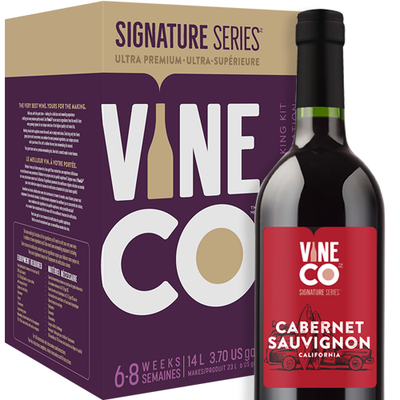
    French Cabernet Sauvignon Merlot blend is easily enjoyed at any time; a reliable go-to wine to have on hand Pairs just as well with refined dining as it does with a fresh pie from the pizza parlor Flavors of black currant, plum, dark berries, and subtle mineral notes Dry with medium-full body, 13.5% ABV Whip up a batch in 30 mins or less! Yields 6 gallons (2 cases) of finished wine in 6-8 weeks Premium kit includes grape skins for an authentic wine making experience Bottle labels included for a professional finish Cabernet Sauvignon Merlot is quite possibly the premier wine blend, pairing two of the most widely-grown grape varieties in the world. Cabernet Sauvignon and Merlot on their own are the foundation of countless remarkable wines produced in Bordeaux, France. Now staples in other major wine growing countries such as Italy, Chile, and the US, these grapes have also become rooted in such far-flung countries as South Africa, New Zealand, Israel, and on and on. The “Bordeaux Blend” combines the tannic, more acidic structure of Cabernet Sauvignon with the juicier, fruit-forward contribution from Merlot for a result that is greater than the sum of its parts. Our French Cabernet Sauvignon Merlot bursts with vivid flavors of black currants, plum, and dark berries, with subtle mineral notes, firm tannic structure, and heavy oak character. An alcohol content of 13.5% provides a considerably dry finish to this medium-full bodied blend. A proven favorite for wine lovers across the globe. The Signature Series™ Cabernet Sauvignon Merlot is one of the most satisfying kits to make thanks to the inclusion of grape skins. You’ll mirror the professional vintner process of “punching the cap”, which makes your winemaking adventure even more hands on. VineCo’s jammy skin packs are much more expressive than dried grape skins, imparting more character from the grapes and boosting tannin structure in the finished wine. High quality French oak cubes are used in the final aging process of the French Cab/Merlot kit. One of the reasons oak has always been used to age wine is the slow release of delicious, complex compounds that complement the wines flavor. Oak cubes have more depth of flavor than chips or powder and slowly release compounds like furfural (sweet, caramel like), lignins (vanillin, spice, smoke), and lactones (classic oak flavor). French oak in particular is known to deliver refined, less apparent oakiness than American oak. It's famous for adding mouthfeel and flavors of custard and chocolate while still allowing the fruit flavors of the wine to shine through. The Vinceo Signature Cabernet Sauvignon Merlot pairs well with any evening occasion, and should be one of your go-to bottles for an important dinner or classy date night. Even though this blend can add a touch of refinement when served along a perfectly seared lamb chop, don’t be afraid to pour a tall glass while cozied up for a night of take out pizza and binge watching. Cabernet Sauvignon Merlot, France Black currant, plum, dark berries, subtle mineral notes Sweetness: Dry Oak: Heavy Body: Medium-Full ABV: 13.5% Kit Volume: 14 L Approximate Yield: 23 L Ready to bottle in 6-8 weeks Grape skins included Bottle labels included

    $182.99 $136.79

  • Replacement Fill Nozzle Assembly for Enolmatic Filler

    Replacement Fill Nozzle Assembly for Enolmatic Filler

    16 reviews

    Replaces the entire fill nozzle assembly on the WE620 Enolmatic Bottle filler, including the support arm and spring.

    $87.99

  • Heat Shrink Sleeves - White - PLACEHOLDER

    Heat Shrink Sleeves - White

    These PVC heat shrink capsules help to make your home made wine look classy and professional. The look is the closest we have seen to commercially used tin capsules, which must be spun on with a $2,000 machine. Conversely, these PVC capsules can be easily used at home. Features horizontal tear tab. To use, slide on to top of wine bottle and dip into hot water for a quick and even shrink. Or for faster processing with a more reliable finish try one of our Heat Shrink tools. 2 1/4" Height x 1 1/4" Diameter.

    $1.79 - $59.99

  • Wood Barrel Spigot #6 (10 in Long) Wood Barrel Spigot #6 (10 in Long)

    Wood Barrel Spigot #6 (10.5 in Long)

    6 reviews

    Replacement spigots for the maintenance of your cherished wooden aging barrel.   A wooden barrel spigot is something that will need to be replaced from time to time. This wooden barrel spigot features a wooden spout and a plastic valve insert. Spigots are sold individually, with no packaging.    The #6 spigot is approximately 10-1/4" long and 34 mm (1-11/32") at the small end.      

    $15.49

  • Scottzyme KS - PLACEHOLDER Scottzyme KS - PLACEHOLDER

    Scottzyme KS

    1 review

    cottzyme KS – High-Power Enzyme for Complex Pectin Breakdown in Red, White, and Problem Wines Breaks down complex, highly esterified pectins that standard pectinases cannot Enhances clarification, settling, and filterability in challenging juices and wines Boosts juice and wine yield by improving extraction from thick-skinned or high-pectin fruit Ideal for problem fermentations or hazy wines that resist fining and filtration Performs well at low temperatures and in a broad pH range Scottzyme KS is a specialized pectolytic enzyme designed to break down complex pectin structures found in high-pectin varietals and difficult ferments. While standard enzymes like PEC5L target simple soluble pectins, KS is formulated with enhanced side-chain cleaving activity that attacks esterified pectins and heavily branched structures. This makes it particularly effective on cultivars like Pinot Gris, Riesling, Gewürztraminer, Muscat, and in juice or wine where haze persists despite prior enzymatic treatment. KS improves clarification, tightens lees, increases press and wine yields, and boosts filtration efficiency—especially in wines that defy typical settling protocols. Comparison to Scottzyme PEC5L: Scottzyme PEC5L is a fast-acting general-purpose pectinase for typical clarification tasks, such as settling and flotation of white and rosé juices. It’s ideal for clean juice production from standard grapes and most fruit wines. In contrast, KS is the go-to choice when PEC5L isn’t enough—it’s stronger on stubborn, esterified pectins and delivers better results with problematic varieties or ferments that remain hazy even after PEC5L. While PEC5L is excellent for fast juice prep, KS excels in the most difficult cases, including post-fermentation haze and challenging press fractions. Protocol Dilute Scottzyme KS in 10 times its volume of chlorine-free water or juice. Add to must, juice, or wine and mix well. Suitable for use before or after fermentation. Do not add simultaneously with bentonite or high SO₂. Works effectively at 10–20°C. Usage Rates Recommended dosage: 1.5–4.0 mL per 1000 lb of fruit or 0.075–0.2 mL per gallon = approximately 0.02–0.05 mL per liter Use lower rates for moderate haze and extended contact time. Use higher rates in cold settling, high-pectin juices, or persistent post-fermentation hazes. Allow 4–24 hours of contact time depending on application.

    $14.99 - $69.99

  • Heat Shrink Sleeves - Matte Green - PLACEHOLDER

    Heat Shrink Sleeves - Matte Green

    1 review

    These PVC heat shrink capsules help to make your home made wine look classy and professional. The look is the closest we have seen to commercially used tin capsules, which must be spun on with a $2,000 machine. Conversely, these PVC capsules can be easily used at home. Features horizontal tear tab. To use, slide on to top of wine bottle and dip into hot water for a quick and even shrink. Or for faster processing with a more reliable finish try one of our Heat Shrink tools. 2 1/4" Height x 1 1/4" Diameter.

    $1.79 - $59.99

  • Wine Kit - VineCo - Niagara Mist - Blue Pom Wine Kit - VineCo - Niagara Mist - Blue Pom

    Blue Pom Wine Making Kit - VineCo Niagara Mist™

    2 reviews

    The VineCo Niagara Mist lineup offers a crisp, easy-drinking alternative to more traditional winemaking kits. These fruit-forward wine kits are all about capturing the refreshing essence of juicy ripe fruit. Light and crisp and offered in a full assortment of reds, whites, and rosés. Niagara Mist wines are easily enjoyed on their own, but also work well as the base for punches or wine spritzers. Blue Pom is packed with delicious aromatics and flavors of red berry, tangy blueberry, and tart pomegranate. A refreshing light-bodied, sweet rosé with an alcohol level of 6% by volume. Blue Pom Red berry fruit, blueberries, pomegranate Sweetness: Sweet Oak: None Body: Light ABV: 6% Volume: 6 L Approximate Yield: 23 L Ready to bottle in 4 weeks    

    $75.99

  • Wine Kit - RJS Craft Winemaking - Cru International - France Rose Style

    French Rosé Wine Making Kit | Cru International

    Made in the classic French rosé style, this wine is light bodied and pink in color with spiced strawberry and crisp, citrus aromas Medium-bodied and dry, 11.8% ABV Try with Italian paninis or an Israeli cous cous salad Yields 6 gallons (2 cases) of finished wine in approximately 5 weeks Made in the classic French rosé style, it is light bodied and pink in color with spiced strawberry and crisp, citrus aromas. The palate features fresh strawberry flavors with a refreshing fruity finish. Food Pairings Try with Italian paninis or an Israeli cous cous salad. Rosé, France Sweetness: Dry Oak: Unoaked Body: Medium ABV: 11.8% Kit Volume: 8L Approximate Yield: 23L Ready to bottle in 5 Weeks

    $87.99

  • Impeller for PMP520 Euro 20 (EPDM) Impeller for PMP520 Euro 20 (EPDM)

    Impeller for Euro 20 Pump (EPDM)

    Replacement impeller for the Euro 20 pump. In documents tab: Position: 7

    $59.99

  • Hydrometer - Brix (0 - 10) With Correction Scale Hydrometer - Brix (0 - 10) With Correction Scale

    Brix Hydrometer (0 to 10) With Correction Scale

    Precise hydrometer for measuring the sugar content and progress of fermentation in wine ferments. Comes with a thermometer/correction scale built-in. Please Note: Due to the large size of this hydrometer, it does not work with our standard 11" or 14" hydrometer jars. We recommend using our 500mL Graduated Cylinder (MT636D) with this hydrometer.

    $30.99

  • pH 4.01 Calibration Solution (500mL) (Hanna# HI7004L)

    Hanna pH 4.01 Calibration Solution - 500mL (Hanna# HI7004L)

    HI7004L is a premium quality pH 4.01 buffer solution. With lot number and expiration date clearly marked on the label and an air tight, tamper-proof seal to ensure the quality of the solution, Hanna’s line of pH calibration solutions are an easy way to get great pH measurements every time. Air tight bottle with tamper-proof seal for quality. Color coded label for easy identification of pH buffer values. Perfect for routine maintenance to ensure accurate readings while extending the life of the electrode. Our pH Technical Buffer Solutions are dedicated to measurements that require extremely accurate pH monitoring, and come with a certificate of analysis prepared by comparison against NIST standards. Our pH Technical Buffer Solutions are dedicated to measurements that require extremely accurate pH monitoring, and come with a certificate of analysis prepared by comparison against NIST standards. Air tight bottle with tamper-proof seal Ensures quality and freshness of solution Each bottle marked with lot number and expiration date. Hanna buffers are specially formulated to have an expiration of 5 years from manufacture for an unopened bottle. Color coded label for easy pH buffer value identification Easy to identify different buffer values    

    $22.00

  • Wine Kit - VineCo - Signature Series - Merlot, California (Includes Skins) Wine Kit - VineCo - Signature Series - Merlot, California (Includes Skins)

    California Merlot Wine Making Kit - VineCo Signature Series™

    8 reviews

    Californian Merlot is a welcome pour whether it's at the dinner table or the picnic table Pair with a basket full of charcuterie fare or burgers hot off the grill Flavors of fruit, baking spices, floral, and chocolate Full-bodied and dry, 14% ABV Whip up a batch in 30 mins or less! Yields 6 gallons (2 cases) of finished wine in 6-8 weeks Premium kit includes grape skins for an authentic wine making experience Bottle labels included for a professional finish Merlot is extraordinary in its flexibility, able to be paired with many different grapes to create magnificent blends, but easily stands on its own in varietal wines. Sometimes mistaken for Cabernet Sauvignon in blind tastings, the two grapes are both descendents of Cabernet Franc and can display similar flavors and textures, although Merlot is known for being softer and less tannic. Aromas and flavors include blackberry, cassis, baked cherries, dark chocolate and mocha, among others. Merlot ranks as the second most-widely grown grape in the world, but reigns supreme in the Médoc district of Bordeaux. California-grown Merlot grapes produce what is known as “Warm-Climate Merlot”, which is the category that Merlot grown in Australia and Argentina also fall under. These grapes tend to be heavier on the fruit notes and lighter in body. Due to the lower tannin levels and softer finish, some vitners employ a longer oak-aging process to give the wine more structure. Our California Merlot is a full-bodied red with big fruit flavors with hints of rich baking spices and purple floral notes. On the higher end in regards to alcohol content at 14%, this wine has a dry chocolate finish with a moderate oak character. The Signature Series™ Merlot is one of the most satisfying kits to make thanks to the inclusion of grape skins. You’ll mirror the professional vintner process of “punching the cap”, which makes your winemaking adventure even more hands on. VineCo’s jammy skin packs are much more expressive than dried grape skins, imparting more character from the grapes and boosting tannin structure in the finished wine. High quality American oak cubes are used in the final aging process of the California Merlot kit. One of the reasons oak has always been used to age wine is the slow release of delicious, complex compounds that complement the wines flavor. Oak cubes have more depth of flavor than chips or powder and slowly release compounds like furfural (sweet, caramel like), lignins (vanillin, spice, smoke), and lactones (classic oak flavor). American oak in particular is known to deliver aromatic sweetness, vanillin, and classic oak flavor. The VineCo Signature Merlot is not to be sequestered to the dinner table. This is a wine you want to pack up and take with you on a picnic. Enjoy with the sun overhead, a light breeze at your back, and a charcuterie board within arm’s reach. At supper time, you may find Merlot to be the perfect compliment to grilled beef burgers or a freshly chopped Caesar salad. Merlot, California Big fruit flavors, rich baking spices, purple floral notes, chocolaty finish Sweetness: Dry Oak: Medium Body: Full ABV: 14% Kit Volume: 14 L Approximate Yield: 23 L Ready to bottle in 6-8 weeks Grape skins included Bottle labels included

    $182.99

  • WineStix - Medium Plus Toast French Oak Carboy 2 Pack

    WineStix - Medium Plus Toast French Oak Carboy 2 Pack

    12 reviews

    WineStix are a new form of oak integration for wine, designed to give new barrel flavors with an extraction time similar to cubes. The combination of Short and Long grains result in amazing gradience of flavor similar to barrels, while extracting significantly quicker! These are Medium Plus toast French Oak staves, and depending on the wine, will impart roasted toasty aromas, with flavors of coffee and caramel sweetness the length of the palate. This is a two pack of WineStix, sized specifically for a 5-6 gallon carboy of wine. WineStix will easily fit through the mouth of a glass carboy, and can be attached to a string via the drilled hole for easy removal! 1" W x 8.5" Long One carboy Winestix will treat 5-6 gallons of wine.

    $12.99

  • Wine Kit - VineCo - Niagara Mist - Cherry Sangria Wine Kit - VineCo - Niagara Mist - Cherry Sangria

    Cherry Sangria Wine Making Kit - VineCo Niagara Mist™

    The VineCo Niagara Mist lineup offers a crisp, easy-drinking alternative to more traditional winemaking kits. These fruit-forward wine kits are all about capturing the refreshing essence of juicy ripe fruit. Light and crisp and offered in a full assortment of reds, whites, and rosés. Niagara Mist wines are easily enjoyed on their own, but also work well as the base for punches or wine spritzers. Cherry Sangria is loaded with flavors of juicy red cherries, tart pomegranate, and sweet, subtle floral notes of cherry blossoms. A light-bodied, sweet red wine with an alcohol level of 6% by volume. Cherry Sangria Red cherries, pomegranate, floral cherry blossoms Sweetness: Sweet Oak: None Body: Light ABV: 6% Kit Volume: 6 L Approximate Yield: 23 L Ready to bottle in 4 weeks    

    $75.99

  • Wood Barrel Spigot #1 (6 in Long)

    Wood Barrel Spigot #1 (6 in Long)

    7 reviews

    Replacement spigots for the maintenance of your cherished wooden aging barrel.   A wooden barrel spigot is something that will need to be replaced from time to time. This wooden barrel spigot features a wooden spout and a plastic valve insert. Spigots are sold individually, with no packaging.    The #1 spigot is approximately 6 5/16" long and 18 mm (23/32") at the small end.      

    $9.89

Frequently Asked Questions

Wine Making Collection Article +

MoreWine! Guide to Red Winemaking Written By: Shea AJ Comfort Download print friendly version Goal of this Manual: To make Great wine at home on your first try It is highly recommended that this paper be read through completely before you start to make your wine. Wine-making is made up of a series of consecutive steps which build on and directly affect each other from the very beginning to the very end. In order to make the best wine possible you will need to make the best decisions possible at each of these steps, and in order to do that, you will need to have a general understanding of the overall process as a whole. Introduction Hello, and welcome to MoreWine!‟s Guide to Red Winemaking. We‟re excited that you‟re interested in learning to make wine, and we‟re hoping that you‟re at least as excited about the idea as we are! We think that you‟ll find winemaking to be at the same time relaxing and invigorating, rewarding and taxing, and a practically limitless source of entertainment and learning. Winemaking has the ability to teach us not only about the world around us, but about ourselves as well. Winemaking is certainly a very old and established activity, the roots of which go back thousands of years. Over the history of the practice, many great texts have been written outlining the process and giving direction to generation after generation of winemaker. Today is no different; there are currently quite a few great books about winemaking available on the market. The purpose of this booklet is not to take the place of a more complete text, so much as to give the new winemaker a more digestible place to start from. The basic process for making red wine is pretty straightforward. Fresh grapes are first crushed and separated from the stems. Next the mixture of juice and solids (called must) is allowed to ferment with yeast, converting the sugar from the fruit to alcohol and carbon dioxide, and extracting the color from the grape skins. As fermentation progresses, the carbon dioxide that is being created pushes the grape skins to the top of the container forming a “cap” on top of the fermenting wine, which must be re-submerged (called punching the cap) frequently in order to continue extracting color and to prevent the cap from spoiling. Once fermentation is completed, the wine is separated from the grape solids in a wine press and set aside for aging. Over about the next year the wine will be allowed to age and develop its flavors. Over the course of this year you may choose to add oak, tannins or a variety of other types of additives to the wine to augment or change its flavor. Also, the wine will be transferred to a fresh container periodically (called racking) in order to separate it from the sediments that naturally settle out of the wine during this time. Towards the end of the aging phase you may choose to add a clarifying agent to improve the wine‟s appearance. Clarifying a wine this way is called fining and the additives used to do it are called fining agents. Alternatively, you may choose to filter your wine to clarify it. Finally, based on a variety of factors that we‟ll expand on as you read further, you‟ll decide that the wine is ready to put into bottles. After a short period of recovery from the bottling process, your wine will be ready to drink! While reading through this booklet, there are a few things we‟d like you to keep in mind. The first, and most important, is that there is very little in winemaking that can really be considered a “right” or “wrong” way to approach a problem or procedure. The favorite maxim on this subject is that if you ask 10 winemakers the same question you are likely to get 11 different answers. Another favorite maxim on the subject of winemaking is that it takes a lot of good beer to make great wine – but more on this later (please contact us if you‟re interested in making beer, we can help you with that too!). So, if, with the exception of a few cardinal rules, there is no real right or wrong way to make wine, then why have we dedicated the time and energy to adding yet another booklet on the subject to those already available? The answer is that over the course of many years we have found that certain techniques offer the greatest chances of success, especially to the first-time winemaker. It is only too easy to have something go wrong which spoils a batch and causes the new winemaker to lose interest or inspiration. Our goal with this booklet is to minimize the chance of this happening and maximize the chance of you sticking with this wonderful, rewarding pastime. There will be things in this booklet that contradict what you have read in other books, or have heard from your friends or relatives who already make wine. We want you to understand that neither we nor they are necessarily wrong. The steps and techniques laid out in this booklet are simply what we have found to work best for the majority of our customers after years of experience and feedback. We‟d like to encourage you to experiment with new products and techniques - and to please contact us with any questions you might have about anything that you see in here. We‟d also like to encourage you to start and maintain a winemaking logbook. Keep track of allthe measurements you make regarding sugar, acid and sulfite levels (don‟t worry if you don‟tknow what these things are, we will go over everything!). Record tasting notes and detailed notes about any procedure that you put the wine through, including any changes that you notice as a result of your procedure. Too often we get phone calls from home winemakers that have a question about their wine and we are unable to help out because the winemaker has kept no or very poor records. We really cannot stress enough how important good record-keeping is. Imagine pulling a wine that you made 3 or 4 years ago and just loving it, but not having any records to refer back to about what additives or fining agents you used. Unless you can remember everything you did with the wine 4 years ago, a record book will be the best resource for you if you want to recreate your best wines. Conversely, if you make a wine that has problems or that you just don‟t like very much, a record book is the best way to avoid repeating the mistakes or procedures that led to the bad wine. Finally, a quick word about the format of this booklet: The text is divided into 10 chapters andis designed to take you through the winemaking process in a step-by-step fashion all the way from picking (or picking up) your fruit through to bottling. Each chapter of the booklet covers a particular phase, stage or aspect of the whole winemaking process. What you‟ll find in Chapter Ten is an Expanded Information section which corresponds to each of the other chapters of the booklet. We‟ve set the text up so that you‟ll get the “nuts and bolts” of what you‟re doing at each stage up front. If you wish to learn more about the “why” as opposed to just the “what” of that particular process just flip back to Chapter Ten and find the corresponding section. Our aim here is for you to have a quick reference guide that you can use to know what it is you need to do, as well as the basic theory behind it, all in an easy to navigate package that will stay within an arm‟s reach in the winery for years to come. So, all that said, let‟s get to it! Chapter 1: Preparation Getting ready to make wine Before we can get into the mechanics of making wine, we need to go over the steps required to prepare. 1.1) Source your fruit There are a variety of resources available to home winemakers nationwide when it comes to sourcing fruit. These sources range from the vineyard down the road to a commercial broker of wine grapes. Many home wine and beer making shops maintain a bulletin board where local grape growers can post ads for their fruit. Starting in 2009, MoreWine! has partnered with Peter Brehm and we are now shipping premium California and Washington State fruit directly to your door via UPS! (To learn more about the many benefits of using frozen must and see what‟s available please take a look at the Brehm Fruit Info section of our website). Finally, MoreWine! offers a free online bulletin board that you can find at www.MoreGrapes.com. As much as possible, we encourage you to develop a direct relationship with the grape grower. We suggest this for a couple of reasons. First, a direct relationship often gets you the best price on the fruit and the best chance of getting the fruit again in subsequent seasons. Second, working with the same fruit year after year will give you the best chance to develop as a winemaker, because you will be able to see how different yeasts and additives affect wine made from the same vineyard and also how differences from one growing season to the next can influence the fruit. 1.2) Get your equipment together If this is your first season making wine there are a few different options for you as far as getting equipment together. We suggest, if possible, that you rent the major equipment like a grape crusher and a wine press if you have a local shop that offers these for rental. Many regional winemaking clubs also have group equipment available. If renting or borrowing equipment is not an option for you, you can also try to find the major items you need in used condition either through a local classified ads website like Craigslist or, again, through a local home winemaking club. Be wary of used equipment as the condition of the equipment can be substandard. Check any steel equipment for rust and any rubber parts for cracks or brittleness. These flaws cannot be effectively repaired and so if you find any rust or cracked, brittle rubber these parts must be replaced. This can be difficult if you‟re looking at older equipment as spare or replacement parts may not still be available. Important note about sanitization!: At all stages in the winemaking process any tools and equipment that are going to come into contact with the juice or wine will need to be sanitized. This is done to eliminate spoilage yeast and bacteria that could contaminate our wine and ruin it. Sanitization is done in two steps: 1. Make sure the surface area to be cleaned is free of any dirt, film or grime. If it isn‟t you will need to scrub it off with a sponge or scrub pad and water. Brushes and hoses can be cleaned with a long hose/line brush made for this purpose. Copyright 2008 MoreFlavor!, Inc Page | 7 2. Once the surface is clean it can now be sanitized. This is done by preparing the sanitizer* and pouring, wiping, or swirling to make sure the sanitizer wets all surfaces needing to be sanitized. After a few minutes contact time, rinse the equipment off with fresh, clean water. * We recommend using Star-San (CL26) as your sanitizer, as it is much friendlier and easy to deal with than the traditional SO2 and citric acid solution that is often referred to in many winemaking books. Unlike the SO2 solution, Star-San has no dangerous fumes and is perfectly safe to come into contact with. In fact during our winemaking, often the first step when we begin working is to dunk our hands into a bucket of prepared Star-San! Chapter 2: The Crush (Day 1) We Picked up the Fruit! Ok, so you‟ve purchased some grapes and brought them home. First, examine the fruit and remove any raisined or rotted/molded clusters. Hopefully the grower will have picked the fruit when the sugars are in the correct range (23°-25° ºBrix). You can request this service, so don't be afraid to ask. If the sugars are outside of this range, you will have to address this after the crush. (Either by adding sugar to raise the ºBrix, or by diluting the must to lower the sugars. See section 2.3 A for a full explanation.) *Note: You can measure ºBrix with a refactometer (MT700) or a standard hydrometer (MT310) - just take your reading off of the ºBrix scale and not the Specific Gravity scale. The grower or your source for the grapes should be able to tell you what the ºBrix are because this usually determines when they are picked. 2.1) Crush and De-Stem the Grapes The goal here is to remove as many of the stems as possible (at least 90%), and make sure that all of the berries have been sufficiently split open to allow the yeast to get in and work their magic. They don‟t need to be completely mashed, just cracked. For small amounts, this can be done by hand with a mesh bag. However, for quantities above 50 lbs, you will want to purchase or rent a Crusher-Destemmer. Unwashed grapes are added directly to the top hopper on these machines. The grapes are crushed by the rollers and fall through the grate below into your fermenter. The separated stems are ejected out of the unit by the “destemming bar.” These machines are available in manual and electric versions. The combination of juice, skins, seeds, and pulp that falls into your fermenter is now called “must”. You add yeast to the must to perform fermentation. Red wines are fermented in contact with solid materials from the grape in order to extract the compounds that give the wine its color, body, and depth of flavor and aroma. 2.2) Let’s Clean the Slate – Adding SO2 (Potassium Metabisulfite) One of the keys to a successful fermentation is removing any native wild yeast and bacteria from the must prior to adding your special winemaking yeast. Wild yeast and bacteria can consume sugar from grape juice just as easily as your special yeast can, but generally produce some pretty terrible flavors in the process. In addition, many wild yeasts are less tolerant to high alcohol levels, and may stop fermenting before all of the sugars have been consumed, creating a “stuck” fermentation. If this happens, left-over sugar could be used as a food supply for any spoilage organisms present, and the wine will be compromised. Therefore, sulfite is added immediately after you crush to “clean the slate” of these unwanted guests. The amount used is usually just enough to kill or at least inhibit spoilage organisms, but not enough to bother more sulfite-tolerant, cultured yeast strains that we recommend using. If your grapes are in good condition, free of mold etc., add 50ppm („parts per million‟) of SO2 based on the total volume of the must. If the grapes are not in good condition, add more sulfite to counteract the presence of the mold and bacteria- up to 100ppm. However, be aware that levels of SO2 above 50 ppm will inhibit an MLF (Malolactic Fermentation) if you choose to do one. The 50ppm dosage rate at the time of the crush is usually fine. *Note: The first sulfite addition made during the crush usually becomes entirely “bound-up” by the end of the alcoholic fermentation. During its aging and storage, only the “free” portion of the SO2 addition is actually contributing to the protection of the wine. Therefore, it is important to keep in mind that this first addition isn't part of the sulfite level needed to protect the wine during its storage and aging. For more comprehensive information on SO2, see sections 8.1 and 10.7.  Types of SO2 We recommend SO2 in 2 specific forms for addition to your wine, Potassium Metabisulfite (most common) and Efferbaktol (our favorite). Potassium Metabisulfite is often shortened to “meta” “SO2” “Sulfite”, and comes in a white powder form. It can be dissolved into water and added to the must or finished wine. Our preferred format for sulfite is in the form of effervescent selfdissolving granules called Efferbaktol. SO2 is also available from Campden tablets, which look like aspirin. Campden tablets are made from Sodium Metabisulfite, a less desirable form of SO2. However, they're easily measurable in small doses. Efferbaktol packets: Sizes: Available in 2g (AD503A), 5g (AD504A), and 10g (AD505B) packets. 2g adds 528ppm per gallon, 5g adds 1320ppm per gallon, 10g adds 2640ppm per gallon. To add the right amount of SO2 for your fermenter using Efferbaktol, divide the ppm by your gallons of must to see how many ppm of SO2 will be added: Let's say you have 10 gallons of must. The 2g packet offers 528ppm per gallon; divide 528ppm by 10 gallons to get 52.8ppm, close enough to our desired 50 ppm. To use: Tear the bag open and add directly to the must or wine. Mix thoroughly. Easy and clean. About Efferbaktol: It takes 2.5 grams of product weight to give 1 gram of SO2. So, the 2 gram packet of Efferbaktol actually weighs 5 grams. This is useful to remember when dividing dosages between vessels while using a scale. If the individual dosages are done at the same time, this is not a problem. Once opened, you should quickly use the entire contents of the package because it begins to lose its effectiveness when exposed to moisture in the ambient air. SO2 in Powdered Form: Sizes: Available in 4oz (AD495), or 1lb (AD500) bags 0.33 grams per gallon results in 50ppm. For 10 gallons you would need 3.3 grams of powdered meta-bisulfite. If you do not have a gram scale, ½ teaspoon (level) is about 3.3 grams and adds 50ppm (“total”) to 10 gallons. To use: Dilute the sulfite powder in water or juice until the crystals are completely dissolved and thoroughly mix into the must. Set Aside a Sample for Testing Once you have added sulfite to the crushed grapes the must is protected. You can safely take out about a quart for testing. 2.3 Testing the Must Before you add the yeast, you need to test the must to determine if any additions/corrections are needed. Very rarely will you get a grape that naturally has the required balance of acids, sugars, and pH necessary to create a harmonious wine. When one or more of these elements are out of their ideal ranges, the quality of the wine suffers. Any potential the fruit had to make a nice wine is significantly lowered. However, if we take the time to correct any possible problems and balance the must early on, the quality of the resulting wine will be better maintained. Correcting a must lays the foundation on which the wine will be built. Even slight adjustments can raise a wine from being just good to great. *Note: When making corrections, consider the varietal. Seed/skin to juice ratio varies for each grape. We will only be getting around 3 (Bordeaux) to 3.5 (Zin and Rhône) gallons of finished wine from every 5 gallons of must! This comes out to 60-70% of the must volume. Don’t forget to take this into account when making corrections to the sugar levels or pH/Total Acidity (TA). In addition, most products designed to go into the must should still use the entire must volume to calculate their dosage. This compensates for the portion of the additions that physically bind to the must itself and will not make it into the final wine volume. This includes SO2, enzymes, tannins, oak, Opti-Red, Booster-Rouge and Noblesse. * Common examples of Bordeaux grapes are Cabernet Sauvignon, Cabernet Franc, and Merlot. Rhône varietals include Syrah, Grenache, Mouvèdre, and Pinot Noir. 2.3 A) Test the Sugar: Before making any adjustments, double-check your °Brix after the grapes have been crushed and the must has had a chance to be completely mixed together. There is usually a bit of variation in sugar levels between each and every bunch of grapes that make up the whole volume. Interestingly enough, these differences are not only found in fruit coming from different sections of the same vineyard, but even off of the same vine. Therefore, the only way to get a truly accurate sugar reading for any must is to wait until the fruit has been completely processed and thoroughly mixed together. *Note: Testing the whole must also helps to make the TA and pH testing more accurate as well. (Information on TA and pH and why they are important will be explained shortly) You can measure the sugar level with a hydrometer or a refractometer A hydrometer works by measuring the density of the liquid you're testing compared to water at a certain temperature. Temperature affects density, so it is important to have a sample close to your hydrometer's calibration temperature. If using a hydrometer: make sure to strain the sample of juice to remove any seeds and skins before filling the hydrometer jar. If the solids are left in the sample, these may cause the hydrometer to stick to the side of the jar, compromising the accuracy of the results. Another good technique for getting a clear juice sample is to place the sample in a freezer for 15-20 minutes. Decant off of the sediment that settles out. However, because a Hydrometer works off of the principle of density, and density changes with temperature, you will need to allow the sample to warm back up to 68 be accurate because this is where most hydrometers are calibrated. The hydrometer jar should contain enough sample that the hydrometer is always floating. Wait until it stabilizes and read the number where the top of the liquid meets the scale on the hydrometer. Note: Depending on the temperature of the sample, you should also add or subtract the amount indicated by the thermometer at the bottom of the hydrometer for the greatest amount of accuracy. If using a refractometer, add a drop or two of the juice to the lens and close the flap onto it. This will cause some of the juice to squish out, which is normal. Next, wait 30 seconds for the sample to adjust to the temperature of the refractometer prism. Then, hold it up to the light and look through it to see where the colored bar extends to on the scale. This is your ºBrix reading. When using a refractometer, make sure the glass lens is clean and dry, and reads 0 ºBrix when testing with plain water. If not, adjust/calibrate it with water according to the instructions that came with it. This usually involves turning a knob or a small screw while looking through it until it reads “0”. Once you have gotten a ºBrix reading for the must, record this in your notes and determine if you need to adjust the sugars or not: As mentioned earlier, you want a sugar level of 22°-25° ºBrix for the start of a red wine fermentation. • If your sugar level is lower than 22° ºBrix, we recommend adding sugar to bring it up to the standard level (called chapitalizing the must). This is done with table sugar: 1.5 oz. of table sugar per US gallon of projected liquid raises the ºBrix by 1°. Measure the amount of sugar needed and completely dissolve it into a small quantity of warm water The warm water ensures that the sugar will dissolve completely into the wine. This small amount of water will not be enough to dilute the wine. Alternatively, you can dissolve the sugar directly into the liquid from the must, but depending on how much you are adding, this may be difficult. Mix thoroughly into the must so that the sugar (which is heavier than must) doesn‟t wind up sitting on the bottom of the fermentation vessel. • If your sugars are higher than 25 ºBrix, you may choose to leave the must as is and make a “big” wine. However, depending on your yeast strain, you may get a wine that does not ferment all the way “dry” (less than 1% residual sugar). To avoid this, you can dilute the juice to 22°-25° ºBrix with water. For complete notes on dilution and chapitalization, see section 10.1. If you don‟t have a scale (MT358): 1 tsp of table sugar = 5 grams (.17 oz.) 8.8 tsp of table sugar = 1.5 oz. TA and pH The next two sections deal with testing pH and TA. These are very important elements to monitor during winemaking because they give us an indication of what is going on with the overall balance of the wine. TA measures all of the combined acids in the wine, (there are many different types) and tells you how acidic/tart the wine is. TA is expressed in either %TA or in g/L of Tartaric Acid. For example, a wine‟s TA could be expressed as 0.65% TA or as 6.5g/L TA. These two values are equivalent, and you can easily switch between the two common ways of expressing TA by moving the decimal point one place left or right. We prefer to express TA in of g/L because we feel it is easier to visualize: We are literally saying that the wine has 6.5g of TA per L of wine. The pH is a measure of how these acids balance out against buffering compounds such as Potassium. pH value also indicates how effective the blend of acidic and basic compounds will be at helping to protect the wine. pH is measured in pH units, pH values of less than 7.0 are acidic. The typical pH range for red wines is between 3.5 and 3.8. Let‟s take a look at how these two parameters interact. Assume we have two red wines that each have the same TA, but different pHs, 3.2 and 4.0 respectively. The wine with a pH of 3.2 will have bright fruit flavors, but it will also be thin, acidic and aggressive on the palette. On the other hand, the wine at 4.0 will be softer and rounder than the wine at 3.2, but also less vibrant; the fruit characteristics will flatten out quickly. Ideally, we are after a wine that has the freshness and strong fruit characteristics of the lower pH wine, but with the roundness and approachability of the higher pH one. The key to achieving this lies in making sure the pH of the wine ends up somewhere in the middle of these two extremes, between 3.4-3.65 pH. Vigilant monitoring of your TA and pH will help you achieve this goal. The importance of correctly preparing a sample for both the TA and pH testing: TA and pH are sensitive tests. It is important to properly prepare samples or we may get false results. With red wines, it is best to get a sample of the must and lightly run it through a blender. The blender serves to open the skins and simulates the chemical make-up the juice will attain once fermentation has completed. The blended sample will need to be strained because the grape solids all have a different pH and TA than the juice itself. If they remain in the sample, they can skew the results. We only want to test the final liquid that is free of solids. To achieve this, first strain the blended fruit to get the solids out. A fine mesh bag (Bag10) is great for this. Next, filter the resulting liquid to obtain a clean juice free of particles. (Paper coffee filters pushed into a wine glass are great for this). The resulting clean juice is optimal for TA and pH determinations. Steps to prepare sample: 1. Lightly blend must in a blender 2. Strain blended must through mesh bag into a bowl or jar to remove solids. Lightly squeeze bag if needed until enough sample has been collected: 50-100mL 3. Place coffee filter part way into a wine glass or jar (maybe use rubber band to secure it around the rim to keep it from falling in.) Pour sample into the filter and allow it to drip into the glass/jar: 30-50 mL. Use this sample to do the pH and TA testing on.  2.3 B) Test for the Total Acidity% There are three methods used by the home winemaker to test for acidity: • Method 1 – Basic: Test the must with an acid test kit (W501). • Method 2 – Better: Use a pH meter with our Test Kit (W501). Run the same test using the acid test kit from the first method, only this time stir with the pH meter while titrating until it reads pH 8.2. Use this as the endpoint for the test in place of the color change. Calculate the results by following the acid test kits instructions exactly as in the first method. • Method 3 – Best: Use the Hanna Acidity titrator (MT682). This is a machine that takes 30 seconds to give you a highly accurate TA reading. Great if doing large batches of multiple samples. Used by hundreds of commercial wineries. Once you have tested your TA, you can decide whether it needs adjusting. Keep in mind that that wine chemistry is very complex. Often, the amount of acid we have calculated on paper is not the amount that winds up being the best choice for taste. This is especially true when working with larger acid additions (>.2%TA or 2 g/L). We recommend making ½ of the addition you think is needed, and then test and taste to see if the balance is correct or if the wine still needs more acid. This is definitely one of those times where art and science come together. Ideally, we are looking for the must to be in a range of .60-.90 TA at the start of fermentation. So: • If your acids are in the

Login

Forgot your password?

Don't have an account yet?
Create account