The VineCo Niagara Mist lineup offers a crisp, easy-drinking alternative to more traditional winemaking kits. These fruit-forward wine kits are all about capturing the refreshing essence of juicy ripe fruit. Light and crisp and offered in a full assortment of reds, whites, and rosés. Niagara Mist wines are easily enjoyed on their own, but also work well as the base for punches or wine spritzers.
White Pear is a cheerful combination of juicy pears and a splash of lemon, wrapped up with notes of custard and white flowers. A light-bodied, sweet white wine with an alcohol level of 6% by volume.
White Pear
Pear, lemon, custard, white flowers
Sweetness: Sweet
Oak: None
Body: Light
ABV: 6%
Kit Volume: 6 L
Approximate Yield: 23 L
Ready to bottle in 4 weeks
You clean your equipment to remove bacteria. Make sure the tool you’re doing it with doesn’t leave scratches that actually promote bacterial growth!
These pads are made of soft, woven fibers making them ideal for equipment cleaning. They are tough enough to scrub off scum and debris without scratching most surfaces. These scrubbers are the best choice for cleaning stainless steel. Also good for chrome, copper, porcelain, glass, and plastic!
9" L x 6" W x 1/4" thick. Sold in packs of three.
2.5 L - Briess - White Wheat malt has a sweet, malty, bready character and contributes a light straw color. Use as a base malt in any wheat beer style, or use as 5% of the grain bill in any other beer style for improved head retention.
Typical Analysis:
Moisture - 4.0%
Color - 2.5° Lovibond
Protein - 12.0%
Diastatic Power (Lintner) - 160
See attached document for more information.
2.8-3.8 L - Great Western - A very light colored Wheat malt. The great thing about this malt is that the kernels are big (unlike some other varieties of Wheat so you do not have to readjust your mill from the standard 2-row setting.
Example Malt Analysis!
We may not be shipping this same lot.
Great Western Malting Company
LOT: 367
TYPE: Premium Wheat Malt
Updated 12/2/2005
% Assortment
7/64" 51.8
6/64" 38.1
5/64" 9.5
Thru 5/64' .6
Chemical Analysis
Moisture, % 4.5
Extract %, finely ground rnalt, as is 82.4
Extrad %, finely ground malt, dry basis 86.3
Extract %, coarsley ground malt, as is 81.5
Extract �/o, coarsley ground mall, dry basis 85.3
F/C Difference % 3.75
Color, laboratory Wort, degrees Lovibond 3.1
Viscosity 1.73
Beta Glucan, ppm 57
Diaslatic Power 188
Alpha Amylase(DU) 41.0
Total Soluble Protein %, dry basis 6.54
Total Protein %, dry basis 11.95
S/T Ratio % 54.7
Conversion, minutes 5-7
Aroma of Mash Aromatic
Filtration Time Normal
Clarity of Wort 24
Imparts a distinct sweet, malty flavor with a subtle fruity note
Elevated protein content contributes to a fuller-bodied beer and enhances head formation and retention
Use as up to 50% of your grain bill
Rahr White Wheat, crafted from North American soft winter white wheat, imparts a distinct sweet, malty flavor with a subtle fruity note. Its elevated protein content contributes to a fuller-bodied beer and can significantly enhance head formation and retention, depending on the overall grain bill. This particular white wheat malt is also favored for its ease of milling compared to red wheat, and its ability to promote the desirable haze often found in Belgian white beers. It's an excellent choice for brewers aiming to produce any wheat-style beer.
Malt Specification:
Color °L - 2.7-3.8
Moisture % - max. 5.0
Extract fine % dm - min. 80.0
Protein % dm - max. 12.0
Usage Rate - Up to 50%
This easy to read book, is a great introduction to souring and wild fermenting your beer.
Explore the world of Lambics, Flanders, and the American variations of these styles like never before! These specialty beers depend upon fermentation by wild yeast and bacteria to give them their signature flavors. Jeff Sparrow has amassed a wealth of knowledge regarding these "non-traditional" beers and was able to put them into an easy-to-read book. This book covers the history of these beers, the breweries that made them famous, and gives an overview of wild yeasts and what to expect when attempting to use them in beer making. You even come away with recipes and techniques for cultivating your own wild yeasts to produce these sour beers.
Put down the mash paddle and grab an oar! Instead of fighting the overwhelming current of industry trends, let's ride these rapids and shred some wild water gnar! Hard Seltzer is here to stay thanks to popular brands like White Claw and Truly, and as a homebrewer you've probably already been asked by friends or family to whip up a batch. The truth is that hard seltzer is very simple to prepare, and any level brewer can make it at home. We've put together a simple kit that includes sugar, yeast, nutrients, and a packet of salts to adjust your water to a proper seltzer profile. Everything is included except for the water -- sorry, but have you ever looked into shipping water? It's stoopid expensive!
Mandatory Tagline: You'll be laid back like an otter when you're drinking Wild Water!
Makes 5 gallons
Estimated Original Gravity: 1.042
SRM (Color Range): 0
IBU's: 0
Estimated Alcohol Percentage: 5.5%
Recommended Carbonation Level: 4 volumes
Included:
5 lbs Corn Sugar
Water Modifier Salt Packet (added at the same time as the sugar)
Yeast
Yeast Rehydration Nutrient
Yeast Fermentation Nutrient
Fining Agent
Apricot Fruit Flavoring
Not Included:
RO or Distilled Water
Priming Sugar (if bottling)
Kayak
The new and improved Wild Water Hard Seltzer kit features retooled water modifier salt packets for increased fermentation performance. The previous single salt pack has been split into separate A and B salt packs, which we found significantly increased the buffering capacity to prevent the fermentation pH from dropping below the tolerance level of the yeast, leading to far fewer instances of stuck fermentation or not reaching the target final gravity.
Please note: each kit includes an extra packet of yeast and FermFed (DAP Free). Read the instructions carefully, and only use the extra packets if you experience a stuck fermentation.
Tip: to ensure your seltzer ferments all the way out, we recommend keeping the fermentation temperature above 70°F. Although it is unlikely to happen with the buffers included in the Water Modifier Salt Packets, a drop in pH below 3 can cause the fermentation to stop. Adding a few grams of chalk, baking soda, or potassium carbonate will bring the pH back up. This should only be done if you have measured the pH and found it is too low.
Put down the mash paddle and grab an oar! Instead of fighting the overwhelming current of industry trends, let's ride these rapids and shred some wild water gnar! Hard Seltzer is here to stay thanks to popular brands like White Claw and Truly, and as a homebrewer you've probably already been asked by friends or family to whip up a batch. The truth is that hard seltzer is very simple to prepare, and any level brewer can make it at home. We've put together a simple kit that includes sugar, yeast, nutrients, and a packet of salts to adjust your water to a proper seltzer profile. Everything is included except for the water -- sorry, but have you ever looked into shipping water? It's stoopid expensive!
Mandatory Tagline: You'll be laid back like an otter when you're drinking Wild Water!
Makes 5 gallons
Estimated Original Gravity: 1.042
SRM (Color Range): 0
IBU's: 0
Estimated Alcohol Percentage: 5.5%
Recommended Carbonation Level: 4 volumes
Included:
5 lbs Corn Sugar
Water Modifier Salt Packet (added at the same time as the sugar)
Yeast
Yeast Rehydration Nutrient
Yeast Fermentation Nutrient
Fining Agent
Not Included:
RO or Distilled Water
Priming Sugar (if bottling)
Kayak
The new and improved Wild Water Hard Seltzer kit features retooled water modifier salt packets for increased fermentation performance. The previous single salt pack has been split into separate A and B salt packs, which we found significantly increased the buffering capacity to prevent the fermentation pH from dropping below the tolerance level of the yeast, leading to far fewer instances of stuck fermentation or not reaching the target final gravity.
Please note: each kit includes an extra packet of yeast and FermFed (DAP Free). Read the instructions carefully, and only use the extra packets if you experience a stuck fermentation.
Tip: to ensure your seltzer ferments all the way out, we recommend keeping the fermentation temperature above 70°F. Although it is unlikely to happen with the buffers included in the Water Modifier Salt Packets, a drop in pH below 3 can cause the fermentation to stop. Adding a few grams of chalk, baking soda, or potassium carbonate will bring the pH back up. This should only be done if you have measured the pH and found it is too low.
This refreshing blush wine presents all the characteristics of a slice of fresh watermelon
Medium-bodied and sweet, 7.6% ABV
Each kit yields 6 gallons (2 cases) of finished wine in approximately 4 weeks
This refreshing blush wine presents all the characteristics of a slice of fresh watermelon. Balancing thirst-quenching crispness with juicy sweetness, Wild Watermelon is best served chilled to enjoy the invigorating flavor of this classic summer beverage.
Wild Watermelon
Sweetness: Sweet
Oak: Unoaked
Body: Medium
ABV: 7.6%
Size: 5.5L
Yield: 23L
Ready to bottle in 4 weeks
We offer wildflower honey from open spaces around the world. We have found it makes a terrific, complex, base-mead. We have found this to be a great basic honey for brewing , so much so that we use it in our ingredient kits that feature honey. Download the PDF Please note: Honey that gets cold often becomes crystalized but this has no detrimental effect on the overall quality. It can still be used in its crystalized form or returned to liquid by gently heating it back up in a warm water bath.
Willamette is one of the most popular hops amongst all types of brewers for its versatility and well-rounded aroma. The moderately spicy, floral and fruity notes compliment just about any style of beer and also blend beautifully with other hops in your recipe. An excellent choice for balanced or malt-forward beers like Pale Ale, Brown Ale, English Ales, or Porters.
Hop Statistics:
Alpha Acids: 4.0 – 6.0%
Beta Acids: 3.0 – 4.5%
Alpha-Beta Ratio: .89 – 2
Cohumulone: (% of alpha acids): 30 – 35%
Total Oils in mls per 100 grams dried: 1.0 – 1.5
Similar Hop Varieties: Glacier, US Fuggle, US Tettnang, Styrian Golding
Ferment and serve from the same vessel—no need to transfer from fermenter to keg
Low profile design fits inside a standard kegerator which can be used for fermentation temperature control
Fermenting under pressure allows you to ferment with lager strains at higher temps while reducing esters
Made from stainless steel with conical bottom
Extra-large collection container for harvesting yeast or dumping sediment
The #1 reason we love the BrewKeg Unitanks is that they eliminate kegging day, which saves a bunch of time. The Brewkeg12.5™ is perfect for a 3-gallon batch, and with the low profile, it still fits in a standard kegerator, which can be used for fermentation, as well as serving. When fermentation is done, crank down the temp, remove the yeast/trub collection ball and start immediately drinking because the beer is already carbonated. Since this is not the standard brewing process, stop and think that over - you don't need a separate night or hours on a weekend morning to clean and keg. You are going to save 2 or more hours with every batch! Plus, you are skipping the most oxidative step in brewing of going from your fermenter to your keg. Yes, the one down side is that your fermenter is tied up as a keg but to many of us who really love brewing our own beer but are time challenged – the sacrifice is totally worth it.
Another great time saving feature is that you can skip wort cooling and 'hot pack' these kegs, literally filling them after boil at around 190°F. Stick them in your refrigerator, let them cool overnight, and pitch yeast the next day. Hot packing is gaining a lot of traction and we suggest you google the term to learn more. It’s been a standard practice in Australian homebrewing for years.
Okay, so there is not a lot out there about fermenting under pressure. We've been doing it for years now with a slew of pressurizable fermenters, including the BrewKeg, and if you want to make amazing lagers quickly you need to try it. Fermenting under pressure reduces esters and even beers fermented between 65-80°F have amazing German lager malt profiles. We once fermented a beer under pressure with WLP001 at room temp and all the tasters thought it was lager yeast. The pressure relief assembly, in the center of the lid, is the slickest out there and adjusts from no pressure up to 25 psi. Leave it open for no pressure fermentations of ales and IPA's where you want the esters. Close it down to make amazing lagers under pressure, quickly.
Features:
Made from stainless steel
Conical base
Extra-large, easy to remove sediment ball
25 psi working pressure & built in relief valve
40 psi maximum pressure rating
Ferments clean and clear beer from 64-82°F
Beer is carbonated perfectly at the end of fermentation
Beer ready to enjoy sooner
Compact design fits in most kegerators
Eliminates kegging
Easy to clean and sanitize
Dimensions:
Height: 25.9 in.
Diameter: 9.25 in.
Actual Volume: 15.1L (4.0 gal)
Ferment, carbonate, and serve finished beer all in one vessel
Pressure ferment as high as 25 psi to reduce esters and produce clean lagers at ale fermentation temps
Extra-large draining sediment bottle allows you to drop out hop matter and yeast throughout your process
Avoid oxidation by skipping the kegging process entirely—simply hook up your draft system to the lid's ball lock posts!
So the first thing to understand is that this is a Unitank - you will be fermenting and serving from the same vessel. The lid has an adjustable pressure relief that you can set to different pressures. More on that later while we first talk about why we are so high on these...
The #1 reason we love the BrewKeg Unitanks is that they eliminate kegging day, which saves a bunch of time. The Brewkeg25 is perfect for a 5-gallon batch, with plenty of headspace for vigorous fermentations. When fermentation is done, crank down the temp, remove the yeast/trub collection ball and start immediately drinking because the beer is already carbonated. Since this is not the standard brewing process, stop and think that over - you don't need a separate night or hours on a weekend morning to clean and keg. You are going to save 2 or more hours with every batch! Plus, you are skipping the most oxidative step in brewing of going from your fermenter to your keg. Yes, the one down side is that your fermenter is tied up as a keg but to many of us who really love brewing our own beer but are time challenged – the sacrifice is totally worth it.
Another great time saving feature is that you can skip wort cooling and 'hot pack' these kegs, literally filling them after boil at around 190°F. Stick them in your refrigerator, let them cool overnight, and pitch yeast the next day. Hot packing is gaining a lot of traction and we suggest you google the term to learn more. It’s been a standard practice in Australian homebrewing for years.
We've been fermenting under pressure for years now with various pressurizable conicals, and if you want to make amazing lagers quickly you need to try it. Fermenting under pressure reduces esters and even beers fermented between 65-80°F have amazing German lager malt profiles. We've fermented a beer under pressure with WLP001 at room temp and all the tasters thought it was lager yeast. The pressure relief assembly, located in the center of the lid, is the slickest out there and adjusts from no pressure up to 25 psi. Leave it open for no pressure fermentations of ales and IPA's where you want the esters. Close it down to make amazing lagers under pressure, quickly.
Features:
Made from stainless steel
Conical base
Extra-large, easy to remove draining sediment ball
25 psi working pressure & built in relief valve
40 psi maximum pressure rating
Ferments clean and clear beer from 64-82°F
Beer is carbonated perfectly at the end of fermentation
Beer ready to enjoy sooner
Compact design fits in most kegerators
Eliminates kegging
Easy to clean and sanitize
Dimensions:
Height: 26 in.
Diameter: 15.5 in.
Actual Volume: 30L (7.92 gal)
Ferment, carbonate, and serve finished beer all in one vessel
Pressure ferment as high as 25 psi to reduce esters and produce clean lagers at ale fermentation temps
Extra-large draining sediment bottle allows you to drop out hop matter and yeast throughout your process
Avoid oxidation by skipping the kegging process entirely—simply hook up your draft system to the lid's ball lock posts!
So the first thing to understand is that this is a Unitank - you will be fermenting and serving from the same vessel. The lid has an adjustable pressure relief that you can set to different pressures. More on that later while we first talk about why we are so high on these...
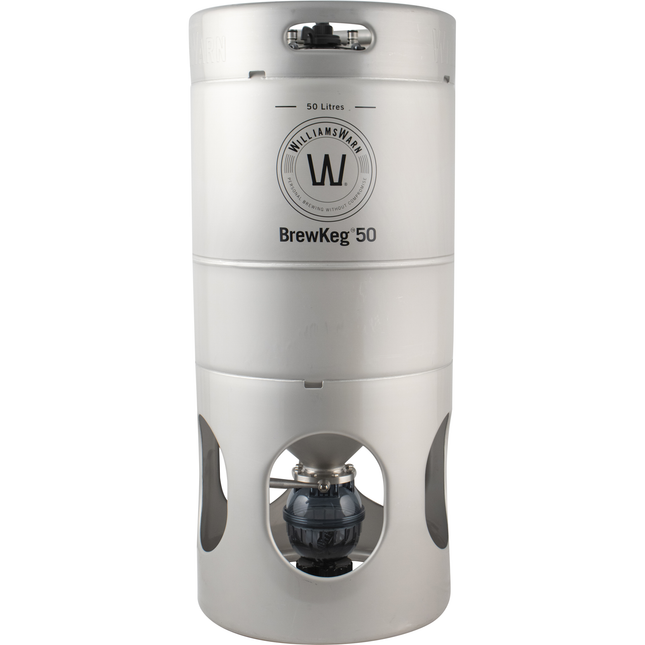
The #1 reason we love the BrewKeg Unitanks is that they eliminate kegging day, which saves a bunch of time. The Brewkeg50 is perfect for a 10-gallon batch, with plenty of headspace for vigorous fermentations. When fermentation is done, crank down the temp, remove the yeast/trub collection ball and start immediately drinking because the beer is already carbonated. Since this is not the standard brewing process, stop and think that over - you don't need a separate night or hours on a weekend morning to clean and keg. You are going to save 2 or more hours with every batch! Plus, you are skipping the most oxidative step in brewing of going from your fermenter to your keg. Yes, the one down side is that your fermenter is tied up as a keg but to many of us who really love brewing our own beer but are time challenged – the sacrifice is totally worth it.
Another great time saving feature is that you can skip wort cooling and 'hot pack' these kegs, literally filling them after boil at around 190°F. Stick them in your refrigerator, let them cool overnight, and pitch yeast the next day. Hot packing is gaining a lot of traction and we suggest you google the term to learn more. It’s been a standard practice in Australian homebrewing for years.
We've been fermenting under pressure for years now with various pressurizable conicals, and if you want to make amazing lagers quickly you need to try it. Fermenting under pressure reduces esters and even beers fermented between 65-80°F have amazing German lager malt profiles. We've fermented a beer under pressure with WLP001 at room temp and all the tasters thought it was lager yeast. The pressure relief assembly, located in the center of the lid, is the slickest out there and adjusts from no pressure up to 25 psi. Leave it open for no pressure fermentations of ales and IPA's where you want the esters. Close it down to make amazing lagers under pressure, quickly.
Features:
Made from stainless steel
Conical base
Extra large, easy to remove sediment ball
Includes stainless steel stand
25 psi working pressure & built in relief valve
40 psi maximum pressure rating
Ferments clean and clear beer from 64-82°F
Beer is carbonated perfectly at the end of fermentation
Beer ready to enjoy sooner
Eliminates kegging
Easy to clean and sanitize
Does not include wheel set pictured in the manual
Dimensions:
Height: 34.7 in.
Diameter: 15.6 in
Actual Volume: 60L (15.85 gal)
Please note: the BrewKeg50 is too tall to fit in one of our kegerators.
The WilliamsWarn Keg Washer is a convenient option for cleaning and rinsing D-Style commercial Sanke kegs. No need to remove the spear from the keg—simply lock the keg washing into the keg as you would a tap coupler, then hook up water or cleaning solution to the 3/4" GHT inlet.
Simple and effective.
If you have a SodaStream CO2 cylinder then you can use this adapter to attach a CO2 regulator to it and avoid having to use those large 5 lb. CO2 tanks.
This adapter also has a side adjustment pin valve into the SodaStream bottle that enables the pin valve to be engaged once the cylinder, adaptor, and regulator have all been screwed together. This ensures that the gas supply from the bottle to the regulator can be engaged and disengaged while everything is screwed in place.
The adapter is incompatible with our Taprite brand regulators.
Get the functionality of a 3 spout gravity filler for a fraction of the price. These fillers are a great alternative to more expensive fillers, while still allowing you to bottle at a quick rate. For a more robust model in Stainless Steel, see our WE602. These 3 spout models have an internal float mechanism to keep the reservoir full. 3 individual nozzles allow for independent filling of bottles.
Wine Cap Puncher - This is an ideal puncher for smaller volume winemaking. Perfect for 20 gallon fermenters.
Our design features a sealed connection where juice cannot travel back up into the handle. We have seen similar models but always passed on selling them because the design had an opening where the 4 metal wires went back into the hollow handle. When juice inevitably did get back up into that space, the punch was done, you could never clean it. Height is 24". Base is 5 3/16" diameter
Rugged punch down tool at a fantastic price. Exterior 1" diameter 304-type stainless tubing is polished to a mirror finish. Bottom disc is 12" in diameter with four large holes to decrease pressure during punch down.
Features
Polished Finish
12" disc made from 10 gauge thick stainless
Capped/Sealed ends for easy cleaning and sanitizing
Constructed from 304-type stainless steel
Actual weight is 7lbs. Shipping weight is calculated at 70 lbs because these ship at FedEx oversize 2 rates.
72" Height
Rugged punch down tool at a fantastic price. Exterior 1" diameter 304-type stainless tubing is polished to a mirror finish. Bottom disc is 12" in diameter with four large holes to decrease pressure during punch down.
Features
Polished Finish
12" disc made from 10 gauge thick stainless
Capped/Sealed end for easy cleaning and sanitizing
Constructed from 304-type stainless steel
Actual weight is 5lbs. Shipping weight is 30lbs as these ship out as a UPS oversize 1 package.
46" Height
These stainless punch-down tools are ideal for punching the cap on a red wine ferment back into solution. Our 48" long punch is great for the home winemaker fermenting in plastic barrels or small stainless fermenters.
48" Long with an 8" Disc. The disc is slightly smaller than our other models making it perfect for punching down in smaller fermentation vats, such as our food-grade garbage can style containers.
Rugged punch down tool at a fantastic price. Exterior 1" diameter 304-type stainless tubing is polished to a mirror finish. Bottom disc is 12" in diameter with four large holes to decrease pressure during punch down.
Features
Polished Finish
12" disc made from 10 gauge thick stainless
Capped/Sealed end for easy cleaning and sanitizing
Constructed from 304-type stainless steel
Actual weight is 6lbs. Shipping weight is calculated at 70lbs because these ship as FedEx oversize 2.
72" Height
Wine Conditioner is a combination sugar/sorbate solution for adding to a fermented wine in order to give it some residual sweetness. The sorbate helps prevent fermentation of the sugar that you are adding. Solution is 76-78° Brix.
Directions: Add to taste, usually up to 125ml (4 oz) per 23L (5 gal) of wine. Wine must be stabilized before adding sweetener.
A custom fabricated 304 stainless steel cooling plate for Macro Bins designed specifically for MoreWine!. The plate hangs in place by the inlet/outlet pipes and is held in the center of your bin. 40" wide x 14.5" tall, yields 0.37 square meters of cooling surface. 1/2 inch MPT threaded inlet and outlet.
Please note that the illustration shown is for demonstration purposes only and is not to scale.
Cool your fermenting must or wine using this weldless, easy-to-install, 304 stainless steel cooling plate that can be inserted into the lid of any Variable Volume Fermenter. Cold water or glycol is recirculated through the cooling plates thereby reducing the temperature of your ferment.
This is a stainless steel setup, ensuring no chance of off-flavor in your wine. You drill two 1-1/16" to 1-1/8" holes into the lid. We provide two gaskets and a lock nut to seal on both sides of your lid, securing the plate in place.
Plate measures 24" H x 10.6" W
Inlet and Outlet 1/2" Male BSPP thread
300 mm long tubes
Bulkheads located approx. 175 mm above the plate
0.36 Square meters of cooling surface
Made from 304 stainless steel
Cool your fermenting must or wine using this weldless, easy-to-install, 304 stainless steel cooling plate that can be inserted into the lid of any Variable Volume Fermenter. Cold water or glycol is recirculated through the cooling plates thereby reducing the temperature of your ferment.
This is a stainless steel setup, ensuring no chance of off-flavor in your wine. You drill two 1-1/16" to 1-1/8" holes into the lid. We provide two gaskets and a lock nut to seal on both sides of your lid, securing the plate in place.
Plate measures 14.5" W x 24" H
Inlet and Outlet 1/2" Male BSPP thread
300 mm long tubes
Bulkheads located approx. 175 mm above the plate
0.48 Square meters of cooling surface
Made from 304 stainless steel
Cool your fermenting must or wine using this weldless, easy-to-install, 304 stainless steel cooling plate that can be inserted into the lid of any Variable Volume Fermenter. Cold water or glycol is recirculated through the cooling plates thereby reducing the temperature of your ferment.
This is a stainless steel setup, ensuring no chance of off-flavor in your wine. You drill two 1-1/16" to 1-1/8" holes into the lid. We provide two gaskets and a lock nut to seal on both sides of your lid, securing the plate in place.
Plate measures 31.5" H x 14.5" W
Inlet and Outlet 1/2" Male BSPP thread
300 mm long tubes
Bulkheads located approx. 175 mm above the plate
0.64 Square meters of cooling surface
Made from 304 stainless steel
Cool your fermenting must or wine using this weldless, easy-to-install, 304 stainless steel cooling plate that can be inserted into the lid of any Variable Volume Fermenter. Cold water or glycol is recirculated through the cooling plates thereby reducing the temperature of your ferment.
By threading our thermowell (FE616) into the extra 1/2" female coupler that comes on every MoreWine Variable Volume Fermenter and inserting the probe from our digital controller (FE610) you can use a digital controller to automatically control temperature. The controller turns a pump on every time the temperature rises above your set-point, sending coolant through the plate.
To build these units we take the stock cooling plates and slide, bored-out, male-threaded couplers half-way down the feed tubes and weld them in place. You drill two 1 1/16 to 1 1/8" holes into the lid. We provide two gaskets and nuts that thread on both sides of the couplers securing the plate in place.
Plate measures 22.5"W x 47.5"H
Inlet and Outlet 1/2" Male BSPP thread
300 mm long tubes
Bulkheads located approx. 175 mm above the plate
1.44 Square meters of cooling surface
Made from 304 stainless steel
#8 agglomerated corks are slightly smaller than the standard #9 corks. They are often used with hand corkers that cannot compress the standard #9's, or for bottles with smaller necks. Agglomerated corks are made from small cork pieces held together with a food grade binder.
Corks are treated with a food grade wax and silicone coating before being packaged by the manufacturer. To use, corks may be dipped briefly in a sanitizer solution and then corked immediately. Do not soak or boil corks as this can remove the silicone coating, making them difficult to remove from the bottles.