
Wine
Shop by collection
-


EasyDens Protection Cover | Anton Paar
Our EasyDens Protection Cover keeps your EasyDens safe and clean. Silicone cover which perfectly fits the EasyDens (Gen 2 / MT751).
$43.99
-


Wine Corks - Aglica
Due to high demand, the package of 1,00- is currently out of stock. Be the first to receive your items by placing a pre-order today. We will automatically ship this to you when we receive more inventory. An agglomerated cork that offers a great seal using compressed pieces of small cork. Fantastic value. Because they do not compress as easy as natural corks, you will need a floor corker, as opposed to a handcorker, to push these into the bottles.
$6.99 - $219.99
-


Farro Glass | Premium Wine Bottles | Bellissima | Clear | 375mL | Case of 12
A slim, elegant bottle design ideal for dessert wines and ice wines Bellissima bottles are typically made in smaller volumes to package wines that are consumed in smaller pours Clear or "flint" glass is most often used for white wines that will be consumed shortly after bottling with little to no ageing The clear glass is an excellent choice for rosé wine to show off the alluring color of the beverage Farro Glass offers a full lineup of the most essential and commonly used bottles in winemaking Bellissima wine bottles are most commonly used for dessert wines and ice wines. The slim design lends an elegant appearance when this bottle appears at the end of your meal. They are typically half the volume of standard bottles, as a Bellissima's contents are often pricey and consumed in smaller pours. Volume: 375 mL Style: Bellissima Use: Sweet Red, Dessert Wine Color: Flint / Clear Finish: Cork Bottom: Punted Case QTY: 12 Pallet QTY: 150 cases Our Farro Glass Wine Bottles offers a full lineup of the most essential and commonly used bottles in winemaking. We scoured the world to find a bottle source that could provide a quality product consistently and at a fair price that we can pass on to our customers. If you've been searching for reasonably priced bottles that are reliably in stock, look no further.
$23.99 - $2,950.99
-


Aroma Sciences | French Oak Barrel Liquid Extract | Medium Toast | Natural Evaporated Oak Extract
Impart a perfect replication of barrel aromatics without the lengthy process of barrel aging Consistent, repeatable results every time without the need to blend various barrels of product together Infuse oak aromatics into beer in minutes. Safe for use with low alcohol beers as there's no risk of infection that comes from barrel aging beer below 12% ABV Increase the perceived quality of your wine without drastically increasing cost or production time Eliminate the expensive, compounding loss of the "Angel's Share"—spirits typically lose 5-10% of their volume in barrels due to evaporation French Oak extract is subtle and complex with exotic savory spice and hints of dark chocolate and roasted coffee. Mellow spice notes with a smooth mocha and toffee finish. Aroma Science's internationally-patented Evaporative Extraction™ technology naturally captures complex aromatics from wine and whiskey barrels to create aroma profiles that are perfect copies of the original barrel source. Use to balance and boost oak aroma in beer, wine, spirits, ciders, seltzers, and traditional, reduced proofed, and nonalcoholic ready-to-drink cocktails. Typical recommended dosing in beer & wine is approximately 1.5-6 mL per gallon and anywhere from 6-60 mL per gallon with spirits. See AromaSciences.com for detailed dosing recommendations for Beer, Wine, and Spirits. Ingredients: Ethanol, Water, Oak Made in the USA
$18.99 - $244.99
-


D80 Dry Wine Yeast
ICV-D80 was isolated by Dominique Delteil of the ICV in 1992 from the Cote Rotie area of the Rhone Valley. In addition to its' ability to enhance tannin structure, it's know for being able to ferment musts high in sugar and polyphenols. With proper nutrition, aeration and fermentation temperatures below 82 degrees F, ICV-D80 will ferment up to 16% alcohol. ICV-D80 brings high fore-mouth volume, big mid-palate mouthfeel and intense fine grain tannin to reds. It is one of the best strains for contributing big tannin volume in a blend. ICV-D80 is characterized by concentrated, dark fruit, smoke and a licorice finish. When blended with wines fermented with ICV-D254 or Syrah, wines fermented with ICV-D80 bring more tannin intensity to the blend. In short, this yeast is truly great for the structural support it can bring to a wine. However, if the winemaker is looking for highlighted fruit and ethereal top-notes as well, it often may not be the best choice when using a single strain in the vintage. Therefore, it may help to think of it as usually needing a companion strain to help bring everything to a finished wine. Renowned for its ability to enhance tannin structure. Produces flavors of dark fruit, smoke, and licorice. Perfect for reds grown in warmer climates or at lower elevations that need more backbone. High alcohol tolerance to 16%. Use 1 gram per gallon. Download the PDF Download the PDF
$3.19 - $67.19
-


Italian Amarone Style Wine Making Kit - VineCo Signature Series™
Italian Amarone Style offers a complex flavor profile and delicious oak character Savor with hearty meals or as an after-dinner treat Flavors of tart cherry, raspberry, chocolate, and spice Full-bodied and dry, 14% ABV Whip up a batch in 30 mins or less! Yields 6 gallons (2 cases) of finished wine in 6-8 weeks Premium kit includes grape skins for an authentic wine making experience Bottle labels included for a professional finish Amarone style red wine hails from Valpolicella in the Veneto region of north-eastern Italy. Traditionally, Amarone is made from only three approved grape varieties—Corvina, Corvinone, and Rondinella. To prepare the grapes, winemakers use a process known as ‘apassimento’, an Italian term for drying the harvested grapes for up to several months to concentrate the sugars and flavor. Amarone is known for its full-body, strong flavor, and high alcohol percentage. Some speculate Amarone’s creation to date back to Ancient Rome, as this powerful red would have slaked the Roman’s thirst for highly alcoholic wine. Our Italian Amarone Style has a deep red fruit quality with notes of tart cherry and raspberry, a hint of chocolate and spice, with a moderate oak character. Standing tall at 14% alcohol by volume, this full-bodied wine is quite dry with a long lingering finish. The Signature Series™ Amarone Style is one of the most satisfying kits to make thanks to the inclusion of grape skins. You’ll mirror the professional vintner process of “punching the cap”, which makes your winemaking adventure even more hands on. VineCo’s jammy skin packs are much more expressive than dried grape skins, imparting more character from the grapes and boosting tannin structure in the finished wine. High quality French oak cubes are used in the making of the Amarone Style kit. One of the reasons oak has always been used to age wine is the slow release of delicious, complex compounds that complement the wines flavor. Oak cubes have more depth of flavor than chips or powder and slowly release compounds like furfural (sweet, caramel like), lignins (vanillin, spice, smoke), and lactones (classic oak flavor). French oak in particular is known to deliver refined, less apparent oakiness than American oak. It's famous for adding mouthfeel and flavors of custard and chocolate while still allowing the fruit flavors of the wine to shine through. The Vineco Signature Amarone Style is best enjoyed over a hearty meal of red steak or venison with good company, or as an after-dinner treat paired with heartfelt conversation with that special someone. Not to be poured on any occasion, but savored as a delicious moment. Amarone Style, Italy Tart cherry, raspberry, hint of chocolate and spice Sweetness: Dry Oak: Medium Body: Full ABV: 14% Kit Volume: 14 L Approximate Yield: 23 L Ready to bottle in 6-8 weeks Grape skins included Bottle labels included
$182.99
-

Wine Corks - Synthetic Supercorks - 23x38 (100ct)
A synthetic cork with the ability to last 4 years plus. Supercorks are manufactured in Italy by Enolandia. One of the very first companies to make a synthetic cork, they have a history of quality since the 1980's. Supercorks have been tested to keep their elasticity and sealing integrity for at least four years. This makes them a nice alternative for winemakers who want to eliminate the potential issues of porosity or TCA contamination inherent in cheaper natural corks but also want the ability to age wine more than a few years. This cork measures 23x38mm. Product Specifications: Construction: Manufactured from recyclable thermoplastic high-tech materials Chemical details: Polietilene, Food pigments, Food expanders. Lubrication: Silico-paraffinic solution. No solvents. Preservation: Corks should be kept away from any possible contact with liquids and odors. Keep at temperature of 18-25° C especially in the summer season. Certification: Corks comply with antitoxic certificates from public authorities. Meets european standards and FDA. Follows CEE directive 85/572-89/109-90/128.
$23.99
-


Rhone 4600 Dry Wine Yeast
Rhone 4600 is a Cote du Rhone isolate that has a short lag phase, low nutrient demand, and has the ability to ferment well at low temperatures. Due to its' high level of polysaccharide production, Rhone 4600 contributes intense mouthfeel and volume to a finished wine. In addition, Rhone 4600 helps create complex aromatic notes along with a high degree of ester production. In whites like Viognier, Marsanne, Roussane, and Chardonnay there is an emphases on pineapple, pear, and apple. When used in Roses made from Mouvedre, Grenache and Syrah, intense, elegant, fresh strawberry becomes the focus. While Rhone 4600 is good for white wine production, it is an excellent yeast for making Roses either by itself or as part of a blend. Best results from 56 to 72 degrees F, with an alcohol tolerance to 15%. Download the PDF Download the PDF
$2.99 - $63.99
-

Heat Shrink Sleeves - Matte Red
These PVC heat shrink capsules help to make your home made wine look classy and professional. The look is the closest we have seen to commercially used tin capsules, which must be spun on with a $2,000 machine. Conversely, these PVC capsules can be easily used at home. Features horizontal tear tab. To use, slide on to top of wine bottle and dip into hot water for a quick and even shrink. Or for faster processing with a more reliable finish try one of our Heat Shrink tools. 2 1/4" Height x 1 1/4" Diameter.
$1.79 - $59.99
-

Viniflora® CH35 | Dry Malolactic Bacteria | 1.5 g
Selected and adapted especially for direct inoculation of rose and white wines Strong fermenter under harsh white wine conditions Direct inoculation, freeze-dried bacteria – does not require rehydration High numbers of active cells which ensure a quick start of fermentation Good for 66 gallons Viniflora CH35 is a freeze-dried culture of Oenococcus oeni. This malolactic bacteria has been selected and adapted especially for direct inoculation of rose and white wines. Viniflora CH35 has been selected for its outstanding performance in malolactic fermentation of difficult white wines. This strain is the perfect match for rose and white wines but can also be used with success in red wines. Application: Viniflora CH35 should be added to dry wine, right after the alcoholic fermentation. No rehydration or reactivation is required. For more information about ML Bacteria, please see MoreWine!'s Guide to Malolactic Fermentation. Characteristics: Outstanding tolerance to low pH and elevated levels of SO2 (down to pH 3.0 and up to 50ppm!) Strong fermenter under harsh white wine conditions Clean and fruity flavor profile No production of biogenic amines High inoculation level encourages a completed malolactic fermentation 14% alcohol tolerance Key Features: Recommended for white wines Direct inoculation, freeze-dried bacteria – does not require rehydration High numbers of active cells which ensure a quick start of fermentation This strain is pH tolerant to 3.0, Total SO2 to 45 ppm (white wines), temperature 59 – 77 ͦF and alcohol to 14% (v/v) Low level of volatile acidity Cinnamoyl Esterase Negative
$34.99
-

Tannin Riche Extra
This product replaces our TAN140 - Tannin Plus Enological tannins offer the winemaker the possibility to add refined, highly-bindable tannin to your wine at any stage during the process. Benefits can include increased structure and mouthfeel, color stabilization, stability, anti-oxidative qualities, and overall complexity. Tannins can reduce vegetal/herbaceous characteristics and perceived astringency. We offer four types of oenolgical tannins, two for use during fermentation, and two for use during the aging phase. Aging Tannins Tannin Riche Extra is a preparation of 100% American oak tannin that has been lightly toasted to impart a soft, aromatic character while enhancing the structure and organoleptic complexity of a wine. Tannin Riche Extra is a great tool for imparting hints of coconut, a heightened vanillin oak character and a smooth finish to your wines. Although designed for fine-tuning a wine, Tannin Riche Extra still maintains the regular properties associated with the use of tannins such as helping with clarification, stability, oxidation, and aging. Works well in conjunction with low doses of other tannins (i.e: Tannin Complex & FT Blanc Soft). To Use: Dissolve the tannin in 10 times its weight in warm water (95F/35C). Add to the wine during a punch-down or pump-over for good mixing. Addition of Tannin Plus should be made a minimum of three weeks before bottling. Recommended dosage: 0.2-0.4 g/gal A rough approximate of weight is 3/4 tsp = 1 gram. We highly recommend using a scale to weigh the product for an accurate dose. We do not recommend relying on these rough conversions for accurate dosage rates.
$4.99 - $293.99
-

Bottle Labels - Wine - Pack of 32
Create your own custom labels for your special homemade wines! With these unprinted sheets of adhesive labels you can easily create your own custom wine labels. The pre-cut labels come on 8-1/2 x 11"" sheets. You can download printing templates that will define the edges of the labels (as a table) so you can make your custom design fit the label. Once you’ve created your own design you print the labels with either inkjet or laser printer. The special adhesive will stay on while wet and during aging, but can easily be peeled off for reusing bottles. Wine labels come 4 per sheet, 8 sheets per pack, for a total of 32 labels. Blank templates for download: MS Word (.doc) PDF (.pdf)
$6.99
-


Sodium Hydroxide (0.1 N)
Replacement Sodium Hydroxide for the CellarScience® Acid Test Kit (W501CS) or any other acid test kit which uses 0.1N Sodium Hydroxide. Please Note: This Sodium Hydroxide is 10x stronger than the MT110 product that is used with our MT140 Aeration Oxidation SO2 Test Kit. They are not interchangeable.
$5.59 - $19.99
-


Lallemand UVAFERM 43® | Dry Wine Yeast
UVAFERM 43 is the yeast of choice for winemakers aiming to produce powerful, structured red wines with deep color and bold flavor Its resilience under challenging fermentation conditions ensures complete fermentation, making it an invaluable tool in both standard and difficult winemaking scenarios Enhance fermentation power and structure in bold red wines UVAFERM 43 is a robust wine yeast strain, selected for its exceptional ability to ferment under challenging conditions. Its fructophilic nature makes it particularly effective in high-sugar musts, ensuring complete fermentation even when fructose concentrations are elevated. This strain is ideal for crafting full-bodied red wines, offering enhanced color extraction, tannin structure, and aromatic intensity. High Alcohol Tolerance: Capable of fermenting up to 18% ABV, suitable for high-sugar musts. Temperature Resilience: Operates effectively between 55°F (13°C) and 95°F (35°C), accommodating a wide range of fermentation environments. Fructophilic Fermentation: Efficiently ferments musts with high fructose content, common in late-harvest or overripe grapes. Enhanced Color and Tannin Extraction: Promotes the extraction of anthocyanins and polyphenols, contributing to vibrant color and structured mouthfeel. Low Nutrient Requirements: Performs well with minimal nitrogen supplementation, reducing the risk of sluggish fermentation. Applications: Full-Bodied Red Wines: Optimal for varietals like Cabernet Sauvignon, Syrah, Zinfandel, and Malbec, enhancing body and color stability. Fortified Wines: Suitable for Port-style and Amarone-style wines, supporting high alcohol levels. Warm Climate Fermentations: Excels in hot climates where fermentation temperatures are elevated. Stuck Fermentation Recovery: Effective in restarting difficult or stuck fermentations due to its high heat and alcohol tolerance. Flavor Profile: Dark Fruit Intensity: Emphasizes bold notes of blackberry, black cherry, and plum. Spice and Earthiness: Introduces subtle layers of black pepper, cocoa, and leather for added complexity. Smooth Tannin Structure: Develops well-rounded tannins, contributing to a balanced mouthfeel. Deep Color Stability: Supports anthocyanin preservation, resulting in rich, vibrant hues. Usage: Rehydration: Rehydrate in 10 times its weight of chlorine-free water at 104°F (40°C) for 15–20 minutes. Stir gently to avoid clumping. Pitch Rate: Use 1–1.5 grams per gallon (0.25–0.4 grams per liter) for optimal fermentation and color development. Nutrient Addition: Supplement with yeast nutrient to optimize fermentation strength, especially in high-Brix musts. Fermentation Temperature: Maintain between 55°F and 95°F to maximize aromatic expression and color stability. Extended Maceration: Suitable for long maceration periods to deepen color and enhance tannin structure. Download the PDF Download the PDF
$2.99 - $796.99
-


Cabernet Sauvignon Style Wine Making Kit - On The House™
On The House winemaking kits are the perfect introduction to creating your very own wine at home. Each kit contains all the ingredients you’ll need with easy-to-follow instructions that will guide you through the whole process from start to finish. Designed with beginners in mind so that anyone can make something they’ll be proud to share with friends and family. Simple and straightforward, On The House offers a full range of red, white, and blush style wines. You’ll be well on your way to sipping your very own house wine in only 4 weeks! Cabernet Sauvignon Style is a medium-bodied wine, brimming with black fruit flavors that are accentuated by a moderate oak presence. A dry red wine with an alcohol level of 11.5% by volume. Cabernet Sauvignon Style Black fruit Sweetness: Dry Oak: Medium Body: Medium ABV: 11.5% Kit Volume: 6 L Approximate Yield: 23 L Ready to bottle in 4 weeks
$74.99
-


California White Wine Making Kit - On The House™
On The House winemaking kits are the perfect introduction to creating your very own wine at home. Each kit contains all the ingredients you’ll need with easy-to-follow instructions that will guide you through the whole process from start to finish. Designed with beginners in mind so that anyone can make something they’ll be proud to share with friends and family. Simple and straightforward, On The House offers a full range of red, white, and blush style wines. You’ll be well on your way to sipping your very own house wine in only 4 weeks! California White is like an orchard in a bottle with lucious flavors of apple and stone fruit. This dry white wine has a light-medium body, zero oak character, and an alcohol level of 11.5% by volume. California White Apple, stone fruit Sweetness: Dry Oak: None Body: Light-Medium ABV: 11.5% Kit Volume: 6 L Approximate Yield: 23 L Ready to bottle in 4 weeks
$61.99
-


Sangiovese Wine Making Kit | VineCo Original Series™
Italiano to its core, Sangiovese is descended from Calabrese di Montenuovo and Ciliegiolo, the former from the south in Calabria and the latter from the north in Tuscany. Not only is it Italy’s most famous grape, when it comes to truly great varietal wine, the country has something of a monopoly. The greatest examples of Sangiovese are remarkably complex, savory, and rustic. A popular choice in creating magnificent blends, in addition to single-grape varietals, Sangiovese is used in the production of the most celebrated red wines to come from Tuscany, including Brunello di Montalcino and Vino Nobile di Montepulciano. Our Sangiovese is a medium-bodied wine that displays notes of sour cherry, strawberry, and prune. A dry red wine with delicate oak character and an alcohol content of 13% by volume. This wine kit includes medium toast French oak chips. Medium toast French oak is subtle and provides refined flavors of custard, chocolate, and spice. French oak in general is often used by winemakers when they want to increase the mouthfeel and complexity of a wine without stepping on or surpressing the fruit. The VineCo Original Sangiovese is a fantastic way to sample and celebrate Italian winemaking. It’s a great option when you want a glass of red that you can sit back with to sip and savor, letting its personality slowly unfold across your tongue with each taste. Options abound for meals to enjoy with Sangiovese, but pasta with tomato sauce is the easiest (if not most obvious) dish to recommend. Sangiovese Sour cherry, strawberry, prune Sweetness: Dry Oak: Light Body: Medium ABV: 13% Kit Volume: 7.5 L Approximate Yield: 23 L Ready to bottle in 4 weeks
$97.99
-

Lallemand | Enoferm Alpha™ | Dry Malolactic Bacteria
Enoferm Alpha will ferment at lower temperatures and at lower pH levels compared to older Viniflora strains of Oenococcus Oeni Alpha was selected as dominant strain that has the capcity to achieve reliable MLF and improve wine complexity This strain will help contribute to mouthfeel while lowering the perception of green and vegetative flavors Lallemand Oenology specializes in the development, production, and marketing of top-grade yeast and bacteria This was the first improved ML strain that we carried and still the most popular. When compared with the older Viniflora strains of Oenococcus Oeni, Enoferm Alpha (which is a different strain of Oenoccoccus Oeni) will ferment at lower temperatures and at lower pH levels. This means it is superior for both red and white wines and can be added later in the wine making process than the Viniflora strain, with the ideal time being right after the completion of primary fermentation. In addition to good performance in harsh conditions, Enoferm Alpha was preferred in blind tastings over the older Viniflora strain for its clean and fruity aromas, a decrease of vegetative and herbaceous notes and increased mouth-feel. Now we are selling multiple strains of improved ML bacteria including Beta, VP41, 31, and Baccus, giving you lots great bugs to choose from. Alpha was selected as dominant strain that has the capcity to achieve reliable MLF and improve wine complexity. Alpha will help contribute to mouthfeel while lowering the perception of green and vegetative flavors. Its low production of biogenic amines respects health concerns. For more information about ML Bacteria, please see MoreWine!'s Guide to Malolactic Fermentation. 2.5 g: good for 66 gallons 25 g: good for 660 gallons Alcohol tolerance: <15.5% v/v. SO2 tolerance: <50 ppm pH: >3.2 Temperature: >57°F You can't store malolactic bacteria once the package has been opened. Note: Malolactic bacteria added during the ferment will compete with the yeast for nutrients and are atagonistic to yeast, potentially causing higher VA levels. The best time to add an ML culture is after racking off the gross lees.
$39.99 - $172.99
-


Cabernet Sauvignon Wine Making Kit | VineCo Original Series™
The world’s superlative winemaking grape, Cabernet Sauvignon is capable of producing the most complex, well-balanced, and lasting red wines you’ll ever come across. As one of the most tannic grapes used in winemaking, Cabernet Sauvignon has long been misunderstood as a wine that required ageing in order for it to develop and soften. But after decades of research, growers have learned to identify when the grapes are ready to be harvested based on the tannic ripeness, rather than sugar content alone. Although these wines are ideal candidates for ageing—and will develop beautifully when laid down—it is well within reach for winemakers to produce excellent, structured Cabernet Sauvignons that are well-enjoyed while they’re still young. Descended from Cabernet Franc and Sauvignon Blanc, this relatively young grape is believed to have sprouted up from a chance crossing in the 17th century. Regardless, Cabernet Sauvignon is now the most widely planted wine grape in the world. The VineCo Original Cabernet Sauvignon is a must for any red wine lover. Add a few bottles to your cellar and revisit over the months and years to see just how much the wine can develop. If you want something to pair well with a char-grilled steak, look no further than this bold, assertive varietal. Cabernet Sauvignon Blackberry, black raspberry and cedar Sweetness: Dry Oak: Medium Body: Medium-Full ABV: 12.5% Kit Volume: 7.5 L Approximate Yield: 23 L Ready to bottle in 4 weeks Bottle Labels sold separately
$97.99
-

Xoakers French Oak - Medium Plus Toast
Xoakers are 1" Solid Oak spheres made from high quality French oak and seasoned for a minimum of 24 months. They will contribute a complex oak character while softening and rounding the wine as well. What sets these apart though, are their shape and ease of use. The uniform size allows for precise dosing, and easy removal once complete. Whether you are using carboys or neutral barrels, additions are as simple as counting out however many Xoakers you need, and tossing them in. Every vessel will be oaked to the same extent when using these, and no need to weigh them out! Removing them is as simple as turning over your carboy or barrel, and watching them roll out! These can be used in both red and white wines, and are perfect for carboys, barrels, small tanks, and kegs. Ideal oak for the home winemaker! These Convection Toasted Medium Plus French Oak Xoakers are packed in Mylar bags, and will contribute various flavors depending on the wine. The 8 pack will treat 4-8 gallons & 1 lb will treat 35-70 gallons. Dosage: 1-2 Xoakers / Gallon (3.78 L) wine (depends on desired Oak Impact) Contact Time: 4 Month Minimum Recommended Useful Life in Wine: 12 Months Size: 1" Diameter Spheres, 70 French Oak Xoakers / lb Liquid Displacement: .10 gal (.41 L) Toast Level: Med +
$9.49 - $69.99
-


Lallzyme C-Max |
Enhances clarification and static settling of white and rosé musts under extreme conditions Active and fast depectinisation at low temperature, low pH, or high total pectin content Produces rapid, compact lees and improves juice quality consistently Requires lower dosage for effective results compared to standard enzymes Cinnamyl-esterase-free pectinase blend minimizes ethylphenol precursor release Lallzyme C-MAX™ is a micro-granulated pectolytic enzyme derived from Aspergillus niger, formulated for use in white and rosé wine production where settling conditions may be difficult. With high activities of pectin lyase, pectin methyl esterase, and polygalacturonase, it provides fast, efficient breakdown of pectin, even at low temperatures (as low as 8 °C / 46 °F) or low pH. Its action reduces must viscosity, speeds up clarification, and generates compact, easy-to-rack lees. Because it contains no cinnamyl esterase, Lallzyme C-MAX™ also limits the formation of ethylphenol precursors, contributing to cleaner, more varietally expressive wines. Protocol for Use: Add after pressing or directly into the settling tank. Dilute the enzyme in 10 times its weight in water or juice before use. Mix thoroughly for uniform distribution. Do not add bentonite during enzyme treatment. Clarification typically completes within 24 hours depending on temperature and juice conditions. Usage Rates: Standard conditions (>12 °C / 54 °F): 0.5–1.0 g/hL = 0.005–0.01 g/L = 0.019–0.038 g/gal Cold or high-pectin conditions (8–12 °C / 46–54 °F): 1.0–2.0 g/hL = 0.01–0.02 g/L = 0.038–0.076 g/gal Store in original sealed packaging at 5–15 °C (41–59 °F) in a dry place. Suitable for organic and vegan wine production.
$2.89 - $134.99
-

Brix Hydrometer (0 to 12) With Correction Scale
Narrow range brix hydrometer that allows for highly accurate measurement. These hydrometers are excellent for use in the middle and towards the end of wine fermentation. It features a built-in thermometer and correction scale for temperature correction of the reading. Thermometer measures a range of 30-150 F (0-50 C) with 1 degree resolution. These brix hydrometers are calibrated at 68 F (20 C).
$59.99
-


WineStix - Medium Toast French Oak Carboy 2 Pack
WineStix are a new form of oak integration for wine, designed to give new barrel flavors with an extraction time similar to cubes. The combination of Short and Long grains result in amazing gradience of flavor similar to barrels, while extracting significantly quicker! These are Medium toast French Oak staves, and depending on the wine, will impart flavors of vanilla and coffee, while clearing out negative vegetal flavors and astringency from the wine. This is a two pack of WineStix, sized specifically for a 5-6 gallon carboy of wine. WineStix will easily fit through the mouth of a glass carboy, and can be attached to a string via the drilled hole for easy removal! One carboy Winestix will treat 5-6 gallons of wine.
$15.99
-


Lallemand ENOFERM Syrah™ | Dry Wine Yeast
Syrah is the perfect choice for winemakers aiming to craft powerful, structured red wines with bold fruit expression and deep color stability Whether perfecting a Syrah/Shiraz, boosting the intensity of Cabernet Sauvignon, or refining a GSM blend, Syrah Yeast delivers exceptional flavor, structure, and age-worthiness in every batch Bold structure and intense aromatics for rich, full-bodied reds Syrah is a specialized wine yeast strain meticulously selected to bring out the bold structure and vibrant aromatics characteristic of Syrah and other robust red wines. Renowned for its ability to enhance color stability, deepen tannin integration, and highlight dark fruit notes, Syrah Yeast is the ideal choice for crafting powerful, age-worthy wines. Its controlled fermentation kinetics ensure balanced attenuation, minimizing off-flavors while preserving the wine’s natural complexity. Enhanced Color Stability: Promotes deep anthocyanin extraction for rich, lasting color. Tannin Development: Integrates structured tannins for a smooth, full-bodied mouthfeel. Alcohol Tolerance: Effective up to 16% ABV, supporting the creation of high-alcohol red wines. Temperature Range: Optimally ferments between 64°F (18°C) and 86°F (30°C), allowing for full expression of bold flavors. High Flocculation: Contributes to clarity and stability post-fermentation. Low SO₂ Production: Preserves fruit purity and aromatic intensity. Applications Syrah/Shiraz: Elevates bold black fruit flavors, peppery spice, and deep color. Cabernet Sauvignon: Enhances structure and tannin integration for age-worthy complexity. Grenache: Promotes ripe berry notes with smooth tannins. Malbec: Boosts dark fruit intensity and earthy undertones. Blended Reds: Perfect for GSM (Grenache, Syrah, Mourvèdre) blends, enhancing body and color. Flavor Profile Dark Fruits: Prominent expressions of blackberry, plum, and dark cherry. Spice and Earthiness: Accentuates hints of black pepper, leather, and subtle tobacco. Full-Bodied Mouthfeel: Enhances the structure and richness of the wine. Aging Potential: Supports long-term aging, improving depth and complexity with time. Usage Rehydration: Rehydrate in 10 times its weight of chlorine-free water at 95°F (35°C) for 15–20 minutes. Stir gently to prevent clumping. Pitch Rate: Use 1–1.5 grams per gallon (0.25–0.4 grams per liter) for optimal fermentation and tannin development. Nutrient Addition: Supplement with yeast nutrients, particularly in high-sugar musts, to ensure complete fermentation. Fermentation Temperature: Maintain between 64°F and 86°F for optimal color extraction and structured tannin formation. Extended Maceration: Ideal for long fermentations to deepen color and enhance tannin complexity. Download the PDF Download the PDF
$3.19 - $859.99
-


GRE Dry Wine Yeast
For easy-to-drink Rhone style wines. This versatile strain is suitable for reds, roses and whites. In red wines, it contributes up front fruit to easy-to-drink Rhone style wines, often with a nice spicy quality if present in the fruit. ICV-GRE can also be effectively used with short skin contact regimes (3 to 5 days) to reduce vegetal and undesirable sulfur components in varietals like Merlot, Cabernet, Grenache and Syrah. In addition to bringing fresh, ripe fruit qualities, ICV-GRE also helps to enhance the mouthfeel of a wine. While it may not be a powerhouse in itself, this yeast truly excels at being able to keep a red wine blend from potentially becoming too heavy and pedestrian. When used in fruit focused whites like Chenin blanc, Riesling, and Viognier, ICV-GRE results in stable fresh fruit characteristics and delivers a big fore-mouth impact. Alcohol tolerant to 15%, best results from 59 to 82 degrees F. Download the PDF Download the PDF
$2.99 - $63.99
-


Chardonnay Wine Making Kit | VineCo Original Series™
Originating in the Burgundy region of France, in such famous appellations as Montrachet, Meursault, Poilly-Fuisse and Chablis, Chardonnay is now the most popular white wine style in the world. Chardonnay thrives in a wide range of soils and weather climates from France to Australia. Winemakers love Chardonnay because it produces such a wide range of complex, flavorful wines. From fruit forward and crisp, to lean and minerally, to hedonistic, rich, and oaky, no wine sparks as much stylistic debate as Chardonnay. Our Chardonnay has highly expressive tree fruit flavors of green apple, pear and apricot with no oak character. With an alcohol level of 12.5% this Chardonnay features a dry finish and medium body. The VineCo Original Chardonnay is the perfect everyday wine to unwind with after work. There is something calming about a glass of this shimmering gold liquid resting on your kitchen counter while you make dinner. Or pull a cork at the next weekend BBQ and share with friends. It’s always time for Chardonnay. Chardonnay Green apple, pear, and apricot Sweetness: Dry Oak: None Body: Medium ABV: 12.5% Kit Volume: 7.5 L Approximate Yield: 23 L Ready to bottle in 4 weeks Bottle Labels sold separately
$90.99
-


Pinot Grigio Style Wine Making Kit - On The House™
On The House winemaking kits are the perfect introduction to creating your very own wine at home. Each kit contains all the ingredients you’ll need with easy-to-follow instructions that will guide you through the whole process from start to finish. Designed with beginners in mind so that anyone can make something they’ll be proud to share with friends and family. Simple and straightforward, On The House offers a full range of red, white, and blush style wines. You’ll be well on your way to sipping your very own house wine in only 4 weeks! Pinot Grigio Style is a light-bodied wine with refreshing flavors of green apple and citrus. A dry white wine with no oak character and an alcohol level of 11.5% by volume. Pinot Grigio Style Green apple, citrus Sweetness: Dry Oak: None Body: Light ABV: 11.5% Kit Volume: 6 L Approximate Yield: 23 L Ready to bottle in 4 weeks
$69.99
-


CellarScience® LiquiBody | Liquid Gum Arabic | Adds Perceived Sweetness and Mouthfeel | Helps Lock In Color
Adds mouthfeel and body to wines, seltzers, ciders, etc. Adds perceived sweetness without the concerns of adding residual sugar Helps lock in color by keeping anthocyanins in suspension in red wines Reduces the formation of tartrate crystals in white wine Makes bubbles in sparkling wine rise slower enhancing the appearance LiquiBody by CellarScience is a specialized, pre-liquefied Gum Arabic preparation that adds body and perceived sweetness while stabilizing color and smoothing tannic astringency. LiquiBody is made from high molecular weight polysaccharides which adds the perception of sweetness without having to stabilize residual sugar in your wine. The ability to add body and a little perceived sweetness has many applications. LiquiBody helps keep anthocyanin color compounds in solution, preventing them from precipitating out in the bottle. It is also particularly useful to help keep tartrates in solution when cold stabilization of white wine is not possible. Popular Uses LiquiBody works really well in hard seltzers to add body and a slight sweetness. LiquiBody is added to sparkling wines to improve mouthfeel while increasing the appearance and fineness of the bubbles. Add perceived sweetness to any wine in your lineup to appeal to a larger portion of the population. Filtering Add after rough filtration is finished and before or after sterile filtration. LiquiBody is suitable for use with a sterile membrane filter if your wine is very clean and you have prefiltered. If your wine is not prefiltered, and you already suspect you may have issues with sterile filtration, do not use LiquiBody. Dosage: LiquiBody is stabilized with potassium bisulfite which will add less than 1 ppm of SO2 into your final wine. Use: Add 0.75 to 5 mL per gallon. Perform bench trials to determine optimal usage or start with a dosage of 2 mL per gallon and adjust as needed on future batches. Works best at a temperature range between 50-68ºF and a pH of 4 to 5.5. Additional Notes: Once opened, partial bottles of LiquiBody should be refrigerated and used within 30 days. If a container is left open for longer than the suggested use, you can add 1000 ppm of SO2 to extend its life span.
$1.99 - $64.99
-


EasyDens & SmartRef Combo | Anton Paar
Our take on unlocking the additional readings when used together: In addition to the individual benefits and readings that both machines offer, the EasyDens and SmartRef can be used together to gain the addtional following measurements in finished beer or wine. These measurements do not require that you have an upfront original measurements. Beer: Alcohol by volume, Alcohol by weight, Final Gravity, Original Gravity (wow), and Real Extract Wine: Alchol by volume and Residual Sugar (very cool) The EasyDens and SmartRef device can now be used together to provide additional measurement parameters Determines alcohol content using density and refractive index measurements Quick results in under 5 seconds Determiniation of wort extract content Fermentation tracking and visualization Automatic temperature correction (ATC) Precise alcohol content determination (0.5% v/v) Unlimted ABV measurements with app subscription Measure finished beer and receive results for: ABV Real extract Original gravity Final gravity Suitable for standard and strong beer New App Features & Updates: Sync all data to the cloud Unlimited ABV measurements with an app account Wine Meister Alcohol & Total Extract in Wine: Get direct results in fermenting or finished kombucha Barcode: Assign measurement data via barcode scan to a batch Residual Sugar Calculator Brew Meister Alcohol in Kombucha: Get direct results in fermenting or finished kombucha Lab Meister TDS%: Using the SmartRef it is possible to measure TDS% in coffee Extract yield of coffee: A calculator is available that lets you calculate the extract yield for the different types Percolation brewing method (eg. Espresso, V60) Immersion brewing method (eg. French press) Mixed phases methods (eg. Aeropress) New measurement units: Now SmartRef support 40+ measurement units New Languages Now supported: English, German, French, Italian, Czech, Portuguese, Turkish, Chinese, Japanese, Spanish Direct ABV determination with the EasyDens & SmartRef Combo Beer: alcohol content (±0.5 %v/v), real extract (±0.2 %w/w), original gravity (±0.8 %w/w) and total extract (±2.0 g/L) Wine: alcohol content (±0.5 %v/v for wines up to 15% and ±1.0 %v/v for wines from 15 to 20 %v/v) Kombucha: alcohol content (±0.5 %v/v) Liquor: alcohol content (±0.5 %v/v) Application specific in-app calculators Beer: color calculator, refractometer brix correction, ABV (OG/FG) calculator, converter for gravity, temperature & more Wine & Fruits: brix acid correction, residual sugar calculator, converter for gravity, temperature & more Coffee: extraction and TDS calculator Spirits: converter for gravity, temperature & more Compatible with RAPT Pill & Tilt Hydrometer Measurement data from these devices can be seamlessly integrated into your Brew Meister and Wine Meister batches The EasyDens & SmartRef Beer Combo includes: SmartRef Digital Refractometer: 1x SmartRef 2x Batteries 4x Pipettes EasyDens Digital Density Meter: 1x EasyDens 2x Batteries 1x Syringe 1x Waste hose 1x Adapter luer SmartRef Digital Refractometer | Anton Paar Wide measuring range from 0 to 85 °Brix (0 to 62.7 °P) Accuracy of 0.2 °Brix (0.2 °P) Built-in wort and alcohol correction for beer that is fully configurable Quick readings – results in under 2 seconds Automatic temperature compensation (ATC) Small sample volume requirement (0.4 mL) Free iOS/Android app The SmartRef Digital Refractometer by Anton Paar is a portable smart pocket device suitable for a wide range of requirements. The SmartGuide+, as a feature in the mobile app, automatically checks any errors of ambient light, impurity, and sample behavior during measurement for you. The device offers more than 15 different measurement units with automatic temperature compensation. Depending on your need, SmartRef enables you to measure the extract content of your beer, the sugar content in wine, the sweetness of fruits and vegetables, the moisture of honey, the salt content of your aquarium or pool, and much more. Smart Technology for Consistent Results The SmartRef portable refractometer is used in combination with a free mobile app for Android and iOS via Bluetooth Low Energy and enables intelligent handling of the measurement results. The app permits easy storage, visualization, management, and sharing of measurement data. SmartGuide+ detects and helps eliminate measurement problems through high ambient light detection, continuous checking of prism and sample condition, and more. In addition to the quick measurement mode, measurements in continuous mode allow a more detailed understanding of the samples’ properties. Over-the-air updates keep your digital refractometer up-to-date with the latest features. SmartRef Measurement Details The SmartRef refractometer measures the refractive index of fluids. This allows retrieval of relevant sample properties in a wide variety of applications. Fast temperature stabilization and automatic temperature compensation for measurement results make additional calculations and correction tables obsolete. The unit has an IP6 rating and an easy-to-clean stainless steel sample well. SmartRef supports a one-point zero adjustment with distilled water and requires only a few drops of sample (0.4 mL). SmartRef displays results in under two seconds and has a measurement range of 0 °Brix to 85 °Brix with an accuracy of 0.2 °Brix. High Variety of Measurement Applications Brix refractometer: For wine, juice, honey, sauces, jams, fruits, vegetables, and maple syrup. The SmartRef measures the sugar content in °Brix, °Babo, °Baumé, °KMW, and °Oechsle. Salinity refractometer: SmartRef determines the salt content in your saltwater aquarium and pool in salinity specific gravity (SG 20/20), practical salinity units (PSU), and salinity in parts per thousand (ppt). Beer refractometer: SmartRef shows the extract content of wort in °Plato. Coffee refractometer: Measure total dissolved solids to assess coffee strength and extraction quality. Instantly calculates extraction yield, letting you dial-in strength, acidity, and sweetness for any brew method. Pet Care Meister: Reads urine specific gravity (USG) to help track hydration in cats, dogs, and other large mammals. As a smart device, SmartRef offers a constant expansion of measurement units. All available scales are provided within the app. Technical Specifications: Measuring Range Refractive index (RI) at 20°C: 1.3330 – 1.5040 Brix: 0° to 85° Sample Temperature: 10°C – 100°C (50°F – 212°F) PSU (practical salinity units): 0 – 50 Salinity ppt (parts per thousand): 0 – 150 Salinity S.G. (20/20): 1.000 – 1.114 Accuracy Refractive index (RI): ±0.0003 Brix: ±0.2° Temperature: 0.5 °C (0.9 °F) PSU (practical salinity units): ±2 Salinity ppt (parts per thousand): ±2 Salinity S.G. (20/20): ±0.002 Resolution Refractive index (RI): 0.0001 Brix: 0.1° Temperature: 0.1°C (0.1°F) PSU (practical salinity units): 1 Salinity ppt (parts per thousand): 1 Salinity S.G. (20/20): 0.001 Further Specifications Sample Volume: 0.4 mL Measurement Time: <2 s Automatic Temperature Compensation 20 °C (ATC) %Brix: 10°C – 100°C (50°F – 212°F) Automatic Temperature Compensation 20 °C (ATC) PSU, ppt, S.G. (20/20): 10°C – 40°C (50°F – 104°F) Mobile Operating System: Android and iOS Data Dimensions (L x W x H): 108mm x 64mm x 35mm (4.3" x 2.5" 1.4") Weight (incl. batteries): ~135 g (0.31 lbs) Power Supply: 2x AAA 1.5V LR03 alkaline batteries (included) or AAA NiMH rechargeable batteries Enclosure Rating: IP6 according to IEC 60529 Condition Ambient Temperature: 10°C – 40°C (50°F – 104°F) Air Humidity: 5% RH – 95% RH, non-condensing Battery Lifetime: ~10,000 measurements Storage Temperature: 10°C – 40°C (50°F – 104°F) Interface: Bluetooth™ Low Energy Frequency Band: 2400 MHz – 2480 MHz Transmitter Power: 7.5 dBm max. (5.6 mW max.) Part Material Sample Area: Stainless steel and glass, FKM O-Ring Enclosure Housing: Flame retardant PBT/PC, UL94-V0 The EasyDens by Anton Paar Anton Paar is a leading producer of analytical testing equipment for commercial breweries. Borrowing some technology from their high end machines, the EasyDens digital gravity/alcohol tester is designed for savvy homebrewers and small commercial breweries. It is a precision gravity/density testing unit which can accurately read gravity with a tiny 2 ml sample at any point in the brewing process. Alcohol % can also be tracked at any point during fermentation. The unit hooks up to your smartphone via Bluetooth and stores various fermentation "profiles" enabling you to track fermentation progress, alcohol levels, and help know when it's time to keg & drink your beer! See the documents tab for frequently asked questions about the Easy Dens. Features: Take a highly accurate gravity reading at any point in the brewing process even when alcohol is present. Very fast and simple to use Only uses 2ml of sample Automatic Temperature Compensation Connects and displays via free app on your phone or tablet Based on oscillating u-tube principle which is known as world's most accurate testing method Extremely durable Measures in specific gravity and alcohol can be determined with original reading App features graphing for gravity and alcohol App stores batch records (10) and can email a batch record as a .csv for saving. Specifications: Measuring Range Extract: –10 %w/w to 40 %w/w Sugar: –10 °Brix to 80 °Brix Specific Gravity (SG): 0.700 - 1.200 Alcohol: 0 %v/v to 100 %v/v Temperature: 5 °C to 30 °C / 41 °F to 86 °F Accuracy Extract: 0.3 %w/w Sugar: 0.3 °Brix Specific Gravity (SG): 0.001 Alcohol: 0.5 %v/v Temperature: 0.2 °C / 0.4 °F Resolution Extract / Sugar / Alcohol: 0.1 %w/w / °Brix / %v/v Specific Gravity (SG): 0.001 Temperature: 0.1 °C / 0.1 °F Additional Specifications: Sample volume: approx. 2 mL Ambient temperature: 5 °C to 35 °C / 41 °F to 95 °F Storage temperature: 5 °C to 35 °C / 41 °F to 95 °F Humidity Range: 5 % to 90 % relative air humidity, non-condensing Interface: Bluetooth Low Energy Power supply: Two 1.5 V LR6 AA alkaline batteries or two AA NiMH rechargeable batteries Battery operation lifetime: > 40 hours Dimensions: 120 mm × 80 mm × 35 mm / 4.7 in × 3.1 in × 1.4 in Weight (incl. batteries): 200 g / 7 ounces Mobile Operating System: Android 4.3 and higher; iOS 7.0 and higher Latest Updates to Meister Apps New batch design with a more detailed user interface Integrated beer style database Recipe creation and management Custom measurement values and labels ABV measurement for light beer, hard seltzer, and cider with the EasyDens & SmartRef Combo (in addition to existing support for standard and strong beer, wine, liqueur, and kombucha) Fermentation tracking for wine with SmartRef (previously only possible with EasyDens) Calorie determination for measurements with EasyDens, SmartRef, and the EasyDens & SmartRef Combo in Brew Meister and Wine Meister Tilt Hydrometer and RAPT Pill support in Brew Meister and Wine Meister
$899.00
-

Sulphite Test Kit
Used to determine the level of SO2 in your wine. Contains 10 tests in the form of glass titrets. They can be used by themselves or you can purchase W510B which is a titret holder. Please keep in mind that due to some chemical interference, this kit is only accurate to within +/- 30ppm when used to test red wines. Please note: the box states that this test kit is to be used with white wines only. However, we have found the kit can still be used for red wines as well. Titration tests are based on chemical reactions that cause a color change in the sample. This color change, which is much more obvious in white wine samples, will be harder to detect when used with red wine samples.
$23.99
-

Ferrari Automatic Bottle Filler
The Ferrari auto bottle filler is a great economical bottle filler option. This unit will automatically stop when the bottle is full. No more messes from accidentally overfilling your bottles. Their patented design is one of the best on the market at a price that can't be beat!
$17.99
-


CellarScience® CITRUS Dry Wine Yeast | Premium Wine Yeast
Cleaves (Chops!) thiols releasing citrus, passionfruit, grapefruit, floral flavors Ferment at 58-61 for maximum enzymatic activity #1 Choice for Sauvinon Blanc. Also good for Viognier Oh thiols, you elusive magical compound. Nice try hiding behind Cysteine-4mmp, but CITRUS sees you. Cleaving thiols from other compounds is what CITRUS does, releasing the classic citrus, lime, passionfruit, and floral flavors that help separate styles like Sauvignon Blanc and Viognier from ordinary white table wine. Also can be used with Chardonnay , other whites, and is great for Rose. CITRUS can ferment at cooler temperatures but the enzymatic cleaving activity is highest at around 56-60F. So if you like Zesty Grapefruit, lime, lemon peel, floral, and passionfruit flavors, CITRUS may be your yeast. This yeast is good and perserving acidity so if you are working with whites from a warmer region that can be particularly helpful. More on Thiols: Thiols are organic sulphur compounds that are resonsible for the most prized flavors in many white wines. 4mmp (black current), 3MH (Passion fruit, Grapefruit and Citrus) and 3MHA (Tropical Passionfruit, Rose) Start Time: Average Alcohol tolerance: 14%+ Nitrogen Demand: low Production of volatile acidity: Average Production of H2S: Average Production of SO2: Low Ease to Ferment with MLF: Good Optimal Fermentation Temp: 53–73°F (Ideal for enzymatic activity: 56–60°F) Proper yeast hydration helps ensure a healthy fermentation. For every gram of yeast, mix .25 g of FermStart yeast nutrient with 25 ml of sterilized tap water between 104–106°F/40–41°C. When water reaches 104°F/40°C, sprinkle yeast into water and stir gently. Allow the slurry to stand undisturbed for 15 minutes and then stir again. For every gram of yeast used add 25 ml of clean must to the yeast slurry and let stand 15–20 minutes. If necessary, use additional must to adjust yeast slurry to within 18°F of must temp before pitching. For a complete nutrient schedule sufficient for most fermentations, add 1.5 g of FermFed DAP Free per gallon of must at the first sign of fermentation and 1 g of FermFed per gallon of must after 1/3 sugar depletion. Download the PDF
$1.79 - $49.19
-


MT Dry Wine Yeast
MT was selected in Saint Emilion by the ITV Bordeaux and Martin Vialatte Oenologie in collaboration with the INRA Montpellier for its' ability to enhance varietal fruit and floral aromas, along with strawberry jam, caramel, and spice notes. Although highly recommended for Merlot and Cabernet Sauvignon, MT also does well in most red programs where a "soft, fresh bowl of berries" element is needed/desired either by itself or as part of a blend. Wines made with MT show good colour stability along with enhanced tannic structure and rich mouthfeel, making MT an ideal compliment to winemaking styles destined for aging. Although MT's fermentation kinetics are steady and its' alcohol tolerance is fairly high, it will still benefit from a balanced nutrient strategy, especially in musts with low available nitrogen and a high potential alcohol. Best results from 59 to 90 degrees F, with an alcohol tolerance to 15%. Download the PDF Download the PDF
$3.39 - $72.49
-

French Oak Cubes (Stavin) - Heavy Toast
Premium, Fire-Toasted Oak Cubes from Stavin Heavy Toast French Oak will impart flavors of campfire, char & roasted coffee, with hints of vanilla, cinnamon and chocolate. These fire-toasted oak cubes are as close as you can come to the full range of flavors you would get from aging your beer in a full sized barrel, unlike convection-toased cubes. The difference is that convection toasted cubes are made by cutting the stave to size, then passing the small cubes through a toasting chamber. Stavin fire-toasts their staves whole, just like they would when making a barrel, and then cuts them down to size. The result is a gradation of toasting from the surface through to the center of the cube, where each different toast level represents a different flavor set that the oak will give your beer. The result is a much more complex and natural profile; by comparison convection toasted cubes taste one dimensional. Oak cubes also release their flavor into your beer more slowly than chips, giving you more control over the final degree of impact in your beer. You should plan on an extended aging period of 1-6 months when using cubes. This longer contact time again promotes flavor complexity by allowing all the flavors of the oak and your beer to marry. Recommended Dosage is 2 oz per 5 gallons for impact equivalent to aging in a brand new oak barrel.
$9.99 - $699.99
-


Wine Corks - 1 3/4 in. Grade 4
The entry level natural cork. This is the lowest grade natural cork we recommend. Corks are typically graded on a scale of 1-10, 1 being the best, based on the degree of porousness that the actual punch of cork exhibits.The Grade 4 corks show average porousness and is a little below the quality of cork used in many commercial facilities. They will normally seal perfectly, however if you are looking for a cork for extended aging of 5-7+ years, consider a grade 3.
$15.99 - $449.99
-


Swing Top for 5 Liter Glass Dama
Swing Top for 5 liter Glass Dama, use this stopper like you would a solid bung.
$1.99
-

Red Wine Vinegar Mother (16 oz)
Take your fermenting skills to another level; make your own red wine vinegar. Put your exceptional homemade wine to further use by making your own high quality vinegar. This raw, unpasteurized, red wine vinegar mother (starter) is used for making high-quality vinegar. There are no additives or sulfating agents. To use, add 1 part vinegar mother, 2 parts wine, and 1 part water, and let convert over a few months (until the wine turns sour). When the fermentation is complete, your vinegar can be strained, bottled, or aged. The longer you age the vinegar, the more muted the flavor becomes. After the first round you can continue building up in a 1 part starter to 2 parts wine ratio.
$8.99
-

Wine Cap Punch Down Tool (Small)
Wine Cap Puncher - This is an ideal puncher for smaller volume winemaking. Perfect for 20 gallon fermenters. Our design features a sealed connection where juice cannot travel back up into the handle. We have seen similar models but always passed on selling them because the design had an opening where the 4 metal wires went back into the hollow handle. When juice inevitably did get back up into that space, the punch was done, you could never clean it. Height is 24". Base is 5 3/16" diameter
$29.99
-

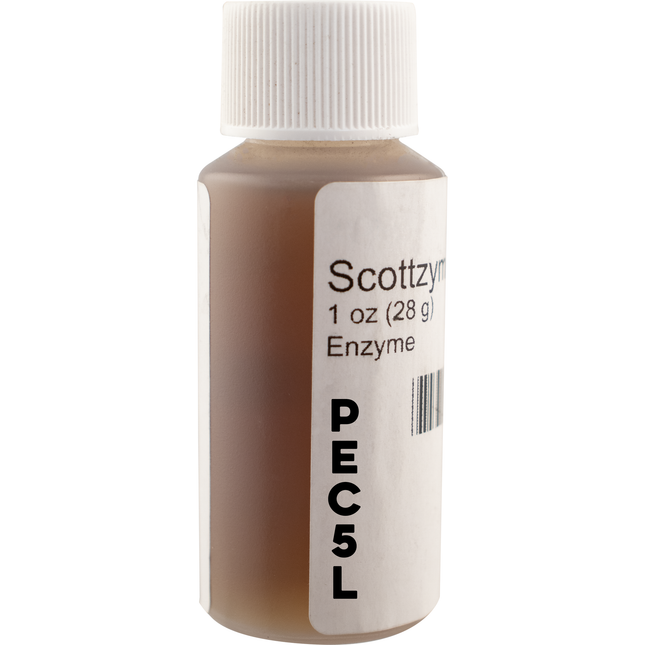
Scottzyme Pec5L
Scottzyme PEC5L – Pectinase Enzyme for Enhanced Settling and Juice Yield Rapidly breaks down soluble pectins for faster settling and improved clarity Increases free-run and press yield by reducing viscosity and cell wall resistance Improves flotation efficiency and tightens lees compaction Effective across a wide pH range and performs well at low temperatures Ideal for white, rosé, and fruit wines requiring fast clarification and clean separation Scottzyme PEC5L is a highly active liquid pectinase enzyme formulated to reduce pectin-related haze and increase processing efficiency in juice production. By breaking down soluble pectins, PEC5L dramatically improves juice release during pressing, reduces must viscosity, and accelerates settling or flotation. The result is clearer juice, more compact lees, and higher overall yield. Its formulation is optimized for cool-temperature performance and a broad pH range, making it a versatile tool in grape and non-grape juice clarification. Unlike general pectinases, PEC5L is designed to act quickly and cleanly, without over-extraction of phenolics or bitterness. Protocol Dilute Scottzyme PEC5L in 10 times its volume of chlorine-free water or juice. Add to must or juice immediately after crushing or during transfer to settling tank. Mix well to ensure even distribution. For flotation, add just before or during the flotation process. Avoid adding at the same time as SO₂ or bentonite. Usage Rates Recommended dosage: 1.5–4.0 mL per 1000 lb of fruit or 0.075–0.2 mL per gallon of juice = approximately 0.02–0.05 mL per liter Use lower rates for clean, low-pectin fruit or warmer temperatures. Use higher rates for pectin-rich grapes, low temperatures, or difficult-to-settle musts. Allow contact time of 2 to 12 hours depending on conditions and desired level of clarification.
$14.99 - $69.99
-

Glass Wine Thief - Economy
A unique, functional variation of the traditional glass wine thief. We ordered these from eastern europe where the pricing/quality is great. The design was supposed to look exactly like our traditional thiefs we have made locally in Berkeley, California. Thus we used a picture of the original thief in our latest catalog. But alas, when they arrived they looked unlike any wine thief we have seen. But.... they work fantastic so we are happy and we think you will be too! Upon further testing and working with this thief, it has become clear that it can be tempermental about which carboys it fits in. If you'd like a glass thief for a carboy, we have to recommend the MT345. This still works great for barrels, even stacked ones! 1" in diameter, 10" from the bend to the tip and about 14" total length.
$34.99
-


Brix Hydrometer (-5 to 5)
Very precise hydrometer for measuring the completion of a wine fermentation. Comes in brix scale.
$21.99
-


Bottle Sealing Wax - Holiday Red Beads
Bottle Sealing Wax is a sealing wax for any type of wine, liquor or bottled liquid. In all applications, Bottle Sealing Wax provides a tough, moisture resistant coating, which preserves freshness, flavor and fragrance. Bottle Sealing Wax adheres on both natural and synthetic corks. It provides tamper evident protection for your product. Bottle Sealing Wax can be applied by capping the top of the recessed cork or by dipping the corked bottle into the wax. Wax beads are easier to measure and melt than wax blocks. Sold in 1 pound bags and 50 pound boxes. 1 pound will cover approximately 30 bottles, depending on usage. DIPPING INSTRUCTIONS: The wax should be melted in a double boiled or crock pot. Maintain wax temperature at 180°F to 190°F. The ideal temperature may vary, depending on ambient temperature and humidity as well as the temperature of the bottle and cork. Invert the bottle and carefully lower the cork end into the melted wax to the desired depth. Leave the top immersed for 10 to 15 seconds. Carefully lift bottle straight up and allow the excess wax to run off the inverted bottle top. When excess wax slows or stops, turn bottle upright and allow to cool.
$17.99 - $599.99
-


Bottle Sealing Wax - Black Beads
Bottle Sealing Wax is a sealing wax for any type of wine, liquor or bottled liquid. In all applications, Bottle Sealing Wax provides a tough, moisture resistant coating, which preserves freshness, flavor and fragrance. Bottle Sealing Wax adheres on both natural and synthetic corks. It provides tamper evident protection for your product. Bottle Sealing Wax can be applied by capping the top of the recessed cork or by dipping the corked bottle into the wax. Wax beads are easier to measure and melt than wax blocks. Sold in 1 pound bags and 50 pound boxes. 1 pound will cover approximately 30 bottles, depending on usage. DIPPING INSTRUCTIONS: The wax should be melted in a double boiled or crock pot. Maintain wax temperature at 180°F to 190°F. The ideal temperature may vary, depending on ambient temperature and humidity as well as the temperature of the bottle and cork. Invert the bottle and carefully lower the cork end into the melted wax to the desired depth. Leave the top immersed for 10 to 15 seconds. Carefully lift bottle straight up and allow the excess wax to run off the inverted bottle top. When excess wax slows or stops, turn bottle upright and allow to cool.
$17.99 - $599.99
-


Farro Glass | Premium Wine Bottles | Burgundy | Antique Green | 750mL | Case of 12
The most classic wine bottle shape perfect for everything from Pinot Noir to Chardonnay Originating from the Burgundy region of France, this bottle design has an unquestioning and timeless appeal Antique green glass color is often preferred for red wines to protect them from light during long term storage Farro Glass offers a full lineup of the most essential and commonly used bottles in winemaking Perhaps the most classic wine bottle. Burgundy bottles are named after the famous wine making region of Burgundy, France. This bottle was invented when all wine bottles were still made by glassblowers, making and molding every bottle by hand. It's said that the shape of the bottle was a result of how easy it was for bottle makers to produce. The Burgundy bottle is the go-to vessel for everything from Pinot Noir to Chardonnay. Volume: 750 mL Style: Burgundy Use: Syrah, Pinot Noir, Grenache, Chardonnay, Chenin Blanc, Viognier Color: Antique Green Finish: Cork Bottom: Punted Case QTY: 12 Pallet QTY: 78 Cases Our Farro Glass Wine Bottles offers a full lineup of the most essential and commonly used bottles in winemaking. We scoured the world to find a bottle source that could provide a quality product consistently and at a fair price that we can pass on to our customers. If you've been searching for reasonably priced bottles that are reliably in stock, look no further.
$23.99 - $1,379.99
-

Bar Top Cork | Super T-Cork | Synthetic | 19mm | Pack of 25
T-Corks are a great option for bottling your homemade concoctions. Dimensions: Top section is 28mm wide by 13mm high, lower cork section (that goes into the bottle) is 19mm wide by 20mm high.
$6.59
-

Ferrari Wing Corker - Easy Corker
Twin lever wing corker for corking wine bottles. The Easy corker has a unique spring mechanism that grabs the neck of the bottle and holds tight while the cork is inserted. Insert a cork into the plastic window and lower the handles. The depth of the cork can be adjusted by moving the 2 nuts on the top of the threaded shaft. Patented design made by Ferrari in Italy.
$33.99
-


CellarScience® RED Dry Wine Yeast | Premium Wine Yeast
Emphasizes red berry fruit flavors High color extraction Makes wines that do not require extended aging Med-High nutrient need Top choice for Zinfandel, Sangiovese, Pinot, Merlot Our most popular red yeast is a perfect choice for Pinot Noir, Zinfandel, Sangiovese, Merlot and other reds where you want to emphasize red fruit flavors. When compared with BIG RED or PURPLE, RED is less about structure and body and more about fruit. Fantastic by itself if you plan to blend separately fermented lots back together. RED is a great choice to contribute red berry flavor. Also known to help produce intense color. Also a great choice for Cabernet, Syrah and other traditinoal big red varietals where you would like to emphasize fruit over structure and body. Because RED ferments cleaner than most yeast at high temperatures, it is the perfect choice if you are fermenting in a warm environment and do not have temperature control. It does not produce much SO2 so it is a great choice for easier ML fermentations Start Time: Average Alcohol tolerance: 16% Nitrogen Demand: Med Yan Requirement @ 23 Brix: 250ppm Production of volatile acidity: low Production of SO2: Low Ease to Ferment with MLF: Good Yeast Type: Cerevisiae Killer Factor: Neutral Malic Acid Consumption: Average Optimal Fermentation Temp: 65–85°F Proper yeast hydration helps ensure a healthy fermentation. For every gram of yeast, mix .25 g of FermStart yeast nutrient with 25 ml of sterilized tap water between 104–106°F/40–41°C. When water reaches 104°F/40°C, sprinkle yeast into water and stir gently. Allow the slurry to stand undisturbed for 15 minutes and then stir again. For every gram of yeast used add 25 ml of clean must to the yeast slurry and let stand 15–20 minutes. If necessary, use additional must to adjust yeast slurry to within 18°F of must temp before pitching. For a complete nutrient schedule sufficient for most fermentations, add 1.5 g of FermFed DAP Free per gallon of must at the first sign of fermentation and 1 g of FermFed per gallon of must after 1/3 sugar depletion. Download the PDF
$1.79 - $49.39
-


Pinot Noir Wine Making Kit | VineCo Original Series™
If wines were personified by movie characters, Pinot Noir would be your Mrs. Robinson—mature and seductive. No wine evokes more sultry descriptions as Pinot Noir, often characterized as having a supple, silky texture and arousing earthy aroma. Sensual summarizations aside, Pinot Noir is considered one of the “founder varieties”. Its exact origins are unknown, but modern genetic study has revealed Pinot to be the parent of countless grape varieties including Chardonnay and Corvina, as well as hundreds of mutations of itself, including Pinot Gris and Pinot Blanc. Flavors and aromas are overwhelmingly fruit-forward—raspberry, plum, rhubarb, pomegranate, and strawberry—with subtle notes of earth and damp leaves. Burgundy, France enjoys the highest acclaim for its Pinot Noir, but this grape is no less renowned in Oregon and California in the U.S. and New Zealand in the southern hemisphere. Our Pinot Noir is fruit-driven with flavors of raspberry and cherry, underscored by delicate earthy notes. A dry red wine with a light to medium body, moderate oak character, and alcohol content of 12.5% by volume. This wine kit includes medium toast oak chips. Medium toast oak is the most popular toast level used in red wines as it imparts a complex balance of vanillin and spice along with a nice mouthfeel. The VineCo Original Pinot Noir demands that it be sipped and savored. Do not drink it down like you might a common table wine. Approach with a subtle assuredness like you might if an attractive stranger caught your eye from across the room. Enjoy the deep, captivating flavors as if you’re getting to know this wine for the first time. For a dance at the dinner table, pair off with something that has a touch of spice like Kerala duck curry or Char siu pork. Pinot Noir Raspberry, cherry, earthy notes Sweetness: Dry Oak: Medium Body: Light-Medium ABV: 12.5% Kit Volume: 7.5 L Approximate Yield: 23 L Ready to bottle in 4 weeks Bottle Labels sold separately
$97.99


You have seen 192 out of 960 products