Detecting your location...
FREE FERMZILLA with every BrewZilla Gen 4.1 Dads & Grads · Ends in 7 days · No code needed
Shop the Bundle
MoreBeer Category Header
Premium Fermentation Equipment

Elevate Your Homebrew with Pro-Grade Fermenters

Start your next batch off right with top-tier conical fermenters, glass carboys, and precise temperature control gear from leading brands like BrewBuilt.

  • Professional Performance: Stainless steel conicals built to last a lifetime and mimic commercial brewery setups.
  • Scratch-Free Cleaning: 1 to 6-gallon glass carboys and jugs that make sanitation a breeze.
  • Complete Temp Control: Dial in your fermentation environment for the perfect flavor profile every time.
  • Unmatched Quality: Access commercial-grade brewing capabilities at the most affordable prices.
Learn More About Fermentation ↓
1

Sanitize & Prep

Thoroughly clean your chosen fermenter to ensure a flawless, bacteria-free environment for your chilled wort.

2

Pitch & Ferment

Add your yeast and use temperature control accessories to maintain the perfect brewing climate.

3

Keg & Enjoy

Once fermentation is complete, easily transfer your clear, professional-quality beer to serve and enjoy.

Shop by collection
368 products

  • Silicone Sleeve for Cooling Snake

    Silicone Sleeve for Cooling Snakes

    1 review

    Use this silicone sleeve to fit a cooling snake into a the existing air lock hole on a Variable Volume Fermenter. Silicone sleeve makes an air tight seal between lid and cooling snake. Note that if you want to use the cooling snake during an active ferment you will need to modify the lid to be fitted with an airlock - we suggest a tri-clover fitting be welded in the top and a piece of tubing connected to this that runs into a bucket of water. We can help you choose the necessary fittings. Dimensions: Bottom OD - 1 5/8" Top OD - 1 15/16" ID - 1 1/8" Dimensions installed on Snake: Bottom OD - 1 3/4" Top OD - 2"

    $16.49

  • Temp Twister Stainless Steel Lid with Thermowell Port for 65L Bucket Buddy Temp Twister Stainless Steel Lid with Thermowell Port for 65L Bucket Buddy

    Temp Twister Lid for Bucket Buddy Fermenters | 65L

    1 review

    This flat lid with pre-drilled holes allows you to easily add a Temp Twister Cooling Coil to your 35L Bucket Buddy fermenter. It also has holes for your stopper & airlock (included with the Bucket Buddy) as well as a Thermowell so you can control the circulation of cooling solution with a Temperature Controller. The lid is also compatible with 65L BrewZillas and DigiBoils. If you're fermenting in the Bucket Buddy with built-in heating element, we recommend plugging the unit into the heating outlet of your temperature controller and leaving the power switch turned on. This will allow the temp controller to provide power to the unit only when heating is needed and it will cut the power as soon as you're back to your set temperature. Using the Bucket Buddy's controller to maintain the heating set temp and using a separate controller to maintain the cooling may result in heating and cooling cycling at the same time. NOTE: The pre-drilled holes are meant for specific sizes of Duotight bulkheads and the stopper included with the Bucket Buddy fermenter. All holes need to be occupied in order to protect your fermentation from outside contaminants. Depending on the placement of the Temp Twister, you might need to shorten the inlet/outlet tubes on the outside of the fermenter using a Pipe Cutter. Lid only. Other accessories must be purchased separately. You Will Also Need: Temp Twister Cooling Coil FermZilla Thermowell Temperature Controller KegLand Part Number: KL28110

    $43.99

  • Sale -25% MB - MiniChilly Multi-Tank Glycol 17 MB - MiniChilly Multi-Tank Glycol 17

    MB® MiniChilly | Multi-Tank Glycol Chiller | Bulkhead Sets for 10 Fermenters | Digital Temp Control | Rolling Casters | Stainless Steel Enclosure | 1.2 HP

    1 review

    The German made 1.2 horse power MB Chiller is an ideal solution for nano breweries looking to chill up to 10 fermenters at once. The idea of the MiniChilly is that for each fermenter you want to a chill a pump kit is added. A pump kit (GLY35) includes a submersible pump that is placed in the cold bath of the Mini Chilly along with a digital controller that is placed next to your fermenter. Silicone tubing is included to make the connections. The digital controller includes a thermal probe that should be inserted into a thermal well in your vessel or can be taped to the outside of the vessel if you don't have a thermal well. The digital controller then measures the temperature of your tank and turns the submersible pump on or off to cool the liquid in your vessel to the desired set temperature. In this way each tank can be set at different temperatures. The MiniChilly is made by Quantor/Kreyer of Germany who is the largest manufacturer of glycol systems for breweries and wineries in the world. Made with high quality manufacturing and components, the MiniChilly is a durable system for many years of problem-free brewing. It is German made and we guarantee you will appreciate the build quality when compared to other chillers on the market. The unit features a stainless steel case with stainless 3/8" barbs in the top that allow for a clean connection of the silicone tubing that will run from each pump to each tank. The MiniChilly is able to chill its reservoir down to 21°F when a 30% glycol solution is used. The compact size and included casters make it easy to move around the brewery when needed. Applications: Cooling of Fermentation Cold Crashing for Brite Tanks Maintain Lagering Temperatures Compatibility: The MiniChilly can be used with any fermenter that has a built-in cooling jacket or a submersed cooling coil. It works well as the cooling source for the following systems and fermenters. BrewBuilt Jacketed Uni Conical - You will need one Glycol Pump Kit for each tank. Ss Brewtech Fermenters and Brites with optional FTS Temperature Control Systems: Because FTS systems include a pump and controller you will not need to buy a separate Glycol Pump Kit. Spike Conical with Optional Cooling Package - Because the optional Spike cooling system includes a pump and controller you will not need to buy a separate Glycol Pump Kit. Speidel Tanks with Optional Cooling Jackets - You will need one Glycol Pump Kit for each tank. Grainfather Fermenters - Grainfather fermenters have standard cooling jackets. You will need one Glycol Pump Kit for each fermenter Blichmann Fermenators with Optional Cooling Coil - You will need one Glycol Pump Kit for each Fermenator. Capacity: Many chiller ratings are based on the theoretical power of the compressor, while the cooling capacity of the MiniChilly is rated at a realistic ambient temperature. This is much more useful for predicting the MiniChilly’s performance in real world applications. Of course, you could cool a greater number of smaller tanks but you’re ultimately limited to the 10 connections. Actual cooling capacities will vary based on the insulation of the tank. For the examples below we assume neoprene or better. Cooling Capacity Example: Up to 10 1BBL (31 Gallon) well-insulated tanks fermenting at 68°F in 80°F ambient temperature. For every fermenter you want to cold crash remove 4 fermenting fermenters from the capacity. Set Up: In order to hook up the MiniChilly to your fermenter or tank's cooling system, you will need 4 lengths of tubing per pump. All tubing connections should be secured with hose clamps. Length 1: Submersible pump outlet to inner barb of 1st bulkhead Length 2: Outer barb of 1st bulkhead to cooling system inlet Length 3: Cooling system outlet to outer barb of 2nd bulkhead Length 4: Inner barb of 2nd bulkhead to MiniChilly reservoir (should drain freely, no connection necessary) Technical Characteristics: Power: 110V-1Ph/50-60Hz Compressor Power: 1.2hp/900watts Cooling Capacity at 32°F glycol temp and 90°F Ambient Temp: 1.05 KW/1050 Watts (60Hz 110V) Cooling Capacity at 60°F glycol temp and 90°F Ambient Temp: 1.92 KW/1920 Watts (60Hz 110V) Stainless Steel Unit Water Temperature Range: 21°F - 86°F (-6°C - 30°C) Ambient Temperature Range: 50°F - 90°F (10°C - 32°C) Refrigerant R134a Free Glycol Water-Bath for Mini-Pumps Fittings 3/8" for Plastic Tubes of Individual Pumps Solid Wheels w/ Breaks for Easy Mobility Universal C19 Plug On/Off Switch Water-Level Sight-Tube Grooves for Individual Pump Cables Safety Inner Separation Water Side from Electric Side Tank Capacity: 12.68 gal. (48 L) Dimensions: 29.5"L x 15.75"W x 21.75"H Weight: 112.5 lbs Made in Germany CE Certified

    $3,699.99 $2,774.99

  • Demijohn Lid - 34L Narrow Mouth Demijohn Lid - 34L Narrow Mouth

    Demijohn Lid - 34L Narrow Mouth

    Plastic dust cap for 34L narrow mouth demijohn

    $1.69

  • Plastic carboy - 3 Gallon - Vintage Shop (Ported) Plastic carboy - 3 Gallon - Vintage Shop (Ported)

    Plastic PET Carboy - 3 Gallon Ported (Spigot Not Included)

    1 review

    The ported version of our popular PET Plastic carboy. No more siphoning thanks the hole located 2 inches from the base of the unit. We recommend using our plastic bucket spigot (FE347). To install the spigot you will need the installation tool (FE311A) to hold the nut in place as you thread in the spigot. Your days of lugging heavy glass carboys around are over thanks to these plastic carboys! Our Plastic Carboys are made from 100% Virgin PET plastic, which is far more resistant to oxygen than regular plastic. They’re much lighter and safer than glass, which is good if you need to move your fermenter around the house to find the right temperature. Full carboys can be heavy and hard to maneuver and glass can break resulting in possible injury. In addition to being safer to handle, they’re more economical than glass as well. With no ribs on the sides, there’s no place for yeast and sediment to collect, making cleaning a breeze. We suggest cleaning them with an overnight PBW soak, shake, rinse, and sanitize. You’ll want to avoid vigorous scrubbing during cleaning to avoid scratches. Two special features we love about our PET Carboys are the punted base and extra head space. The punted base makes the carboy easier to hold while carrying or pouring, and prevents sediment disturbance during transfers. The extra head space is a huge plus to make sure you have enough room for when your fermentation gets going. Specifications: Uses a #10 stopper or a 5 Gallon Carboy Hood. Weighs 1.0 lbs Rated to 140 degrees F Height: 16 inches Diameter: 9 inches Completely taste and odor free Punted base to prevent sediment disturbances during transfer Does not come with spigot.

    $29.99

  • Stopper - #8.5 With Hole

    Rubber Stopper - #8.5 With Hole

    1 review

    Size 1 7/16" - 1 3/4" Fits our 1000ml Flask

    $4.09

  • Silicone Stopper / Bung - 17.5mm x 22.5mm - With Hole Silicone Stopper / Bung - 17.5mm x 22.5mm - With Hole

    Silicone Stopper | 17.5mm x 22.5mm | With Hole

    This versatile silicone bung is made from a food-grade, lead-free material, making it ideal for use with all food and beverages. It's the perfect size for sealing most standard beer bottles, making it a great option for micro and nano brewers. It also serves as a replacement airlock bung for the KegLand Bucket Buddy. Dimensions: Tapered Diameter: 17.5mm to 22.5mm (0.68" to 0.88") Hole Diameter: 9mm (0.35") KegLand Part Number: KL12638

    $0.99

  • Replacement Racking Arm O-Ring for Bucket Buddy Replacement Racking Arm O-Ring for Bucket Buddy

    Stainless Bucket Fermenter | Replacement O-ring for Racking Arm

    Replacement o-ring for the racking arm included with the KegLand Bucket Buddy stainless fermenter. Single o-ring. If you are replacing both o-rings, you will need to order 2. KegLand Part Number: KL24754

    $2.19

  • Low stock! WilliamsWarn - BrewKeg25 Litre w/ Draining Sediment Bottle

    WilliamsWarn BrewKeg25 | Pressurizable Conical Fermenter | Draining Sediment Bottle | 25 L | 6.6 Gallon

    Ferment, carbonate, and serve finished beer all in one vessel Pressure ferment as high as 25 psi to reduce esters and produce clean lagers at ale fermentation temps Extra-large draining sediment bottle allows you to drop out hop matter and yeast throughout your process Avoid oxidation by skipping the kegging process entirely—simply hook up your draft system to the lid's ball lock posts! So the first thing to understand is that this is a Unitank - you will be fermenting and serving from the same vessel. The lid has an adjustable pressure relief that you can set to different pressures. More on that later while we first talk about why we are so high on these...  The #1 reason we love the BrewKeg Unitanks is that they eliminate kegging day, which saves a bunch of time. The Brewkeg25 is perfect for a 5-gallon batch, with plenty of headspace for vigorous fermentations. When fermentation is done, crank down the temp, remove the yeast/trub collection ball and start immediately drinking because the beer is already carbonated. Since this is not the standard brewing process, stop and think that over - you don't need a separate night or hours on a weekend morning to clean and keg. You are going to save 2 or more hours with every batch! Plus, you are skipping the most oxidative step in brewing of going from your fermenter to your keg. Yes, the one down side is that your fermenter is tied up as a keg but to many of us who really love brewing our own beer but are time challenged – the sacrifice is totally worth it.  Another great time saving feature is that you can skip wort cooling and 'hot pack' these kegs, literally filling them after boil at around 190°F. Stick them in your refrigerator, let them cool overnight, and pitch yeast the next day. Hot packing is gaining a lot of traction and we suggest you google the term to learn more. It’s been a standard practice in Australian homebrewing for years. We've been fermenting under pressure for years now with various pressurizable conicals, and if you want to make amazing lagers quickly you need to try it. Fermenting under pressure reduces esters and even beers fermented between 65-80°F have amazing German lager malt profiles. We've fermented a beer under pressure with WLP001 at room temp and all the tasters thought it was lager yeast. The pressure relief assembly, located in the center of the lid, is the slickest out there and adjusts from no pressure up to 25 psi. Leave it open for no pressure fermentations of ales and IPA's where you want the esters. Close it down to make amazing lagers under pressure, quickly. Features: Made from stainless steel Conical base Extra-large, easy to remove draining sediment ball 25 psi working pressure & built in relief valve 40 psi maximum pressure rating Ferments clean and clear beer from 64-82°F Beer is carbonated perfectly at the end of fermentation Beer ready to enjoy sooner Compact design fits in most kegerators Eliminates kegging Easy to clean and sanitize Dimensions: Height: 26 in. Diameter: 15.5 in. Actual Volume: 30L (7.92 gal)

    $659.99

  • Ss BrewTech - Chilling Coil Kit - 3.5 gal Brew Bucket Mini

    Chilling Coil Kit | 3.5 gal Brew Bucket Mini | Ss BrewTech

    1 review

    The Chilling Coil kit can be used to update the 3.5 gal Brew Bucket Minis for temperature control. Then you can add an FTSs Touch kit for use with the Ss Glycol Chiller.  Features: 304 Stainless steel Immersion chiller coil Thick 5 mm zippered neoprene jacket FTSs designed lid included Weldless 200mm thermowell Included hose clamps (for chiller coil), 17mm stopper (for airlock) Specs: Assembled Dimensions: 17.5"H x 11.5"W x 11.5"D (on Bucket) Assembled Weight: 10lbs / 4.5kgs (on Bucket)  

    $99.95

  • Sale -15% Brew Bucket Mini - Replacement Base

    Replacement Silicone Base for the Brew Bucket Mini Fermenter

    Replacement silicone base for the Brew Bucket Mini Fermenter

    $21.95 $18.66

  • Ss BrewTech - Glycol Chiller - 3/8 HP Ss BrewTech - Glycol Chiller - 3/8 HP

    Glycol Chiller | 3/8hp | Ss BrewTech

    Introducing the Ss Glycol Chiller 3/8 HP, which will maintain lager temps and enable crash cooling for up to 6 vessels even in relatively high ambient temperatures. We designed the chiller to integrate seamlessly with our FTSs kits to provide a complete temperature control system. Since each FTSs kit includes its own dedicated temperature controller, pump, and tubing, each vessel can be connected to the glycol chiller with its own independent loop. The parallel design of this set up offers the ability to ferment at ale temps in one vessel, and maintain precise serve or crash cooling temps in another vessel. The Glycol Chiller can also be paired with our line of Ss Brite Tanks to hold beer at serving temperatures. This system offers both flexibility and expandability for your home brewery.  Features: Pumps not included, attach up to 6 FTSs Touch kits (sold separately) Capable of crash cooling and lagering Assuming one vessel is crash cooled at a time: Chills Up to 4 - 1 BBL Chronicals, Unitanks or Brite Tanks Chills Up to 6 - 1/2 BBL, 14, or 7 gal Chronicals or Unitanks, 10 or 20 gal Brite Tanks Chills up to 6 - 14 or 7 gal Brew Buckets  Not Compatible with the FTSs Pro Series Controllers Specs: Vertical chassis layout 120 VAC 3/8 HP Compressor 3576 BTUs/Hr 10 Gallon Reservoir with Pressure Vent R290 Refrigerant Casters included Made in France Dimensions: 18" W x 18" D x 28" H  

    $1,499.00

  • Ss BrewTech - Glycol Chiller - 1/5 HP Ss BrewTech - Glycol Chiller - 1/5 HP

    Glycol Chiller | 1/5hp | Ss BrewTech

    The Ss Glycol Chiller | 1/5 HP, will maintain lager temps and enable crash cooling for up to 3 vessels even in relatively high ambient temperatures. We designed the chiller to integrate seamlessly with our FTSs kits to provide a complete temperature control system. Since each FTSs kit includes its own dedicated temperature controller, pump, and tubing, each vessel can be connected to the glycol chiller with its own independent loop. The parallel design of this setup offers the ability to ferment at ale temps in one vessel, and maintain precise serve or crash cooling temps in another vessel. The Glycol Chiller can also be paired with our line of Ss Brite Tanks to hold beer at serving temperatures. This system offers both flexibility and expandability for your home brewery.  Features:  Pumps not included, attach up to 3 FTSs Touch kits (sold separately) Capable of crash cooling and lagering Assuming one vessel is crash cooled at a time: Chills Up to 2 - 1/2 bbl, 14 gal Chronicals, Unitanks, or Brew Buckets Chills Up to 3 - 7 gal Chronicals, Unitanks, or 10 gal Brite Tanks Chills Up to 3 - 7 or 3.5 gal Brew Buckets Not Compatible with the FTSs Pro Series Controllers Specs: Vertical chassis layout 120 VAC 1/5 HP Compressor 1450 BTUs/Hr 4.75 Gallon Reservoir with Pressure Vent R290 Refrigerant Casters Included Made in France Dimensions: 14" W x 11" D x 27.5" H  

    $999.00

  • Sale -15% RAPT - PC Heat Resistant Shelf Tray (60mm deep) RAPT - PC Heat Resistant Shelf Tray (60mm deep)

    RAPT Fermentation Chamber | Polycarbonate Heat Resistant Shelf Tray

    Heat resistant shelves for your brand new RAPT Fermentation Chamber. Can be used for trays of mushrooms or seed sewing with added grow lights. It can also be used as a humidity tray if you require a humid environment for your project. 60 mm (2.3") deep. KegLand Part Number: KL25553    

    $43.99 $37.39

  • Temperature Sensor for GLY410 Kreyer Chilly 45

    Temperature Sensor for Kreyer Glycol Chillers

    Replacement Temperature Sensor for Kreyer Chilly 45, Chilly Max, and MCK units.

    $65.99

  • Glycol System #1

    Glycol System Beer Chiller #1

    Glycol Chillers for cooling fermentations of beer and wine, and also used for maintaining temperature for draft beer dispensing. These glycol packs are perfect for controlling temperature during fermentations. They can be used with cooling plates and snakes for macro bin fermentation, as well as connected to tanks via cooling jackets. If you desire to do cold stabilization with this small chiller you will need to insulate your tanks very well and have sufficient cooling surface area in contact with the wine. A better machine for cold stabilization is our Chilly45 made by Kreyer, featuring 4x the power. Features of Glycol System #1 Digital Thermostat Digital Temperature Controller 2,300 btu/hr Compressor 1/3 hp Vertical-type pump 115V power 4.5 gallon bath capacity Max distance of glycol line is 75 feet 22-1/4" H x 17-3/8" W x 26" D 118 pounds Will cool glycol bath down to approximately 20°F

    $1,899.00

  • Silicone Stopper / Bung - 32mm x 48mm - With Hole

    Silicone Stopper | 32mm x 48mm | With Hole

    This versatile silicone bung is made from a food-grade, lead-free material, making it ideal for use with all food and beverages. Dimensions: Tapered Diameter: 32mm to 48mm (1.25" to 1.88") Hole Diameter: 9mm (0.35") KegLand Part Number: KL12836

    $4.99

  • Silicone Stopper / Bung - 20mm x 36mm - Solid Silicone Stopper / Bung - 20mm x 36mm - Solid

    Silicone Stopper | 20mm x 36mm | Solid

    This versatile silicone bung is made from a food-grade, lead-free material, making it ideal for use with all food and beverages. Dimensions: Tapered Diameter: 20mm to 36mm (0.78" to 1.41") Solid stopper (no hole) KegLand Part Number: KL12829

    $1.99

  • Silicone Stopper / Bung - 19.5mm x 28.5mm - With Hole Silicone Stopper / Bung - 19.5mm x 28.5mm - With Hole

    Silicone Stopper | 19.5mm x 28.5mm | With Hole

    This versatile silicone bung is made from a food-grade, lead-free material, making it ideal for use with all food and beverages. Dimensions: Tapered Diameter: 19.5mm to 28.5mm (0.76" to 1.12") Hole Diameter: 9mm (0.35") KegLand Part Number: KL41669

    $1.59

  • Sale -15% Brewtools - F80 Unitank Light 20-75 liters capacity Brewtools - F80 Unitank Light 20-75 liters capacity

    Brewtools | F80 Unitank Light | 5.2-19.8 Gallon Capacity | 20-75L

    Unitank Light offers the same tank body as the standard Brewtools Unitank with a slight difference in included accessories for a more affordable price Ferment, cold crash, and carbonate beer all in one vessel with the Brewtools F-Series Unitank Cooling jacket welded to the vertical walls of the tank provide superior cooling capabilities compared to in-solution cooling coils Made from stainless steel throughout with Brewtools' proprietary PureBlast™ surface—no passivation required, simply rinse with warm water before your first use Pressure rated to 30 PSI so you can safely ferment under pressure and pressure transfer finished beer to kegs with virtually no oxygen pickup Brewtools is a Norwegian brand known for high-quality products made without compromise. From brewing systems to fermenters, they continue to push the envelope of innovation for homebrewers around the globe All valves, fittings, and gaskets come included Unitank Light is the same tank body as the standard Brewtools Unitank, but with slightly less equipment and some parts made from Polyketone (POK), which vastly reduces cost without compromising the user experience for smaller tanks. Unitank Light can be upgraded to a standard Unitank where you prefer. Key Differences: CleanCore butterfly valves made from Polyketone Barbed blow-off PRV Can be set to open during fermentation for blow-off Also acts as 2 bar / 30 psi safety valve Pushfit sample valve Compatible with optional Push-fit Coil and Adapter Polyketone 8” to 3” tri-clamp lid adapter replaces stainless steel adapter Polyketone racking arm replaces stainless steel racking arm Does not include neoprene insulation jacket, ss blow-off tube or ss blow-off valve Brewtools Unitanks are fermenters made for ambitious homebrewers and small breweries. As part of the Brewtools identity, they've explored new techniques and solutions. This has resulted in a series of high-end fermentation tanks with new features and a lot of possibilities. Key Features: Brewtools PureBlast™ surface inside and out which eliminate the use of wax and polishing compounds and does not require passivation Cooling jacket in the vertical walls offers efficient cooling without the hassle of cleaning a coil Many options for connecting accessories like sensors, heaters, carb. stones and other accessories Conical pressure rated for 2 bar / 30 PSI Cooling jacket pressure rated for 0.5 bar / 7 PSI 8" TC port on top for easy access 2" TC dump and racking valves Brewtools Unitanks are designed and manufactured with special attention to safety and quality. They are tested and certified according to the requirements for PED 2014/68/EU by a third party. Specifications: Low height w/o acc.: 43.3" Max height w/o acc.: 51.2" Packaging size: 44.5" (h) x 20.5" (w) x 20.5" (d) Net weight: 88 lbs Gross weight: 101 lbs Tank diameter (inside): Ø15.75" Gross volume: 22.7 gal Max rec. volume: 21.1 gal Min rec. volume: 5.3 gal Volume, cone: 3.1 gal Material: 1.5mm stainless steel (SS304) Operating pressure: 1.0 bar / 15 PSI Max pressure: 2.0 bar / 30 PSI In the box: Unitank with adjustable frame 1 pcs Analog pressure gauge, TC34mm 2 pcs CleanCore Butterfly-valve, 2" 1 pcs Racking arm 2", POK 1 pcs TC elbow 90°, 2" 1 pcs Sample valve, 34mm, POK 1 pcs TC Adapter 8"-3", POK 1 pcs TC blind cap, 3" 1 pcs TC blind cap 2" 2 pcs TC blind cap 1.5" 4 pcs TC blind cap 34mm 2 pcs TC gasket 8" lipped 2 pcs TC gasket 3" 2 pcs TC gasket 2" 5-pack 1 pcs TC gasket 1.5" 5-pack 3 pcs TC gasket 34mm 5-pack (DN20) 1 pcs Tri Clamp 8" 1 pcs Tri Clamp 3" 5 pcs Tri Clamp 2" 2 pcs Tri Clamp 1.5" 9 pcs Tri Clamp 34mm 1 pcs TC tool 4 pcs M10 steel/rubber feet 1 pcs TC34mm pull-type PRV/Safety valve with 7mm barb 1.5m (4.9') Silicone tube 6x10mm Necessary bolts and parts for assembly 5 year manufacturer's warranty Recommended accessories include: HopDrop-kit, Thermowells for your sensors, 34mm Ball-Lock gas adapter for CO2 filling, Carb. stone kit with Ball-Lock, Coil for sample valve, Spunding valve, Hose barbs for filling and dumping, 2" sight glass etc. For User Manuals and support, please follow this link to Brewtools Docs. NOTE: Model in photo is a prototype. Minor changes and improvements may occur.

    $1,785.00 $1,517.25

  • Sale -15%Low stock! Brewtools - F40 Unitank Light 20-40 liters capacity Brewtools - F40 Unitank Light 20-40 liters capacity

    Brewtools | F40 Unitank Light | 5.2-10.5 Gallon Capacity | 20-40L

    Unitank Light offers the same tank body as the standard Brewtools Unitank with a slight difference in included accessories for a more affordable price Ferment, cold crash, and carbonate beer all in one vessel with the Brewtools F-Series Unitank Cooling jacket welded to the vertical walls of the tank provide superior cooling capabilities compared to in-solution cooling coils Made from stainless steel throughout with Brewtools' proprietary PureBlast™ surface—no passivation required, simply rinse with warm water before your first use Pressure rated to 30 PSI so you can safely ferment under pressure and pressure transfer finished beer to kegs with virtually no oxygen pickup Brewtools is a Norwegian brand known for high-quality products made without compromise. From brewing systems to fermenters, they continue to push the envelope of innovation for homebrewers around the globe All valves, fittings, and gaskets come included Unitank Light is the same tank body as the standard Brewtools Unitank, but with slightly less equipment and some parts made from Polyketone (POK), which vastly reduces cost without compromising the user experience for smaller tanks. Unitank Light can be upgraded to a standard Unitank where you prefer. Key Differences: CleanCore butterfly valves made from Polyketone Barbed blow-off PRV Can be set to open during fermentation for blow-off Also acts as 2 bar / 30 psi safety valve Pushfit sample valve Compatible with optional Push-fit Coil and Adapter Polyketone 8” to 3” tri-clamp lid adapter replaces stainless steel adapter Polyketone racking arm replaces stainless steel racking arm Does not include neoprene insulation jacket, ss blow-off tube or ss blow-off valve Brewtools Unitanks are fermenters made for ambitious homebrewers and small breweries. As part of the Brewtools identity, they've explored new techniques and solutions. This has resulted in a series of high-end fermentation tanks with new features and a lot of possibilities. Key Features: Brewtools PureBlast™ surface inside and out which eliminate the use of wax and polishing compounds and does not require passivation Cooling jacket in the vertical walls offers efficient cooling without the hassle of cleaning a coil Many options for connecting accessories like sensors, heaters, carb. stones and other accessories Conical pressure rated for 2 bar / 30 PSI Cooling jacket pressure rated for 0.5 bar / 7 PSI 8" TC port on top for easy access 2" TC dump and racking valves Brewtools Unitanks are designed and manufactured with special attention to safety and quality. They are tested and certified according to the requirements for PED 2014/68/EU by a third party. Specifications: Low height w/o acc.: 32.6" Max height w/o acc.: 40.5" Packaging size: 33.4" (h) x 20.5" (w) x 20.5" (d) Net weight: 73 lbs Gross weight: 88 lbs Tank diameter (inside): Ø15.75" Gross volume: 13.5 gal Max rec. volume: 10.5 gal Min rec. volume: 5.3 gal Volume, cone: 3.1 gal Material: 1.5mm stainless steel (SS304) Operating pressure: 1.0 bar / 15 PSI Max pressure: 2.0 bar / 30 PSI Min. pH: 4.0 In the box: Unitank with adjustable frame 1 pcs Analog pressure gauge, TC34mm 2 pcs CleanCore Butterfly-valve, 2" 1 pcs Racking arm 2", POK 1 pcs TC elbow 90°, 2" 1 pcs Sample valve, 34mm, POK 1 pcs TC Adapter 8"-3", POK 1 pcs TC blind cap, 3" 1 pcs TC blind cap 2" 2 pcs TC blind cap 1.5" 4 pcs TC blind cap 34mm 2 pcs TC gasket 8" lipped 2 pcs TC gasket 3" 2 pcs TC gasket 2" 5-pack 1 pcs TC gasket 1.5" 5-pack 3 pcs TC gasket 34mm 5-pack (DN20) 1 pcs Tri Clamp 8" 1 pcs Tri Clamp 3" 5 pcs Tri Clamp 2" 2 pcs Tri Clamp 1.5" 9 pcs Tri Clamp 34mm 1 pcs TC tool 4 pcs M10 steel/rubber feet 1 pcs TC34mm pull-type PRV/Safety valve with 7mm barb 1.5m (4.9') Silicone tube 6x10mm Necessary bolts and parts for assembly 5 year manufacturer's warranty Recommended accessories include: HopDrop-kit, Thermowells for your sensors, 34mm Ball-Lock gas adapter for CO2 filling, Carb. stone kit with Ball-Lock, Coil for sample valve, Spunding valve, Hose barbs for filling and dumping, 2" sight glass etc. For User Manuals and support, please follow this link to Brewtools Docs. NOTE: Model in photo is a prototype. Minor changes and improvements may occur.

    $1,603.00 $1,362.55

  • RAPT - Fermentation Chamber - Probe RAPT - Fermentation Chamber - Probe

    RAPT Fermentation Chamber | Replacement Temperature Probe

    Replacement temperature probe for the RAPT Fermentation Chamber. This is the standard probe that is included with the fridge. It can also be replaced with the Extension Probe which is long enough to be fed into a fermenter's thermowell. KegLand Part Number: KL26451

    $3.29

  • Silicone Stopper / Bung - 20mm x 36mm - With Hole Silicone Stopper / Bung - 20mm x 36mm - With Hole

    Silicone Stopper | 20mm x 36mm | With Hole

    This versatile silicone bung is made from a food-grade, lead-free material, making it ideal for use with all food and beverages. Dimensions: Tapered Diameter: 20mm to 36mm (0.78" to 1.41") Hole Diameter: 9mm (0.35") KegLand Part Number: KL12812

    $1.99

  • Ss Brewtech - FTSs Touch - XT30 Barrel Adapter Ss Brewtech - FTSs Touch - XT30 Barrel Adapter

    FTSs Touch | XT30 to Barrel Adaptor | Ss BrewTech

    Designed to allow the use of older FTSs pumps and heaters with new FTSs Touch controller.

    $12.95

  • Ss Brewtech - FTSs Touch - Extension Cable Ss Brewtech - FTSs Touch - Extension Cable

    FTSs Touch | Extension Cable | Ss BrewTech

    Designed for situations where your FTSs Touch and fermenter are more than 3ft away from your power supply. Can be used to extend the pump and/or power cable.

    $16.95

  • Replacement Ball Valve O-Ring for Bucket Buddy Replacement Ball Valve O-Ring for Bucket Buddy

    Stainless Bucket Fermenter | Replacement O-ring for Ball Valve

    Replacement o-ring for the ball valve included with the KegLand Bucket Buddy stainless fermenter. Please note the color of the O-ring recently changed to white/clear. Updated images coming soon. KegLand Part Number: KL29186  

    $2.19

  • Sale -15% RAPT - Fermentation Chamber - Glass Door RAPT - Fermentation Chamber - Glass Door

    Glass Door for RAPT Fermentation Chamber

    RAPT - Fermentation Chamber - Glass Door

    $274.99 $233.74

  • Sale -15% REX-100 Switching PID (Short) - Celsius Only - 220V REX-100 Switching PID (Short) - Celsius Only - 220V

    REX-100 Switching PID | 220V | Celsius Only

    This is a 1/6" DIN Relay Output controller with PID. It is compatible with many probe types including our PT100s. This reads Celsius only. 220V supply.  

    $27.49 $23.37

  • Glycol System #2 Glycol System #2

    Glycol Chiller System #2

    Glycol power packs for cooling fermentations of beer and wine, and also used for maintaining temperature for draft beer dispensing. These glycol packs are perfect for controlling temperature during fermentations. They can be used with cooling plates and snakes for macro bin fermentation, as well as connected to tanks via cooling jackets. Features 2300 btu Digital Thermostat Max distance of glycol "out" line - 125 Feet. Vane (Procon) with 1/3 HP Motor 115V Power 11.5 gallon bath capacity Dimensions: 27-1/2"H x 18"W x 29"D Weight: 120 pounds

    $2,862.00

  • Sale -15% Brewtools - F300 Unitank 120-290 liter capacity Brewtools - F300 Unitank 120-290 liter capacity

    Brewtools | F300 Unitank | 32-76 Gallon Capacity | 120-290L

    Ferment, cold crash, and carbonate beer all in one vessel with the Brewtools F-Series Unitank Cooling jacket welded to the vertical walls of the tank provide superior cooling capabilities compared to in-solution cooling coils Made from stainless steel throughout with Brewtools' proprietary PureBlast™ surface—no passivation required, simply rinse with warm water before your first use Pressure rated to 30 PSI so you can safely ferment under pressure and pressure transfer finished beer to kegs with virtually no oxygen pickup Brewtools is a Norwegian brand known for high-quality products made without compromise. From brewing systems to fermenters, they continue to push the envelope of innovation for homebrewers around the globe All valves, fittings, and gaskets come included Brewtools Unitanks are fermenters made for ambitious homebrewers and small breweries. As part of the Brewtools identity, they've explored new techniques and solutions. This has resulted in a series of high end fermentation tanks with new features and a lot of possibilities. Key Features: Brewtools PureBlast™ surface inside and out which eliminate the use of wax and polishing compounds and does not require passivation. Cooling jacket in the vertical walls offers efficient cooling without the hassle of cleaning a spiral. Many options for connecting accessories like sensors, heaters, carb. stones and other accessories. Pressure rated for 2 bar / 30 PSI Cooling jacket pressure rated for 0.5 bar / 7 PSI 8" TC port on top for easy access. 2" TC dump and racking valves. BrewTools Unitanks are designed and manufactured with special attention to safety and quality. They are tested and certified according to the requirements for PED 2014/68/EU by a third party. Specifications: Low height w/o acc.: 66.1" Max height w/o acc.: 74" Packaging size: 70.8" (h) x 28.3" (w) x 28.3" (d) Net weight: 167.1 lbs Gross weight: 209.4 lbs Tank diameter (inside): Ø23.6" Gross volume: 81.8 gal Max rec. volume: 76.6 gal Min rec. volume: 31.7 gal Volume, cone: 10.5 gal Material: 1.5mm stainless steel (SS304) Operating pressure: 1.0 bar / 15 PSI Max pressure: 2.0 bar / 30 PSI In the box: Unitank with adjustable frame 1 pcs Analog pressure gauge, TC34mm 2 pcs Butterfly-valve, 2" 1 pcs Butterfly-valve, 34mm DN20 1 pcs Blow-off pipe 1 pcs Racking arm 2" 1 pcs TC elbow 90°, 2" 1 pcs Insulation jacket, black neoprene 1 pcs Sample valve, 34mm 1 pcs TC Adapter 8"-4" 1 pcs TC blind cap, 4" 1 pcs TC blind cap 2" 2 pcs TC blind cap 1.5" 3 pcs TC blind cap 34mm 2 pcs TC gasket 8" lipped 2 pcs TC gasket 4" 2 pcs TC gasket 2" 5-pack 1 pcs TC gasket 1.5" 5-pack 3 pcs TC gasket 34mm 5-pack 1 pcs Tri Clamp 8" 1 pcs Tri Clamp 4" 5 pcs Tri Clamp 2" 2 pcs Tri Clamp 1.5" 10 pcs Tri Clamp 34mm 1 pcs TC tool 4 pcs M10 steel/rubber feet 1 pcs TC34mm safety valve (PRV, 2 bar) Necessary bolts and parts for assembly 5 year manufacturer's warranty Recommended accessories include: HopDrop-kit, Thermowells for your sensors, 34mm Ball-Lock gas adapter for CO2 filling, Coil for sample valve, Spunding valve, Hose barbs for filling and dumping, etc. For User Manuals and support, please follow this link to Brewtools Docs. NOTE: Model in photo is a prototype. Minor changes and improvements may occur.

    $4,923.00 $4,184.55

  • Ss BrewTech - FTSs Touch - Nano Jacketed Tank Kit Ss BrewTech - FTSs Touch - Nano Jacketed Tank Kit

    FTSs Touch | Nano Jacketed Tank Kit | Ss BrewTech

    The FTSs Touch | Nano Jacketed Tank Upgrade kit has been designed to leverage components from our home brewing FTSs Touch line in an effort to provide a low-cost solution to pair a 1, 2, or 3.5 BBL Nano Jacketed Unitank and Nano Jacketed Brite Tanks with one of our 3/8 HP or 3/4 HP glycol chillers. This system features a custom TC thermowell adapter, along with a silicone insert to adapt the temperature probe from an FTSs Touch controller to the welded-in sleeved thermowell port on our line of Nano Jacketed Tanks.  In addition, a custom-designed low-pressure open silicone check valve is included to prevent backflow to the chiller's reservoir when glycol is not flowing.  The kit includes 1/2" NPT to 3/8" barbs to adapt the glycol ports for use with our standard FTSs Touch pump.  Since most Nano Jacketed Tanks are set up for use with a pressurized loop glycol system typically found in commercial breweries, this kit offers a Nano brewery an affordable, easy-to-setup alternative to more elaborate or expensive installations.  Everything is included to interface a single Nano Jacketed Tank between an FTSs Touch and Ss Glycol Chiller.  Cooling options for Ss Branded Glycol Chillers  FTSs Touch | Jacketed Tank Kit — Designed to be paired with our line of Ss Glycol Chillers.  Cooling options for Pressurized Glycol Loops on Commercial Chillers  FTSs Pro Touch (+ FTSs Pro Touch Solenoid Valve)  — Designed to be paired with pressurized-loop (Non-Ss Brewtech) commercial glycol systems. Not recommended for 5bbl & Larger Tanks Includes: (4) FTSs hose clamp for 3/8" barbs (1) Hose barb - 3/8" to 1/2" MPT (1) Silicone thermowell cover (1) 1.5" TC sleeved thermowell adapter (1) FTSs harness extension 3 ft (1) Silicone check valve Works with 1, 2, and 3.5 bbl Nano Jacketed Tanks Not required for Unitank 2.0  

    $49.95

  • Ss BrewTech - Chilling Coil Kit - 14 gal Brew Bucket Ss BrewTech - Chilling Coil Kit - 14 gal Brew Bucket

    Chilling Coil Kit | 14 gal Brew Bucket | Ss BrewTech

    The Chilling Coil kit can be used to update the 14 gal Brew Buckets for temperature control. Then you can add an FTSs Touch kit for use with the Ss Glycol Chiller. Features: Thick 5 mm zippered neoprene jacket Immersion chiller coil mounted to 6" TC cap Cap | 3” TC with ½” Blow-Off 3/8" hose barbs on the chiller coil Included hose clamps (for chiller coil), TC Clamps, TC Gaskets Kit not compatible with Brite Tanks, Chronical Series, or Unitanks. Specs: Assembled Dimensions: 30"H x 16.5"W x 16.5"D (on Bucket) Assembled Weight: 30lbs / 13.5kgs (on Bucket)

    $249.95

  • Sale -15% RAPT - Fermentation Chamber - Screen Board RAPT - Fermentation Chamber - Screen Board

    RAPT Fermentation Chamber | Replacement Screen Board

    Replacement LCD control panel for the RAPT Fermentation Chamber. This Replacement LCD screen has been flashed with the firmware for the RAPT Temperature Controller. It is not compatible with the RAPT Temperature Controller. KegLand Part Number: KL17091

    $71.99 $61.19

  • RAPT - Fermentation Chamber - Replacement Main Circuit Board RAPT - Fermentation Chamber - Replacement Main Circuit Board

    RAPT Fermentation Chamber | Replacement Main Circuit Board

    Replacement Main Circuit Board for RAPT Fermentation Chamber KegLand Part Number: KL17084

    $27.49

  • Sale -35% REX-100 Switching PID (Short) REX-100 Switching PID (Short)

    REX-100 Switching PID | 220V

    This is a 1/6" DIN Relay Output controller with PID. It is compatible with many probe types including our PT100s. 220V supply.  

    $32.99 $21.44

  • Valve for Fermentegg

    Valve for Fermentegg

    Replacement valve for the Speidel Fermentegg  

    $153.99

  • Low stock! Ranco Hanger Bracket

    Hanger Bracket For Ranco Digital Temperature Controller

    Tired of your digital controller laying awkwardly in the way? Now there is a solution - hang it up! Our hanger screws into a vertical surface and allows you to hang the controller. The hanger bracket features two posts that fit the mounting holes that are a part of the Ranco Controller. This allows you to hang the unit when in use and the remove the unit when you want to clean. This can be handy when you are cleaning with water and could potentially get the controllers wet. Use it to hang your controller on a refrigerator, fermenter stand, brew system, or whatever else you have dreamed up. This is a custom piece made by MoreBeer!

    $18.99

  • RAPT - Fermentation Chamber - Replacement Foot RAPT - Fermentation Chamber - Replacement Foot

    RAPT Fermentation Chamber | Replacement Foot

    Replacement adjustable foot for the RAPT Fermentation Chamber. Single foot, not a set of 4. KegLand Part Number: KL26789

    $2.79

  • RAPT - Fermentation Chamber - Blank Insert RAPT - Fermentation Chamber - Blank Insert

    RAPT Fermentation Chamber | Replacement Blank Insert

    This plastic insert is located in the top panel of the RAPT fermentation chamber. These can be removed or replaced to route gas line from a mounted Duotight regulator. KegLand Part Number: KL26444

    $2.19

  • RAPT - Fermentation Chamber - Lid Cover RAPT - Fermentation Chamber - Lid Cover

    RAPT Fermentation Chamber | Replacement Top Lid Cover

    Replacement Top Lid Cover for RAPT Fermentation Chamber. KegLand Part Number: KL26420

    $54.99

  • RAPT - Fermentation Chamber - Water Drip Tray RAPT - Fermentation Chamber - Water Drip Tray

    RAPT Fermentation Chamber | Replacement Water Drip Tray

    This water drip tray is a replacement part if you have damaged your drip tray or you simply want a new one. Makes for easy cleanup of any spills or condensation formed during the operation of your RAPT Fermentation Chamber KegLand Part Number: KL26284

    $27.49

  • RAPT - Fermentation Chamber - Base Tray Cover RAPT - Fermentation Chamber - Base Tray Cover

    RAPT Fermentation Chamber | Base Tray Cover

    Replacement Base Tray Cover for RAPT Fermentation Chamber. KegLand Part Number: KL26277

    $10.99

  • Sale -15% RAPT - Fermentation Chamber - Replacement Foam Filled Door RAPT - Fermentation Chamber - Replacement Foam Filled Door

    RAPT Fermentation Chamber | Replacement Door

    Replacement Foam Filled Door for RAPT Fermentation Chamber. This is a direct replacement for the standard door included in the RAPT. Brushed stainless steel with PU foam insulation. KegLand Part Number: KL15837

    $219.99 $186.99

  • Sale -35% REX-100 Switching PID (Long) REX-100 Switching PID (Long)

    REX-100 Switching PID | Long | 220V

    This is a 1/6" DIN Relay Output controller with PID. It is compatible with many probe types including our PT100s.

    $32.99 $21.44

  • Diffusion Stone - .5 Micron (Carbonation/Oxygenation Stone)

    Oxygen Stone - 0.5 Micron (1/4 in. Barb)

    12 reviews

    Better Than Shaking a Keg!   Are you tired of carbonating your beer the unpredictable way? You crank up the PSI in the keg, shake, and wait with bated breath, hoping you didn’t just over-carbonate your batch. Using a diffusion stone pays off with a reliable level of carbonation every time.   Our .5 micron carb stone is ideal to force carbonate your kegged beer, or as an aeration stone prior to fermentation. It produces nice small bubbles, giving more surface area for diffusion.    0.5 micron stone 316 Stainless 1/2" diameter. Stone is 1" in length. Overall length is 1 7/8" The barb is 1/4" OD   To Use: Attach 2 feet of 1/4" tubing to the stone and the "gas in" dip tube inside the keg. (Tubing not included). Set your desired pressure on the regulator and gas gets emitted through the .5 micron stainless stone. The bubbles rise through the beer creating so much surface area contact between gas and liquid that the absorption rate is very rapid. This is very similar to how beer is carbonated in breweries.   Cleaning & Sanitizing: It is important to know the oils from your skin can clog the small pores in the stone. We that you attach the tubing to the stone, then hold the assembly by the tubing while submerging the stone in boiling water for a few minutes to break down and drive the oils out. When the stone comes out of the boiling water, tightly wrap it in saniitized aluminum foil until you are going to mount it in your keg. 

    $12.99

  • Diffusion Stone - 2 Micron w/ Flare Threads

    Oxygen Stone - 2 Micron (Flare Threads)

    11 reviews

    New! Easier to Sanitize Design This innovative design was the result of customer feedback about the difficulty of santizing our traditional barbed stone when tubing was attached. We added threads instead of a barb and now you can use the fittings you see at the bottom of this page to connect and disconnect your tubing. This allows you to place the carb stone by itself directly in a pot of boiling water to sanitize. Easy. 316 Stainless 1/2" diameter. Stone is 1" in length. Overall length is 1 7/8" To Sanitize To properly sanitize your stones, we recommend you run it in a sanitized solution for 5 minutes. If the stone becomes clogged we recommend boiling the stone for 1-3 minutes to help break down anything within it. Important Notes You do not want to touch the stainless stone portion with your hands. The oils on your fingers can actually clog the small pores in the stone. The stone does not come with the barb fitting or flare nut - those will have to be purchased on their own. See the Related Items below. The 2 Micron size is more commonly used for aeration or oxygenation pre fermentation, but can be used to carbonate beer. If you wish to use an aquarium style Aeration Pump to pump air through this stone we recommend a "deep water" type for aquariums, as these will have the necessary PSI to force the air through the stone and into the wort. If you are looking for a ready to use package check out Complete Aeration System. Thank You!

    $14.99

  • Diffusion Stone - 2 Micron (Oxygenation/Aeration)

    Oxygen Stone - 2 Micron (1/4 in. Barb)

    14 reviews

    Healthy yeast need plenty of oxygen to grow. Aerating your wort before pitching your yeast will give it just the boost it needs!    Use this 2 micron oxygen / carb stone with an oxygen source or aeration pump. The barb is 1/4" OD. (Note: if you are using an aeration pump, we recommend a "deep water" type for aquariums, to ensure teh pump is strong enough to force the air through the stone and into the wort)   Specifications AISI 316L Stainless Steel Stone is 1/2"" diameter and 1" in length. 1/4" OD barb 1 7/8" Overall length  

    $12.99

  • Low stock! Oxygen Tank 20 (cu/ft) Oxygen Tank 20 (cu/ft)

    Steel 20 ft³ Oxygen Tank | New | CGA540 Valve | US DOT Appoved

    1 review

    Yeast require oxygen for growth, make sure you always have some available to oxygenate your wort prior to pitching! This 20 cubic foot O2 cylinder is good for about 500 batches of beer. Hate having your disposable oxygen tank run out right before you were about to pitch your yeast? Or just tired of running through disposable tanks in general? Consider stepping up to a refillable oxygen cylinder. Whether you brew big batches or brew frequently, a refillable oxygen tank is a great way to save time and money. The tank needs to be hydrotested every 10 years and is easily and affordably filled at any participating welding gas company. Specs: Cylinder: 20 cu ft Material: Steel Cylinder – Standard Valve Capacity: 20 cu ft (566 Liters) Service Pressure: 2015 PSI / 139 Bar   Test Pressure: 3360 PSI DOT- and TC- Approved Valve Type: CGA540 Dimensions: Diameter: 5.2" (132 mm) Height: 14.8" (376 mm) Empty Weight: 14.1 lb    

    $139.99


You have seen 336 out of 368 products

Frequently Asked Questions

Fermenting Equipment Collection Article +

Fermentation: A Play in Three Acts By John Palmer The fermentation of malt sugars into beer is a complicated biochemical process. Although the conversion of sugar into alcohol can be regarded as yeast’s primary function, fermentation is much more. Total fermentation is a composite of three phases: the lag (or adaptation) phase, the attenuative (or primary) phase, and the conditioning (or secondary) phase. Yeast does not end the second phase before beginning the third; rather, the processes occur in parallel. Yeast’s early gusto for wort sugars is gradually phased out as the concentration of remaining easy food (simple sugars) in the wort decreases relative to the amount of complex sugars and yeast by-products. The conditioning process occurs more slowly than the attenuative process, however, which is why beer (and wine) will improve with age, to a degree, as long as they are in contact with the yeast. The accompanying box below summarizes the key factors required for a good fermentation: Pitch plenty of yeast, make sure the cells have the nutrients they need to multiply, and let them do their thing at the right temperature. Act I —the adaptation phase: Immediately after pitching, yeast spends some time adjusting to the wort conditions and indulging in a period of high growth. During this time, yeast takes stock of the sugars, free amino nitrogen (FAN), and other nutrients present in the wort and figures out what enzymes and other attributes it needs to adapt to the environment. This delay between the pitching of the yeast and the formation of the foamy head in the fermentor is referred to as the adaptive phase, or lag time. This initial phase is critical in setting the stage for a good fermentation. During the adaptation phase, yeast cells use their own glycogen reserves, lipids, and any dissolved oxygen from the wort to synthesize sterols. Sterols are critical for the development of healthy, permeable cell membranes, which makes wort sugars and other wort nutrients available to the yeast. Strong cell membranes will also protect the yeast from premature death due to rising alcohol levels as the fermentation progresses. Yeast can also synthesize sterols under oxygen-poor conditions from the fatty acids found in wort trub, but that method is less efficient and less reliable for the brewer. With healthy, permeable cell membranes, yeast can start metabolizing its food — free amino nitrogen (FAN) and sugars in the wort. Like every animal, yeast cells live to reproduce, which they do asexually by “budding,” a process in which daughter cells split off from the parent cell. Reproduction takes a lot of energy, and the process works more efficiently when oxygen is present (that is, under aerobic conditions). Thus, an oxygen-rich wort shortens the adaptation phase and allows yeast to quickly reproduce to levels that will ensure a good fermentation. Once the oxygen is used up, the yeast cells switch metabolic pathways and begin what brewers regard as fermentation: the anaerobic metabolism of sugar to alcohol. The key to a good fermentation is lots of strong healthy yeast cells that can get the job done before depleted resources, rising alcohol levels, and old age render them dormant. As noted, the rate of reproduction is slower in the absence of oxygen. At some point in the fermentation cycle of the beer, the rate of yeast reproduction will fall behind the rate of yeast dormancy. By providing optimum conditions for yeast growth and reproduction in the wort initially, we can ensure that this rate transition will not occur until after the beer has become fully attenuated. Worts that are underpitched or poorly aerated will have insufficient quantities of viable yeast, leading to slow or incomplete fermentations. Experienced brewers make a great point about wort aeration and building up a yeast starter because these practices guarantee a large enough population of yeast to do the job well. Under nominal conditions, yeast should proceed through the adaptation phase and begin primary fermentation within 12 hours. If 24 hours pass without apparent activity, then a new batch of yeast should probably be pitched. Lag time is a common benchmark that brewers use to gauge the health of yeast and the vigor of fermentation. It is possible, however, to overemphasize the significance of lag time, on its own, as a meaningful indicator. A very short lag time, for example, does not necessarily mean that your yeast has gotten off to a phenomenal start and just can’t wait to ferment. It could well mean just the opposite — that a low supply of nutrients and oxygen in the wort gave the yeast no recourse but to begin converting sugar to alcohol in order to survive. The latter stages of fermentation may also appear to finish more quickly when in fact the process was not super-efficient, but rather, incomplete. The point is that speed does not necessarily correlate with quality. Under optimal conditions, of course, the process will generally be more efficient and thus will take less time. But it’s better to pay attention to getting the process right than to focus on a rigid time schedule. Check out our yeast starter kits and accessories to improve fermentation! Act II — the attenuative phase: The attenuative, or primary, phase is a time of vigorous, robust fermentation during which the gravity of the beer drops by two-thirds to three-quarters of the original gravity. The primary phase will last anywhere from 2 to 6 days for ales or 4 to 10 days for lagers, depending on the yeast and on the fermentation conditions. A head of foamy kräusen will form on the beer as the sugar is converted to alcohol and the beer attenuates. The foam will be a light creamy color with islands of green-brown gunk that will tend to collect and adhere to the sides of the fermentor. The gunk is made up of extraneous wort protein, hop resins, and dead yeast. These compounds are very bitter and will contribute harsh aftertastes to the beer if allowed to mix back into the wort. Fortunately these compounds are relatively insoluble and will separate themselves from the wort, sticking to the sides of the fermentor as the kräusen subsides; they can also be removed by racking (transferring) to another, or secondary, vessel. Alternatively, they can be removed using the blow-off method, whereby a tube is attached to the fermentor at one end and submerged in water (makeshift sanitary airlock) at the other. Pressure in the fermentor forces the material on the surface of the wort out of the fermentor through the tube and into the water at the other end. As this primary phase winds down, a majority of the yeast cells start settling out and the kräusen begins to subside. If you are going to transfer the beer off of the trub and primary yeast cake, this is the proper time to do so. Take care to avoid aerating the beer during the transfer. At this point in the fermentation process, any exposure to oxygen will only contribute to staling reactions in the beer or worse, expose it to contamination. Click here to browse our fermenting equipment, fermenters and accessories! Key Factors for a Good Fermentation Yeast-Based Factors Pitch plenty of yeast: The first step to achieving a good fermentation is to pitch enough yeast. Yeast can be grown using yeast starters or it can be harvested from previous fermentations. When recycling yeast, use yeast that has proven itself through good fermentations in the past. Harvest from the middle layer of the primary yeast cake, where you are most likely to find healthy cells from the most active period of the fermentation. This yeast will have the optimum characteristics for repitching: It will have good glycogen reserves and will readily adapt to the new wort. With nominal levels of aeration and nutrients, the yeast will quickly multiply to the levels necessary for an exemplary fermentation. Yeast can also be taken from the secondary, but it may be less inclined to flocculate. However you obtain your yeast, plan to pitch at least 1/3 cup (75 mL) of yeast slurry for a typical 5-gallon batch of ale, or 2/3 cup (150 mL) of slurry for lagers. For stronger beers (O.G. >1.050 [12.34 °P]), pitch more yeast to ensure optimum fermentations. For very strong beers such as Doppelbocks and barleywines, pitch at least 1 cup (225 mL) of slurry. Wort-Based Factors Three issues must be considered to ensure that the wort has been properly prepared to support a good fermentation. Aeration: The first issue is the infusion of oxygen into the wort through aeration. Yeast will use up any available oxygen in the wort during the lag time to synthesize sterols for growth and cell membrane development. Strong cell membranes enable the yeast to absorb nutrients and protect it from rising ethanol levels later in the fermentation. FAN content: The second issue is the level of amino acid nutrients in the wort, specifically referred to as free amino nitrogen (FAN). Malted barley normally supplies all of the FAN that yeast needs to grow and adapt to the fermentation environment. If the recipe incorporates large amounts of adjuncts (refined sugar, corn, unmalted wheat, or unmalted barley, for example), however, then the wort may not have the minimum levels of nutrients necessary for yeast to build strong cells. In extract brewing, it is always advisable to add some yeast nutrient powder to worts made exclusively from light-colored extracts because these extracts are often thinned with corn sugar. Avoid refined sugars: Be aware also that in worts that contain a high percentage of refined sugar (about 50% or more), yeast will sometimes lose the ability to secrete the enzymes that allow it to ferment maltose. Temperature Factors Yeast cells are greatly affected by temperature — too cold and they go dormant; too warm (more than 10 °F [6 °C] above the nominal range, which varies from strain to stain) and they indulge in an orgy of fermentation resulting in by-products that often cannot be cleaned up by conditioning. High temperatures also encourage the production of fusel alcohols — heavier-than-average alcohols that can have harsh solvent-like flavors. Many of these fusels esterify during secondary fermentation, but in large amounts these esters can dominate the beer’s flavor. Excessive “banana” flavors are a common consequence of high-temperature fermentation. High temperatures can also lead to excessive levels of diacetyl. A common problem among home brewers is to pitch the yeast when the wort is too warm. If the yeast is pitched when the wort is 90 °F (32 °C), for example, and slowly cools to room temperature during primary fermentation, the early stages will produce more diacetyl than the yeast can reabsorb during the secondary stage. Furthermore, primary fermentation is an exothermic process. Yeast activity can raise the internal temperature of the fermentor as much as 10 °F (6 °C) above ambient conditions, but as long as this higher temperature is within the optimal range for the yeast, the beer will be fine, even if the yeast is warmer than its surroundings. The point is that if it is midsummer in Florida, you might want to find a way to keep the fermentor cool or just consider waiting until the weather turns cooler. Beer fermented too warm will not be drinkable. Keep the Yeast Happy Fermentation is the most important part — the purpose, in fact — of the whole process of brewing. Careful attention to the factors that affect fermentation will help to ensure that your labor of love lives up to your expectations. Many canned kits and even brewing texts advise bottling the beer after one week or after the kräusen has subsided. Don’t. The beer has not yet gone through the conditioning phase. The flavor of unconditioned beer reveals rough edges such as yeasty, buttery, or green apple flavors that will disappear after a few weeks of conditioning. Take your time — it will be worth the wait! The final act — the conditioning phase: The reactions that take place during conditioning are primarily a function of the yeast. The vigorous, primary stage is over, the majority of the wort sugars have been converted to alcohol, and a lot of the yeast cells are going dormant — but some are still active. Flavor effects. During the earlier phases, the yeast produced many compounds in addition to ethanol and carbon dioxide (acetaldehyde, esters, amino acids, ketones-diacetyl, pentanedione, and dimethyl sulfide, for example). By the time the kräusen has subsided, the yeast has eaten the easy food and now turns its attention toward the heavier sugars such as maltotriose and dextrins, as well as to the reprocessing of its own undesirable by-products. Diacetyl and pentanedione are two ketones that have buttery and honey-like flavors. These flavors are considered flaws when present in large amounts, and the compounds responsible cause flavor stability problems during storage. The compound acetaldehyde is a specific aldehyde that has a pronounced green apple smell and taste. It is an intermediate compound in the production of ethanol, and is reduced during the later stages of fermentation. Primary fermentation also produces an array of fusel alcohols that often give harsh solvent-like tastes to beer. During secondary fermentation, yeast converts many fusel alcohols to more pleasant-tasting fruity esters. Natural filtration. Conditioned beer is not only better tasting, but naturally clearer. Toward the end of secondary fermentation, a majority of the suspended yeast cells flocculate (settle out). Tannin and phenol compounds will bind with high molecular weight proteins and also settle out, greatly smoothing the taste of the beer. This process can be helped along by chilling the beer, very much like one might do in lagering. In reference to ales, this process is referred to as cold conditioning and is a popular practice at most brewpubs and microbreweries. Depending on the yeast strain, cold conditioning for a week will often clear the beer without the use of finings.* *Fining agents such as isinglass and gelatin are added to the secondary fermentor to help speed the flocculation process and to promote the settling of haze-forming proteins and tannins. While finings are most often used to drop unflocculant yeast strains and to combat chill haze, their real benefit is to improve the taste and stability of the beer. Conditioning times. How long you choose to condition will depend on your recipe and your preference. Different beer styles benefit from different amounts of conditioning time. Generally, the higher the original gravity, the longer the conditioning time needed for a beer to reach peak flavor. Small beers such as 1.035 O.G. (8.76 °P) pale ales will need less than two weeks. Stronger, more complex ales such as porters may require a month or more. Very strong beers such as Doppelbocks and barleywines can take six months to a year before they condition to their peak flavor. The downside. Unfortunately, yeast may also consume some of the proteins and other compounds in the trub, the “fermentation” of which can produce any of several off-flavors. In addition, the dormant yeast on the bottom of the fermentor begins excreting more amino and fatty acids. If the postprimary beer is left on the trub and yeast cake for too long (more than about two weeks), soapy off-flavors may become evident. The longer the yeast cells are left in contact with the beer, the more likely it is that they will begin to secrete enzymes that allow them to feed on each other (autolysis), which produces rubbery, sulfury tastes and smells. For these reasons, it can be important to remove the trub and dormant yeast from the beer during the conditioning phase. Conditioning Fundamentals Conditioning can take place in either the primary fermentor, a secondary fermentor, or the bottle, but each method produces different results. Debates over the benefits of each abound within the home brewing community. For and against bottle conditioning: Beer bottled immediately after completion of the primary fermentation will condition in the bottle, and this is the method of choice for many brewers. Many seasoned home brewers declare, for example, that racking to a secondary fermentor offers no real taste benefit and that the dangers of contamination and the cost in additional time are not worth what little benefit may be gained. I agree that for a new brewer’s first low-gravity pale beer, the risks probably outweigh the benefits, and I advise keeping it simple until you have gained some experience with racking and sanitization. If you are concerned about the risks of racking and want to bottle without using a secondary fermentation phase, you can leave an ale in the primary fermentor for a total of two weeks instead of just one, which will give the conditioning reactions time to improve the final beer. The extra time will also let more sediment settle out before bottling and result in a clearer beer and easier pouring. Just remember not to leave the beer on the yeast for more than two weeks. For most beer styles, however, conditioning before bottling makes the most sense, partly because the larger yeast mass in the fermentor is more effective at conditioning than the smaller amount of yeast suspended in the bottle. Priming and bottling right after the primary can create some other unwelcome problems as well. Studies have shown that bottle-conditioned beer actually goes through another mini-primary fermentation, making use of some of the headspace air. Unfortunately, though, only about 30% of that oxygen is used for reproduction; the rest slowly diffuses into the beer as it ages, contributing to staling reactions. Furthermore, a bottle-conditioned beer is stuck with the job of dealing with all of the usual intermediary compounds and by-products of fermentation, including aldehydes, diacetyl, fusels, and esters, that are produced during this short fermentation process on top of any byproducts left over from primary fermentation. Thus, to avoid these problems and get the most of conditioning, the beer should be given time in a secondary fermentor before priming and bottling. This is as true for homemade beer as it is for commercial “bottle-conditioned” beers. Even if the yeast has flocculated and the beer has cleared at bottling time, enough active yeast will still be in suspension to ferment the priming sugar and carbonate the beer. Bottle conditioning is not, however, always bad or inefficient. Bottle conditioning simply results in different ester profiles than those that are normally produced in the main fermentor. In fact, in some styles, for instance Belgian strong ale and Hefeweizen, bottle conditioning and the resultant flavors are the cornerstones of the style. These styles cannot be produced with the same hallmark flavors if they are immediately kegged (draft style). Click here to check out our bottles, caps, and other bottling equipment! The case for secondary fermentation: Secondary fermentation is beneficial to all beer styles if you have a good understanding of fermentation processes and can complete the transfer carefully. The key is in mastering some of the simple facts of racking. Dos and don’ts of racking. Racking from the primary can occur any time after primary fermentation has more or less finished, when the bubbling rate drops off dramatically to about 1–5 per minute. This will be about 2–6 days after pitching for ales, 4–10 days for lagers (though if it has been more than two weeks for ales you may as well just bottle). The kräusen will have started to settle back into the beer. Use a sanitized siphon to rack the beer off the trub into another sanitized fermentor and affix an airlock. The beer should still be fairly cloudy with suspended yeast. Although oxygen is a desirable commodity very early in the critical adaptation phase, it is absolutely not wanted in the later stages of fermentation. Racking at any time exposes the beer to the potential risks of exposure to oxygen and bacterial contaminants. Also, racking the beer before the primary fermentation phase is completed can result in a stuck or incomplete fermentation. Most brewers will notice a brief increase in activity after racking which is due not to additional primary fermentation, but simply to dissolved carbon dioxide coming out of solution because of the disturbance. Fermentation (conditioning) does continue after racking, so just leave it alone for awhile. A minimum useful time in the secondary fermentor is two weeks. Leaving the beer in the secondary for too long (more than six weeks for ales) may require the addition of fresh yeast at bottling time to achieve good carbonation. (Always use the same strain as the original.) Keep liquid notes. No matter which method you choose for fermenting and packaging your beer, it is always a good idea to set aside a six-pack in the corner of the basement and leave it for a good long time. It can be enlightening to compare a home-brewed beer after three months of bottle conditioning to the batch as it initially tasted. Browse our selection of equipment for racking and siphoning your homebrew! Rave Reviews Can Be Yours Fermenting a beer without allowing time for the conditioning phase is like raising the house lights and leaving the show before the final act has played out. Something will be missing from the total experience, and you deprive yourself of the full value of the show you paid for. Giving the beer time to condition smoothes and refines the beer’s flavor. Conditioning reduces diacetyl levels, vents dimethyl sulfide, and esterifies fusel alcohols. Yeast is given time to consume the remaining fermentables without also consuming the junk food in the trub. The low concentration of dormant yeast cells also prevents off-flavors caused by fatty acid excretion and autolysis. Finally, secondary fermentation allows time for more yeast and haze to settle out before bottling. The result is better beer. With a little patience, you can see the process through to the end and discover the full rewards of the grand finale. Fermentation FAQ What is fermentation? Fermentation is any process where bacteria or fungus change one thing into antoher. Lots of foods are fermented too!: Sauerkrautt, kimchi, soy sauce, and more! What is yeast and what does it do? Yeast is a single celled fungus that eats sugar and poops ethanol. What is the primary role of yeast? To transform our sugars into alcohols. Do you need to rehydrate dry yeast? why or why not? Strongly recommended but not necessary, if you do not hydrate you could experience a long lag time until your fermentation takes off. Do you want a constant temperature for fermentation? Absolutely!  This is extremely important.  Fluctuations in temperature can have a large impact on the final flavor outcome. What is a carboy? A carboy is a container with a typical capacity of 3 to 6.5 gallons and is used for transporting liquids.  They are used as both fermenters and storage containers for beer, wine and other fermented beverages.  Many people have seen them used as water jugs for businesses to have water on tap. What is a hydrometer? A hydrometer is a measuring tool used to detect the density of liquid.  It is used in brewing to determine the sugar content in wort. How do I read my Hydrometer? After filling your hydrometer jar with wort, you’ll carefully drop the hydrometer in.  Allow the wort to reach the appropriate temperature (some hydrometers will have a temperature correction scale, but not all will).  Once at the correct temperature find where the liquid comes up to on the hydrometer (meniscus) and read that number.  It will generally be a “1.0XX” number - the higher the XX, the more sugar in solution. What is specific gravity? The measure of the density of a liquid specifically grams of sugar per liter of water. A gravity of 1.040 means 40 grams of sugar per liter. "Specific" refers to "this sample right now". What is gravity and what is brix? how are they related? Gravity refers to the specific gravity or the relative density compared to water.  Gravity describes the concentration of malt sugar in the wort.  Brix describes the amount of available extract as a weight percentage of cane sugar in solution.  Both are used to describe the amount of potential alcohol and can be used to determine the amount alcohol in a beer or wine. How do you measure brix and how to you convert to gravity? Brix is measured by using a refractometer and you can convert by multiplying the number you get by 4 and  then putting “1.0” in front of that number and you will get your gravity.  This is a loose calculation and is okay at lower gravities but the higher your starting gravity goes the less accurate the conversion is.  So for example you get a brix reading of 12 which would be a 1.048 in specific gravity. What is original gravity? The gravity of the substrate before it was fermented. Usually called OG. Tells you the potential alcohol of a wort. What is final gravity? The gravity of the beer after it has fermented. Also called Terminal Gravity. How do I calculate ABV? (OG - FG) x 0.131 = ABV Using the SG and FG, how do you determine ABV? (SG - FG) * 131 = ABV (Starting gravity minus final gravity multiplied by 131 = Alcohol by volume)

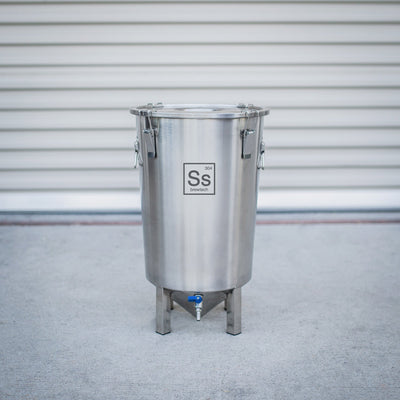
There is a small localized spot or area of rust on my kettle / fermenter that I bought recently. I thought stainless steel can't rust? +

Stainless steel itself shouldn't rust, you are right there. Especially a high grade 304 Ss like we use on all of our products. But what can rust are surface particles of iron that are sometimes left residual from the manufacturing process and the tools used to grind and polish the interiors and exteriors of Ss Brewtech's various vessels. This is one reason why proper cleaning and care prior to first use (or even exposure to water) is important. We have detailed documentation both in the box and on our website on all the product pages. The main thing here is cleaning and conditioning the stainless the first time prior to exposure to beer, water, whatever… In any case, if you do see a localized spot(s) of surface rust - simply get yourself a WHITE (NOT green type pad if you can avoid it) Scotchbrite pad, dab some Starsan onto the pad, and then GENTLY brush over the area in question until the surface rust has broken up and the area looks consistent with the surrounding areas of stainless. Then just rinse off, dry it with a paper towel, and the area will be good to go and free of the surface layer iron particles that were causing the issue to begin with.

Is my beer finished fermenting? +

If you have waited two weeks for an ale, or four weeks for a lager, or you're just curious. Most veteran homebrewers will tell you the beer is done once the airlock stops bubbling but this isn't a sure thing that fermentation is complete. This is where a hydrometer is sometimes worth its weight in gold. If you call our advice line and ask "Is my beer finished fermenting?" the first question will be, "Have you taken a hydrometer reading?" A hydrometer reading at the end of fermentation is called a final gravity reading, often abbreviated "FG". This tells you the amount of sugar left in the beer. Most yeast strains consume 65-75% of sugar in solution, this is called "attenuation." Here's an example gravity: OG: 1.050 your Goal FG would be: 1.010-1.015. If you are more than a few points above your estimated FG you will need to wait a couple more days. After a few days take another reading to see if the FG has dropped. If the FG has not dropped you will either need to consult us on our advice line at 925-671-4958. We will ask you some questions about the recipe, the yeast strain, and the fermentation temperatures your beer was exposed to. Sometimes we have some insightful comments on why fermentation is acting strangely, and other times only the beer Gods know.

My beer started fermenting, then stopped, and then started again? +

This usually happens when the beer goes through temperature changes. The yeast stops fermenting when it gets cold as the metabolic activity of the yeast slows down. It then proceeds to start up again when the fermenter warms up. If your fermentation gets stuck warm up the beer to the desired temperature range for your yeast. Sometimes it helps to give the carboy a swirl. DO NOT add oxygen. If there is one step you do as a homebrewer, investing in temperature control equipment will be the best thing you ever do for your beer.

Login

Forgot your password?

Don't have an account yet?
Create account