CALI is the classic American ale strain famous for its clean, neutral flavor and its ability to be used in nearly any style
A quintessential house strain that will allow malt and hops to shine
Designed to be sprinkled directly onto the surface of your wort with no pre-oxygenation before pitching required
Ferment between 59-72°F
CellarScience offers high-quality yeast that is easy to use, consistent, and available at a tremendous value
The classic American ale strain that has a long history of producing amazing beers. Famous for its clean, neutral flavor and its ability to be used in nearly any style. The reason this is the most popular strain in homebrewing and craft brewing is that it allows malt and hops to shine. You can never go wrong with CALI. Like all CellarScience yeast, CALI is eligible for direct pitch straight into your wort. CellarScience provides 12g of yeast per sachet, which is up to 9% more than any other brand of dry yeast. Every batch of yeast is PCR tested to ensure quality. CALI has been selling to pro breweries for awhile but was just recently packaged down to sachets for homebrewers.
Dosage:
One sachet is enough to treat a 5-6 gallon batch. When calculating for larger batches, use at a rate of 2-3 grams per gallon of wort. We recommend rounding up by one full sachet rather than measuring out the yeast exactly.
Direct Pitch or Rehydrate:
CALI yeast is designed to be sprinkled directly onto the surface of your wort with no oxygenation required in the initial fermentation. Our aerobic growth process makes this possible by creating dry yeast with high viability and high sterol levels. CALI yeast is pre-loaded with essential nutrients to ensure a successful, complete fermentation. While not required, some brewers prefer to rehydrate yeast. To hydrate yeast, first, sanitize the yeast brick and scissors. Use 10 grams of sterilized tap water between 85-95°F (29-35°C) mixed with 0.25 grams of FermStart per gram of yeast. Sprinkle yeast on the water. Allow the slurry to stand undisturbed for 20 minutes, then swirl. Use small amounts of wort to adjust to within 10°F (6°C) of wort temperature before pitching. Ferment between 59-72°F (15-22°C).
Optimum Fermentation Temp: 59-72°F
Flocculation: Medium
Alcohol Tolerance: 10-11% ABV (WY1056 11%)
Attenuation: 75-84%
Similar Strains: WLP001, WY1056, US-05
Gluten-free
CellarScience Yeast:
For years liquid yeast has been sold as the higher quality option but times are changing. Yes, 20 years ago dry yeast was made by bread yeast producers and the quality was not as good as liquid yeast. CellarScience is helping to flip that script with a full lineup of high-quality dry yeasts. Cell count and viability is usually higher than commercial liquid yeast pitches, which vary from pouch to pouch and don't ship well. CellarScience yeast can be pitched directly in most batches of wort, offering significant time savings. Yeast that is quick and easy to use, high quality, and available at a reasonable cost adds up to a tremendous value. Quality yeast that doesn't "break the brink".
CellarScience Nutrients:
For high gravity ferments consider rehydrating yeast with CellarScience FermStart yeast hydration nutrient. For high gravity or low nutrient wort, feed your fermentation with CellarScience FermFed DAP Free complex yeast nutrient mix.
Due to high demand, the 500 g is currently out of stock. Be the first to receive your items by placing a pre-order today. We will automatically ship this to you when we receive more inventory.
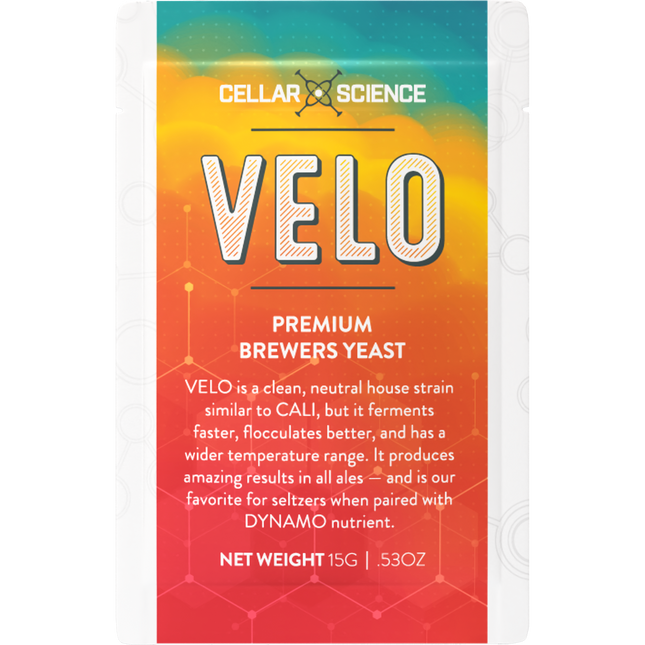
Our top choice for Seltzers — highly efficient at metabolizing simple sugars with minimal off-flavors (low fusel/sulfur)
Amazing house strain – for neutral-profile ales
VELO delivers – rapid fermentation while maintaining a clean, neutral profile
Doesn’t require temperature control - Loves to ferment Hot
Ferment between 60-94°F
Designed to be sprinkled directly onto the surface of your wort with no pre-oxygenation before pitching required
Amazing as a House Strain
VELO is a high-performance ale yeast selected for speed, flavor neutrality, and wide temperature tolerance. In internal sensory comparisons, VELO’s ester suppression and clean finish exceeded CellarScience CALI, while offering faster kinetics and a wide operating range that, within reason, can substantially reduce the need for temperature control. We’ve found it to be a dependable house strain across styles, especially for hop-forward ales. delivering clean results quickly while staying remarkably forgiving across real-world fermentation conditions
Why It Works in Seltzers
For hard seltzer production, VELO excels thanks to highly efficient metabolism of simple sugars (“mono- and disaccharides”) with low fusel and sulfur byproducts when supported by a complete nutrient regimen. When developing our Seltzer nutrient Dynamo 800 we tried many yeasts and Velo was consistently the best. From there we tweaked the formulation specifically for Velo with over 60 fermentations. Across broader sensory feedback beyond internal bench work, VELO consistently presented as noticeably cleaner than several common industry benchmarks, delivering a true neutral, blank-canvas base that stays out of the way of your seltzer flavor additions.
Lagers Fermented at Warmer Temperatures (Sometimes called pseudo-lagers)
VELO excels in this role by delivering a clean, lager-like profile at ale fermentation temperatures. Its wide operating range (60–94°F / 16–34°C), fast kinetics, and low ester/phenol expression let you run lager-style recipes in the mid-60s to low-70s °F without temperature control. When you ferment under pressure (up to 12 PSI), you can push these lager-like beers toward the upper end of VELO’s range right up to 94°F while still maintaining a neutral, crisp finish. High attenuation and medium–high flocculation help the beer finish dry and drop clear quickly, making VELO an amazing house strain for clean, lager-like beers on an ale timeline.
Technical Attributes
Neutral & Clean: Ester/phenol expression held very low; as clean or cleaner than CellarScience CALI in sensory comparisons.
Fast Fermentation: Wraps primary quickly, reducing tank residency and tightening production schedules.
Wide Temp Range: Performs cleanly from 60–94 °F (16–34 °C) with minimal off-flavors—useful where tight temperature control isn’t feasible.
Pressure-Ready: Stable up to 12 PSI, ideal for closed or spunded ferments.
Hop-Smart: Preserves hop brightness in modern IPAs while remaining tidy in low-IBU and malt-forward beers.
High Attenuation: ~75–83 % for a dry, polished finish; alcohol tolerance up to 10 % ABV with full nutrient support.
Medium–High Flocculation: Drops bright post-fermentation while staying in suspension long enough to finish cleanly.
Thermotolerant Physiology: Robust stress response (e.g., trehalose storage) supports clean performance at elevated temperatures.
Specifications:
Fermentation Temperature: 60–94°F (16–34°C)
Apparent Attenuation: ~75–83 %
Alcohol Tolerance: up to 10 % ABV (with complete nutrient regimen)
Flocculation: Medium–High
Pressure Tolerance: up to 12 PSI
Format: 15 g high-cell-count sachet (≈ 36 % more than standard 11 g)
Direct Pitch: No rehydration required
Quality Control: Every batch PCR-verified for purity and consistency
Applications
Clean ales and pseudo-lagers • West Coast/Cali-style IPAs • Pale & session ales • Kölsch-like ferments • Hard seltzers and other sugar-based ferments
Dosage
Homebrew: One 15 g sachet treats 5–6 gal (19–23 L).
Scale-up: Use 2–3 g/gal (0.5–0.8 g/L). When scaling, round up to the next full sachet for consistency.
VELO is the practical house strain for clean results on a tight timeline—neutral like CALI, ferments fast, handles a wide temperature range, and produces a polished finish in beer and seltzer when paired with appropriate nutrients.
Due to high demand, the 500 g is currently out of stock. Be the first to receive your items by placing a pre-order today. We will automatically ship this item to you when we receive more in mid August.
WEST COAST is a refined evolution of the classic American ale strain engineered for modern brewing while honoring its proven roots
Clean, versatile, and reliable, it’s ideal for brewers seeking subtle depth without compromising balance at an unbeatable value
Designed to be sprinkled directly onto the surface of your wort with no pre-oxygenation before pitching required
Ferment between 59-72°F
WEST COAST is a refined evolution of the classic American ale strain engineered for modern brewing while honoring its proven roots. It delivers the same clean, dependable performance as CALI, with just a trace of fruit character that lends a quiet depth to the final beer. This nuance stays well in the background, complementing rather than competing with hops or malt. Ideal as a house strain, WEST COAST can refresh a Flagship recipe or anchor a new one, offering robust, reliable fermentations every time. Designed for simplicity, it can be pitched directly into wort no oxygenation or rehydration required.
Flocculation: Medium to High
Fermentation: Range: 59-72ºF (15-22°C)
Attenuation: Approximately 75–84%
Alcohol Tolerance: 10% ABV
Direct Pitch: No rehydration needed
Reliable & Consistent: Every batch undergoes PCR testing for quality
High Cell Count: 15g per sachet—over 36% more than standard 11g dry yeast packs
Dosage:
One sachet is enough to treat a 5–6 gallon batch. When calculating for larger batches, use at a rate of 2–3 grams per gallon of wort. We recommend rounding up by one full sachet rather than measuring out the yeast exactly.
Like all CellarScience yeast, WEST COAST offers professional-grade performance for both homebrewers and craft brewers at an unbeatable value. If you love the clean versatility of CALI but want a touch more character, West Coast is your next go-to strain.
Due to high demand, the 500 g is currently out of stock. Be the first to receive your items by placing a pre-order today. We will automatically ship this to you when we receive more inventory.
JUNGLE produces intense notes of guava, passion fruit, and mango, specializing in hop biotransformation to boost fruity hop character
Performs reliably across a wide temperature range and tolerates up to 15% ABV and 12 PSI of pressure
Designed to be sprinkled directly onto the surface of your wort with no pre-oxygenation before pitching required
Ferment between 65-90°F
JUNGLE is a high performance ale yeast strain that specializes in massive fruity esters. It produces a distinct guava, passion fruit and mango aroma. This strain excels at biotransformation, enhancing hop character when paired with big dry-hop additions—select a fruity hop variety to maximize its potential. JUNGLE thrives in a wide fermentation temperature range, ensuring minimal risk of off-flavors even at high temperatures or with temperature fluctuations. It’s also extremely robust, capable of tolerating alcohol levels up to 15% ABV and fermenting under pressure up to 12 PSI. With accelerated maturation, JUNGLE delivers a drinkable beer in just days, making it an ideal choice for both pros and homebrewers alike.
Biotransformation Powerhouse: Maximizes hop aroma and flavor
Fast Fermentation & Maturation: Drinkable beer in just days
Wide Temperature Tolerance: Ferments cleanly across a broad temperature range 65-90°F (18-32°C)
Attenuation: 73-80%
Alcohol Tolerance: Up to 15% ABV
Pressure-Tolerant: Ferments under pressure up to 12 PSI
Direct Pitch: No rehydration needed
Reliable & Consistent: Every batch undergoes PCR testing for quality assurance
High Cell Count: 15g per sachet, over 36% more than standard 11g dry yeast packs
Versatile for Homebrewers & Pros: Professional-grade performance at an unbeatable value
Dosage:
One sachet is enough to treat a 5–6 gallon batch. When calculating for larger batches, use at a rate of 2–3 grams per gallon of wort. We recommend rounding up by one full sachet rather than measuring out the yeast exactly.
Like all CellarScience yeasts, JUNGLE offers professional-grade performance for both homebrewers and craft brewers, delivering exceptional quality at an unbeatable value.
Due to high demand, the 500 g is currently out of stock. Be the first to receive your items by placing a pre-order today. We will automatically ship this to you when we receive more inventory.
HEFE produces classic banana and clove notes for traditional Hefeweizen
Contributes to a smooth body, persistent haze, and high drinkability
Designed to be sprinkled directly onto the surface of your wort with no pre-oxygenation before pitching required
Ferment between 59-77°F
HEFE is a top-fermenting dry yeast, crafted specifically for wheat beers. It produces the hallmark banana and clove aromas expected in traditional Hefeweizen styles, with a clean, smooth finish and excellent drinkability. HEFE produces bright, refreshing wheat beers with pronounced banana notes (isoamyl acetate) at the higher end of its temperature range. Subtle clove character (4-vinyl guaiacol) at the lower end. Expect a smooth body and a persistent, signature haze.
Fermentation Temperature: 59-77°F (15-25°C), optimal range 64-72°F (18-22°C)
Attenuation: 80–91%
Alcohol Tolerance: Up to 10% ABV
Flocculation: Low
Direct Pitch: No rehydration needed
Reliable & Consistent: Every batch undergoes PCR testing for quality control
High Cell Count: 15g per sachet (over 36% more than standard 11g dry yeast packs)
Dosage:
One sachet is enough to treat a 5–6 gallon batch. When calculating for larger batches, use at a rate of 2–3 grams per gallon of wort. We recommend rounding up by one full sachet rather than measuring out the yeast exactly.
Like all CellarScience yeasts, HEFE offers professional-grade performance for both homebrewers and craft brewers, delivering exceptional quality at an unbeatable value.
NE HAZY is a low-flocculating, biotransformative yeast designed for NE-style hazy beers
Enhances mouthfeel, turbidity, and hop aroma, creating a juicy, pillowy body and stable haze perfect for Hazy IPAs and juicy doubles
Designed to be sprinkled directly onto the surface of your wort with no pre-oxygenation before pitching required
Ferment between 62-75°F
NE HAZY – The Yeast for Hazy, Juicy Beers
NE HAZY is our specialized ale yeast for New England style (NE) hazy beers. If you’re looking to craft a juicy, flavor-packed brew with a lasting, stable haze, this strain has you covered.
This low-flocculating, biotransformative strain enhances mouthfeel and turbidity through its interaction with glycoproteins and hop compounds, making it ideal for NEIPAs, Hazy IPAs, Pale Ales, and Juicy Doubles. During fermentation, it releases mannoproteins, a class of glycoproteins from its cell walls that create a soft, pillowy body while reinforcing haze stability.
NE HAZY actively participates in biotransformation, modifying hop-derived polyphenols and interacting with protein-rich compounds from wheat and oats. This process forms stable protein-polyphenol complexes that lock haze into suspension and intensify the beer’s juicy, full-bodied character. The result is an exceptionally stable haze, smooth-drinking beer with elevated mouthfeel, hop saturation, and tropical fruit expression.
It ferments cleanly across a wide temperature range (62–75°F / 17–24°C) and is pressure-tolerant up to 12 PSI, making it highly versatile for a variety of brewhouse setups.
Amplifies Hop Aroma & Flavor: Boosts tropical and citrus notes for NE-style juiciness
Enhances Juicy Character: Transforms hop precursors into free thiols like grapefruit, passionfruit, guava, pineapple, peach, apricot, tangerine, and lime
Boosts Haze Stability: Builds durable haze through glycoprotein and polyphenol interactions
Flexible Fermentation: Performs across 62–75°F (17–24°C); pressure-tolerant to 12 PSI
Robust & Reliable: Medium-low flocculation, consistent haze retention
Attenuation: ~75–80%
Alcohol Tolerance: 12% ABV
Direct Pitch: No rehydration needed
Quality Control: Every batch PCR-verified for purity and consistency
High Cell Count: 15 g per sachet — over 36% more than standard 11 g dry yeast packs
Dosage
One sachet treats 5–6 gal (19–23 L). For larger batches, use 2–3 g/gal (0.5–0.8 g/L). Round up to the next full sachet rather than measuring precisely.
Like all CellarScience yeasts, NE HAZY delivers professional-grade performance for both homebrewers and craft brewers producing the saturated, juicy haze that defines the modern New England IPA.
ENGLISH is a rapid fermenting English ale strain that is loved for its clean flavor, neutral aroma and dry finish Recommended for all types of ales from malt-forward Ambers and Porters to high-gravity IPAs and hoppy Pales Designed to be sprinkled directly onto the surface of your wort with no pre-oxygenation before pitching required Ferment between 61-70°F CellarScience offers high-quality yeast that is easy to use, consistent, and available at a tremendous value A rapid fermenting English ale strain that is loved for its clean flavor, neutral aroma and dry finish. This yeast settles quickly and forms a compact sediment. Like all CellarScience yeast, ENGLISH is eligible for direct pitch straight into your wort. CellarScience provides 12g of yeast per sachet, which is up to 9% more than any other brand of dry yeast. Every batch of yeast is PCR tested to ensure quality. ENGLISH has been selling to pro breweries for awhile but was just recently packaged down to sachets for homebrewers. Dosage: One sachet is enough to treat a 5–6 gallon batch. When calculating for larger batches, use at a rate of 2–3 grams per gallon of wort. We recommend rounding up by one full sachet rather than measuring out the yeast exactly. Direct Pitch or Rehydrate: ENGLISH yeast is designed to be sprinkled directly onto the surface of your wort with no oxygenation required in the initial fermentation. Our aerobic growth process makes this possible by creating dry yeast with high viability and high sterol levels. ENGLISH yeast is pre-loaded with essential nutrients to ensure a successful, complete fermentation. While not required, some brewers prefer to rehydrate yeast. To hydrate yeast, first, sanitize the yeast brick and scissors. Use 10 grams of sterilized tap water between 85-95°F (29-35°C) mixed with 0.25 grams of FermStart per gram of yeast. Sprinkle yeast on the water. Allow the slurry to stand undisturbed for 20 minutes, then swirl. Use small amounts of wort to adjust to within 10°F (6°C) of wort temperature before pitching. Ferment between 61-70°F (16-21°C). Optimum Fermentation Temp: 61-70°F Flocculation: Very High Alcohol Tolerance: 12% ABV Attenuation: 75-83% Similar Strains: WLP007, WY1098, S-04 Gluten-free CellarScience Yeast: For years liquid yeast has been sold as the higher quality option but times are changing. Yes, 20 years ago dry yeast was made by bread yeast producers and the quality was not as good as liquid yeast. CellarScience is helping to flip that script with a full lineup of high-quality dry yeasts. Cell count and viability is usually higher than commercial liquid yeast pitches, which vary from pouch to pouch and don't ship well. CellarScience yeast can be pitched directly in most batches of wort, offering significant time savings. Yeast that is quick and easy to use, high quality, and available at a reasonable cost adds up to a tremendous value. Quality yeast that doesn't "break the brink". CellarScience Nutrients: For high gravity ferments consider rehydrating yeast with CellarScience FermStart yeast hydration nutrient. For high gravity or low nutrient wort, feed your fermentation with CellarScience FermFed DAP Free complex yeast nutrient mix.
BAJA is a versatile lager strain with neutral character and finishes dry Perfect for Mexican-style light lagers, dark lagers, and cold IPAs Designed to be sprinkled directly onto the surface of your wort with no pre-oxygenation before pitching required Ferment between 50-56°F CellarScience offers high-quality yeast that is easy to use, consistent, and available at a tremendous value If you're looking for a cold fermenting yeast with a neutral character, BAJA from CellarScience is the perfect candidate. Originally developed and popularized by the Modelo Group, this Mexican yeast strain will produce clean, crisp lagers and finishes dry. Allowing for the balanced expression of malt and hops, BAJA will become your go-to yeast for fermenting Mexican-style light lagers, dark lagers, and cold IPAs. Every batch is PCR tested to ensure contamination free yeast. Dosage: Two sachets are enough to treat a 5–6 gallon batch. When calculating for larger batches, use at a rate of 2.5–4 grams per gallon of wort. We recommend rounding up by one full sachet rather than measuring out the yeast exactly. Direct Pitch or Rehydrate: BAJA yeast is designed to be sprinkled directly onto the surface of your wort with no oxygenation required in the initial fermentation. Our aerobic growth process makes this possible by creating dry yeast with high viability and high sterol levels. BAJA yeast is pre-loaded with essential nutrients to ensure a successful, complete fermentation. While not required, some brewers prefer to rehydrate yeast. To hydrate yeast, first, sanitize the yeast brick and scissors. Use 10 grams of sterilized tap water between 85-95°F (29-35°C) mixed with 0.25 grams of FermStart per gram of yeast. Sprinkle yeast on the water. Allow the slurry to stand undisturbed for 20 minutes, then swirl. Use small amounts of wort to adjust to within 10°F (6°C) of wort temperature before pitching. Ferment between 50-56°F (10-13°C). Optimum Fermentation Temp: 50-56°F Flocculation: Medium-High Alcohol Tolerance: 10-11% ABV Attenuation: 75-85% Similar Strains: WLP940 Gluten-free CellarScience Yeast: For years liquid yeast has been sold as the higher quality option but times are changing. Yes, 20 years ago dry yeast was made by bread yeast producers and the quality was not as good as liquid yeast. CellarScience is helping to flip that script with a full lineup of high-quality dry yeasts. Cell count and viability is usually higher than commercial liquid yeast pitches, which vary from pouch to pouch and don't ship well. CellarScience yeast can be pitched directly in most batches of wort, offering significant time savings. Yeast that is quick and easy to use, high quality, and available at a reasonable cost adds up to a tremendous value. Quality yeast that doesn't "break the brink". CellarScience Nutrients: For high gravity ferments consider rehydrating yeast with CellarScience FermStart yeast hydration nutrient. For high gravity or low nutrient wort, feed your fermentation with CellarScience FermFed DAP Free complex yeast nutrient mix.
HAZY is the ideal strain for fermenting expressive New England IPAs or Hazy Pale Ales, enhancing the fruit-forward character of your hops Leaves beer with a hazy appearance while contributing its own ester profile with notes of peach, citrus, mango and passionfruit Designed to be sprinkled directly onto the surface of your wort with no pre-oxygenation before pitching required Ferment between 62-75°F CellarScience offers high-quality yeast that is easy to use, consistent, and available at a tremendous value For hop-forward beer styles that you want bursting with tropical, fruity flavors and aromas, you can't go wrong fermenting with HAZY from CellarScience. HAZY will enhance the fruit-forward 'juicy' character of your hops while contributing its own ester profile with notes of peach, citrus, mango and passionfruit. It will be more expressive the higher in its temperature range you let it go, leaving your beer with a hazy appearance when its finished. This is the ideal strain for fermenting expressive New England IPAs or Hazy Pale Ales. Every batch is PCR tested to ensure contamination free yeast. Dosage: One sachet is enough to treat a 5–6 gallon batch. When calculating for larger batches, use at a rate of 2–3 grams per gallon of wort. We recommend rounding up by one full sachet rather than measuring out the yeast exactly. Direct Pitch or Rehydrate: HAZY yeast is designed to be sprinkled directly onto the surface of your wort with no oxygenation required in the initial fermentation. Our aerobic growth process makes this possible by creating dry yeast with high viability and high sterol levels. HAZY yeast is pre-loaded with essential nutrients to ensure a successful, complete fermentation. While not required, some brewers prefer to rehydrate yeast. To hydrate yeast, first, sanitize the yeast brick and scissors. Use 10 grams of sterilized tap water between 85-95°F (29-35°C) mixed with 0.25 grams of FermStart per gram of yeast. Sprinkle yeast on the water. Allow the slurry to stand undisturbed for 20 minutes, then swirl. Use small amounts of wort to adjust to within 10°F (6°C) of wort temperature before pitching. Ferment between 62-75°F (17-24°C). Optimum Fermentation Temp: 62-75°F Flocculation: Medium-Low Alochol Tolerance: 11-12% ABV Attenuation: 75-80% Similar Strains: WLP06, WY1318 Gluten-free CellarScience Yeast: For years liquid yeast has been sold as the higher quality option but times are changing. Yes, 20 years ago dry yeast was made by bread yeast producers and the quality was not as good as liquid yeast. CellarScience is helping to flip that script with a full lineup of high-quality dry yeasts. Cell count and viability is usually higher than commercial liquid yeast pitches, which vary from pouch to pouch and don't ship well. CellarScience yeast can be pitched directly in most batches of wort, offering significant time savings. Yeast that is quick and easy to use, high quality, and available at a reasonable cost adds up to a tremendous value. Quality yeast that doesn't "break the brink". CellarScience Nutrients: For high gravity ferments consider rehydrating yeast with CellarScience FermStart yeast hydration nutrient. For high gravity or low nutrient wort, feed your fermentation with CellarScience FermFed DAP Free complex yeast nutrient mix.
GERMAN is the classic lager strain from Weihenstephan Germany that has been used for generations
Produces clean, balanced lagers from pilsners to doppelbocks
Designed to be sprinkled directly onto the surface of your wort with no pre-oxygenation before pitching required
Ferment between 50-59°F
CellarScience offers high-quality yeast that is easy to use, consistent, and available at a tremendous value
The classic lager strain from Weihenstephan Germany that has been used for generations to produce clean, balanced lagers from pilsners to doppelbocks. Like all CellarScience yeast, GERMAN is eligible for direct pitch straight into your wort. CellarScience provides 12g of yeast per sachet, which is up to 9% more than any other brand of dry yeast. Every batch of yeast is PCR tested to ensure quality. GERMAN has been selling to pro breweries for awhile but was just recently packaged down to sachets for homebrewers.
Dosage:
One sachet is enough to treat a 5–6 gallon batch. When calculating for larger batches, use at a rate of 2.5–4 grams per gallon of wort. We recommend rounding up by one full sachet rather than measuring out the yeast exactly.
Direct Pitch or Rehydrate:
GERMAN yeast is designed to be sprinkled directly onto the surface of your wort with no oxygenation required in the initial fermentation. Our aerobic growth process makes this possible by creating dry yeast with high viability and high sterol levels. GERMAN yeast is pre-loaded with essential nutrients to ensure a successful, complete fermentation. While not required, some brewers prefer to rehydrate yeast. To hydrate yeast, first, sanitize the yeast brick and scissors. Use 10 grams of sterilized tap water between 85-95°F (29-35°C) mixed with 0.25 grams of FermStart per gram of yeast. Sprinkle yeast on the water. Allow the slurry to stand undisturbed for 20 minutes, then swirl. Use small amounts of wort to adjust to within 10°F (6°C) of wort temperature before pitching. Ferment between 50-59°F (10-15°C).
Optimum Fermentation Temp: 50-59°F
Flocculation: High
Alcohol Tolerance: 9-10% ABV (WY2124 9%)
Attenuation: 78-85%
Similar Strains: WLP830, WY2124, W-34/70
Gluten-free
CellarScience Yeast:
For years liquid yeast has been sold as the higher quality option but times are changing. Yes, 20 years ago dry yeast was made by bread yeast producers and the quality was not as good as liquid yeast. CellarScience is helping to flip that script with a full lineup of high-quality dry yeasts. Cell count and viability is usually higher than commercial liquid yeast pitches, which vary from pouch to pouch and don't ship well. CellarScience yeast can be pitched directly in most batches of wort, offering significant time savings. Yeast that is quick and easy to use, high quality, and available at a reasonable cost adds up to a tremendous value. Quality yeast that doesn't "break the brink".
CellarScience Nutrients:
For high gravity ferments consider rehydrating yeast with CellarScience FermStart yeast hydration nutrient. For high gravity or low nutrient wort, feed your fermentation with CellarScience FermFed DAP Free complex yeast nutrient mix.
ACID yeast will complete both Lactic and Alcoholic fermentation on its own, producing an acidic beer with light notes of fruity floral esters
Shave days off your sour beer making process by skipping the kettle souring step altogether!
No need for added equipment to purge your kettle with CO2 or add heating to maintain high temps for lactic fermentation
To reduce acidity, pitch an ale yeast strain to stop souring and wrap up alcoholic fermentation
Ferment between 66-77°F
CellarScience offers high-quality yeast that is easy to use, consistent, and available at a tremendous value
Consistent, repeatable results without the need for kettle souring. ACID from CellarScience is a naturally selected, GMO-free yeast strain that has the ability to ferment and sour beer simultaneously. In a traditional kettle souring process, you'll need to pre-boil wort, purge it with CO2, pitch lactic acid, wrap and seal the kettle, and insulate or provide a heat source to maintain lactic acid fermentation temps that may be as high as 100°F+ depending on your chosen pitch. ACID allows brewers to bypass those steps and produce sour beers with the equipment they already own. Pitch directly in your fermenter and ACID yeast will complete both Lactic and Alcoholic fermentation on its own. When allowed to run its course, this yeast produces a rounded, refreshingly acidic beer with light notes of fruity floral esters.
If you wish to reduce acidity, simply pitch a regular ale yeast strain when the desired pH is obtained which will hault souring and complete the rest of the alcoholic fermentation.
Every batch is PCR tested to ensure quality.
Dosage:
Use at a rate of 80-120 grams per barrel, depending on wort temperature and gravity.
Direct Pitch or Rehydrate:
ACID yeast is designed to be sprinkled directly onto the surface of your wort with no oxygenation required in the initial fermentation. Our aerobic growth process makes this possible by creating dry yeast with high viability and high sterol levels. ACID yeast is pre-loaded with essential nutrients to ensure a successful, complete fermentation. While not required, some brewers prefer to rehydrate yeast. To hydrate yeast, first, sanitize the yeast brick and scissors. Use 10 grams of sterilized tap water between 85-95°F (29-35°C) mixed with 0.25 grams of FermStart per gram of yeast. Sprinkle yeast on the water. Allow the slurry to stand undisturbed for 20 minutes, then swirl. Use small amounts of wort to adjust to within 10°F (6°C) of wort temperature before pitching. Ferment between 66-77°F (19-25°C).
Optimum Fermentation Temp: 66-77°F
Flocculation: High
Alcohol Tolerance: 9% ABV
Attenuation: 75-80%
Lachancea thermotolerans
Gluten-free
CellarScience Yeast:
For years liquid yeast has been sold as the higher quality option but times are changing. Yes, 20 years ago dry yeast was made by bread yeast producers and the quality was not as good as liquid yeast. CellarScience is helping to flip that script with a full lineup of high-quality dry yeasts. Cell count and viability is usually higher than commercial liquid yeast pitches, which vary from pouch to pouch and don't ship well. CellarScience yeast can be pitched directly in most batches of wort, offering significant time savings. Yeast that is quick and easy to use, high quality, and available at a reasonable cost adds up to a tremendous value. Quality yeast that doesn't "break the brink".
CellarScience Nutrients:
For high gravity ferments consider rehydrating yeast with CellarScience FermStart yeast hydration nutrient. For high gravity or low nutrient wort, feed your fermentation with CellarScience FermFed DAP Free complex yeast nutrient mix.
ACID yeast will complete both Lactic and Alcoholic fermentation on its own, producing an acidic beer with light notes of fruity floral esters
Shave days off your sour beer making process by skipping the kettle souring step altogether!
No need for added equipment to purge your kettle with CO2 or add heating to maintain high temps for lactic fermentation
To reduce acidity, pitch an ale yeast strain to stop souring and wrap up alcoholic fermentation
Ferment between 66-77°F
CellarScience offers high-quality yeast that is easy to use, consistent, and available at a tremendous value
Consistent, repeatable results without the need for kettle souring. ACID from CellarScience is a naturally selected, GMO-free yeast strain that has the ability to ferment and sour beer simultaneously. In a traditional kettle souring process, you'll need to pre-boil wort, purge it with CO2, pitch lactic acid, wrap and seal the kettle, and insulate or provide a heat source to maintain lactic acid fermentation temps that may be as high as 100°F+ depending on your chosen pitch. ACID allows brewers to bypass those steps and produce sour beers with the equipment they already own. Pitch directly in your fermenter and ACID yeast will complete both Lactic and Alcoholic fermentation on its own. When allowed to run its course, this yeast produces a rounded, refreshingly acidic beer with light notes of fruity floral esters.
If you wish to reduce acidity, simply pitch a regular ale yeast strain when the desired pH is obtained which will hault souring and complete the rest of the alcoholic fermentation.
Every batch is PCR tested to ensure quality.
Dosage:
Use at a rate of 80-120 grams per barrel, depending on wort temperature and gravity.
Direct Pitch or Rehydrate:
ACID yeast is designed to be sprinkled directly onto the surface of your wort with no oxygenation required in the initial fermentation. Our aerobic growth process makes this possible by creating dry yeast with high viability and high sterol levels. ACID yeast is pre-loaded with essential nutrients to ensure a successful, complete fermentation. While not required, some brewers prefer to rehydrate yeast. To hydrate yeast, first, sanitize the yeast brick and scissors. Use 10 grams of sterilized tap water between 85-95°F (29-35°C) mixed with 0.25 grams of FermStart per gram of yeast. Sprinkle yeast on the water. Allow the slurry to stand undisturbed for 20 minutes, then swirl. Use small amounts of wort to adjust to within 10°F (6°C) of wort temperature before pitching. Ferment between 66-77°F (19-25°C).
Optimum Fermentation Temp: 66-77°F
Flocculation: High
Alcohol Tolerance: 9% ABV
Attenuation: 75-80%
Lachancea thermotolerans
Gluten-free
CellarScience Yeast:
For years liquid yeast has been sold as the higher quality option but times are changing. Yes, 20 years ago dry yeast was made by bread yeast producers and the quality was not as good as liquid yeast. CellarScience is helping to flip that script with a full lineup of high-quality dry yeasts. Cell count and viability is usually higher than commercial liquid yeast pitches, which vary from pouch to pouch and don't ship well. CellarScience yeast can be pitched directly in most batches of wort, offering significant time savings. Yeast that is quick and easy to use, high quality, and available at a reasonable cost adds up to a tremendous value. Quality yeast that doesn't "break the brink".
CellarScience Nutrients:
For high gravity ferments consider rehydrating yeast with CellarScience FermStart yeast hydration nutrient. For high gravity or low nutrient wort, feed your fermentation with CellarScience FermFed DAP Free complex yeast nutrient mix.
The ideal yeast for producing a very neutral, clean base for hard seltzers, canned cocktails, further distillation, etc.
Works with malt or sugar fermentations
Includes nutrients and pH buffers to keep fermentation humming to finish
Able to handle high levels of ethanol and osmotic pressure
Ferments clean up to 80°F
Our motto is to Empower Your Creative Vision. Origin is a unique style of yeast used to create a neutral alcoholic base that acts as the Origin upon which you layer other flavors. Perfect for Hard Seltzers, Canned Cocktails, and whatever else you can dream up. Also great for neutral washes designed for distillation and tough to ferment honey-based mead fermentations. Works on both sugar, honey, and malt-based fermentations. The secret sauce is a very neutral, high alcohol tolerant yeast combined with nutrients and pH buffers. The non-urea-based nutrients help the yeast in simple sugar mediums naturally low in nutrients. pH buffers ensure a high enough pH to allow the yeast to run to completion in even the toughest of situations. The yeast strain used in Origin is a very low producer of H2S and fruity esters resulting in a clean final product. Origin stays clean at higher fermentation temperatures up to 80°F. Origin could technically be called a Turbo Yeast being packed with nutrients. However, we don't like that association as many turbo Yeasts are not selected and assembled for quality and flavor but rather price and speed. Turbo Yeasts also do not include pH buffers. Origin will work with all commonly used sugars, including sucrose, dextrose, and liquid invert sugar. When fermenting wort from malted barley, use our Brutzyme Glucoamylase Enzyme to break down α-1,4 and α-1,6 glycosidic linkages of starch, dextrins, and oligosaccharides for a drier, more fully attenuated final product. Pilot batches should always be performed to find the optimum final product for your further vision. Directions: Add 10 to 20 g per gal (2.5 to 5 g per liter) directly into your fermentation with no hydration required. Ferment between 65 to 80°F (18-27°C). We recommend starting with a dosage of 15 g per gal (4 g per liter) and adjusting as desired in future batches.
One of the most trusted, top-selling strains in craft brewing!
Ferment almost any style of ale ranging from IPA to Kölsch with this fantastic all-around house strain
Produces a clean, dry, balanced beer that accentuates the flavor of malt and hops
Dry format is gluten-free and has an extended shelf life compared to liquid—keep on hand and use with confidence!
White Labs Yeast has been producing high-quality brewers yeast since 1995 and continues to raise the bar in the art of fermentation
Our top-selling yeast! White Labs California Ale yeast is known for its ability to be used in almost any style Ale. It produces a clean, dry, balanced beer. It also accentuates the flavor of the malt and hops in your homebrew. This strain was the first yeast strain produced by White Labs in 1995. When used in hoppy beers, it accentuates hop flavors and aromas and attenuates well, even for high-gravity beers. This strain can be used in almost any style of ale ranging from IPA to porter and even Kölsch, making it a great all-around house strain. WLP001 is a genetically different strain than other descendants of this classic yeast and many brewers prefer WLP001 over similar variations from other companies.
Top Benefits of White Labs Dry Yeast
Performance You Can Rely On. High live cell count and highly shelf-stable result in consistent fermentation performance with every batch.
Convenience of Brew Planning. Extensive shelf life allows you to keep some sachets on hand for your next brew day or in case you ever run into a fermentation issue. Ensure you have viable yeast ready to go even if you have to reschedule your brew day or encounter unforeseen issues like stuck or slow fermentations.
Easy-to-Use. No rehydration or wort aeration is necessary due to the high sterol content and simple measurements of pitch rate by weight for hassle-free fermentations.
Gluten-Free. Propagated using beet molasses and is 100% gluten-free.
Available Anywhere You Brew. White Labs Yeast will now be available for global brewers who had challenges importing liquid yeast, with straightforward and more affordable delivery in dry format.
Attenuation: 73-85%
Flocculation: Medium
Alcohol Tolerance: 5-10% ABV
Optimum Fermentation Temp: 64-73°F
NECTAR is a unique yeast strain recommended for fruit-forward Pale Ales and IPAs Emphasizes fresh malt flavor while contributing fruit, citrus, and floral flavors Designed to be sprinkled directly onto the surface of your wort with no pre-oxygenation before pitching required Ferment between 63-72°F CellarScience offers high-quality yeast that is easy to use, consistent, and available at a tremendous value A fun, unique yeast with a UK pedigree that emphasizes fresh malt flavor while producing fruity, citrus and floral flavors. Perfect for Pale Ales and IPA's. Like all CellarScience yeast, NECTAR is eligible for direct pitch straight into your wort. CellarScience provides 12g of yeast per sachet, which is up to 9% more than any other brand of dry yeast. Every batch of yeast is PCR tested to ensure quality. NECTAR has been selling to pro breweries for awhile but was just recently packaged down to sachets for homebrewers. Dosage: One sachet is enough to treat a 5–6 gallon batch. When calculating for larger batches, use at a rate of 2–3 grams per gallon of wort. We recommend rounding up by one full sachet rather than measuring out the yeast exactly. Direct Pitch or Rehydrate: NECTAR yeast is designed to be sprinkled directly onto the surface of your wort with no oxygenation required in the initial fermentation. Our aerobic growth process makes this possible by creating dry yeast with high viability and high sterol levels. NECTAR yeast is pre-loaded with essential nutrients to ensure a successful, complete fermentation. While not required, some brewers prefer to rehydrate yeast. To hydrate yeast, first, sanitize the yeast brick and scissors. Use 10 grams of sterilized tap water between 85-95°F (29-35°C) mixed with 0.25 grams of FermStart per gram of yeast. Sprinkle yeast on the water. Allow the slurry to stand undisturbed for 20 minutes, then swirl. Use small amounts of wort to adjust to within 10°F (6°C) of wort temperature before pitching. Ferment between 63-72°F (18-22°C). Optimum Fermentation Temp: 63-72°F Flocculation: Medium Alcohol Tolerance: 12% ABV Similar Strains: N/A Attenuation: 75-80% Gluten-free CellarScience Yeast: For years liquid yeast has been sold as the higher quality option but times are changing. Yes, 20 years ago dry yeast was made by bread yeast producers and the quality was not as good as liquid yeast. CellarScience is helping to flip that script with a full lineup of high-quality dry yeasts. Cell count and viability is usually higher than commercial liquid yeast pitches, which vary from pouch to pouch and don't ship well. CellarScience yeast can be pitched directly in most batches of wort, offering significant time savings. Yeast that is quick and easy to use, high quality, and available at a reasonable cost adds up to a tremendous value. Quality yeast that doesn't "break the brink". CellarScience Nutrients: For high gravity ferments consider rehydrating yeast with CellarScience FermStart yeast hydration nutrient. For high gravity or low nutrient wort, feed your fermentation with CellarScience FermFed DAP Free complex yeast nutrient mix.
Due to high demand, the 500 g item is currently out of stock. Be the first to receive your items by placing a pre-order today. We will automatically ship this to you when we receive more inventory.
BIG BEN allows your malt and hop flavors to shine with its neutral profile
Ideal for a wide variety of styles including Pale Ales, ESBS, IPAs, Porters, Stouts, Blonde Ales, and Amber Ales
Designed to be sprinkled directly onto the surface of your wort with no pre-oxygenation before pitching required
Ferment between 59-72°F
BIG BEN, just like its iconic namesake, is big in all the right ways. Known for its exceptional flocculation, this yeast settles quickly, leaving your beer bright and clear. BIG BEN is proudly malt-forward, allowing your grain bill and chosen ingredients to truly shine through. Its neutral profile enhances malt sweetness and hop character without imposing its own flavors, resulting in clean, crisp beers with remarkable clarity. Its high flocculation contributes significantly to its clarity, rapidly settling and making it ideal for styles where visual appeal matters, such as Pale Ales, ESBS, IPAs, Porters, Stouts, Blonde Ales, and Amber Ales.
BIG BEN also boasts impressive alcohol tolerance, comfortably fermenting beers up to 12% ABV, making it suitable for both session ales and higher-gravity brews. Efficient and reliable, BIG BEN consistently achieves attenuation rates up to 82%. It comfortably ferments across a wide temperature range of 55°F to 78°F, making it versatile for various ale styles.
Exceptional flocculation for bright, clear beer
Malt-forward character that lets your grain bill shine
Neutral profile enhances malt sweetness and hop character
Ideal for: Pale Ales, IPAs, Porters, Stouts, Blonde Ales, Amber Ales
Alcohol Tolerance: 12% ABV
Attenuation: Approximately 75- 82%
Fermentation Range: 59-72°F (15-22°C)
Direct Pitch: No rehydration needed
Reliable & Consistent: Every batch undergoes PCR testing for quality
High Cell Count: 15g per sachet—over 36% more than standard 11g dry yeast packs
Dosage:
One sachet is enough to treat a 5–6 gallon batch. When calculating for larger batches, use at a rate of 2–3 grams per gallon of wort. We recommend rounding up by one full sachet rather than measuring out the yeast exactly
Like all CellarScience yeast, BIG BEN offers professional-grade performance for both homebrewers and craft brewers at an unbeatable value.
A classic yeast strain for Kölsch & Altbier beer styles. A neutral ester profile allows the beer to better express noble hops & malt character. Finishes dry with low levels of diacetyl.
Every batch is PCR tested to ensure quality.
Dosage:
Use at a rate of 50-95 grams per barrel, depending on wort temperature and gravity.
Direct Pitch or Rehydrate:
KÖLSCH yeast is designed to be sprinkled directly onto the surface of your wort with no oxygenation required in the initial fermentation. Our aerobic growth process makes this possible by creating dry yeast with high viability and high sterol levels. KÖLSCH yeast is pre-loaded with essential nutrients to ensure a successful, complete fermentation. While not required, some brewers prefer to rehydrate yeast. To hydrate yeast, first, sanitize the yeast brick and scissors. Use 10 grams of sterilized tap water between 85-95°F (29-35°C) mixed with 0.25 grams of FermStart per gram of yeast. Sprinkle yeast on the water. Allow the slurry to stand undisturbed for 20 minutes, then swirl. Use small amounts of wort to adjust to within 10°F (6°C) of wort temperature before pitching. Ferment between 60-73°F (16-23°C).
Optimum Fermentation Temp: 60-73°F
Flocculation: Medium
Alcohol Tolerance: 10-11% ABV
Attenuation: 75-80%
Similar Strains: WLP029, WY2565
Gluten-free
BERLIN is a popular German yeast strain for producing lagers with soft malt character and balanced esters
An ideal choice for Bocks, Oktoberfests, and American amber lagers
Designed to be sprinkled directly onto the surface of your wort with no pre-oxygenation before pitching required
Ferment between 50-59°F
CellarScience offers high-quality yeast that is easy to use, consistent, and available at a tremendous value
A popular yeast strain with a Berlin lineage that is famous for producing amazing lagers with soft malt character and balanced esters. Like all CellarScience yeast, BERLIN is eligible for direct pitch straight into your wort. CellarScience provides 12g of yeast per sachet, which is up to 9% more than any other brand of dry yeast. Every batch of yeast is PCR tested to ensure quality. BERLIN has been selling to pro breweries for awhile but was just recently packaged down to sachets for homebrewers.
Dosage:
Two sachets are enough to treat a 5–6 gallon batch. When calculating for larger batches, use at a rate of 2.5–4 grams per gallon of wort. We recommend rounding up by one full sachet rather than measuring out the yeast exactly.
Direct Pitch or Rehydrate:
BERLIN yeast is designed to be sprinkled directly onto the surface of your wort with no oxygenation required in the initial fermentation. Our aerobic growth process makes this possible by creating dry yeast with high viability and high sterol levels. BERLIN yeast is pre-loaded with essential nutrients to ensure a successful, complete fermentation. While not required, some brewers prefer to rehydrate yeast. To hydrate yeast, first, sanitize the yeast brick and scissors. Use 10 grams of sterilized tap water between 85-95°F (29-35°C) mixed with 0.25 grams of FermStart per gram of yeast. Sprinkle yeast on the water. Allow the slurry to stand undisturbed for 20 minutes, then swirl. Use small amounts of wort to adjust to within 10°F (6°C) of wort temperature before pitching. Ferment between 50-59°F (10-15°C).
Optimum Fermentation Temp: 50-59°F
Flocculation: High
Alcohol Tolerance: 10-11% ABV
Attenuation: 75-85%
Similar Strains: WLP820, WY2206, S-23
Gluten-free
CellarScience Yeast:
For years liquid yeast has been sold as the higher quality option but times are changing. Yes, 20 years ago dry yeast was made by bread yeast producers and the quality was not as good as liquid yeast. CellarScience is helping to flip that script with a full lineup of high-quality dry yeasts. Cell count and viability is usually higher than commercial liquid yeast pitches, which vary from pouch to pouch and don't ship well. CellarScience yeast can be pitched directly in most batches of wort, offering significant time savings. Yeast that is quick and easy to use, high quality, and available at a reasonable cost adds up to a tremendous value. Quality yeast that doesn't "break the brink".
CellarScience Nutrients:
For high gravity ferments consider rehydrating yeast with CellarScience FermStart yeast hydration nutrient. For high gravity or low nutrient wort, feed your fermentation with CellarScience FermFed DAP Free complex yeast nutrient mix.
RØKKAR was selected for its clean performance, fast maturation, and balanced fruit character
Handles up to 15% ABV and is suitable for IPAs, Stouts, Porters, and even Belgian-style ales
Designed to be sprinkled directly onto the surface of your wort with no pre-oxygenation before pitching required
Ferment between 65-95°F
RØKKAR is a Norwegian kveik ale yeast selected for its clean performance, fast maturation, and balanced fruit character. It delivers rapid, thorough fermentations with a soft tropical ester profile that complements modern hop-forward styles. RØKKAR’s high flocculation produces exceptional clarity, and its natural efficiency often brings beers to a polished, drinkable state 1–2x faster than standard ale strains, especially in high-gravity beers. Capable of reaching up to 15% ABV, RØKKAR adapts easily to a wide range of styles from Hazy IPAs and Pale Ales to robust Stouts, Porters, and Belgian-inspired strong ales.
Flocculation: High – forms a dense yeast cake for improved clarity
Fast Conditioning: Typically 1–2x faster to a drinkable state than conventional ale strains, especially in high-gravity beers
Fermentation Temperature: 65–95°F (18–35°C)
Alcohol Tolerance: up to 15% ABV
Apparent Attenuation: ~75–83%
Direct Pitch: No rehydration required
Quality Control: Every batch PCR-verified for purity and consistency
High Cell Count: 15 g per sachet (≈ 36% more than standard 11 g dry yeast packs)
Dosage:
One sachet treats 5–6 gal (19–23 L). For larger batches, use 2–3 g/gal (0.5–0.8 g/L). When in doubt, round up to the next full sachet.
Like all CellarScience yeasts, RØKKAR provides professional-grade results for both home and craft brewers—offering clean fermentation, quick maturation, and exceptional value.
Really strong and fast fermentations
Best strain to ferment out in touch conditions
One of the most popular, classic Champagne strains
Low nutrient requrements
The classic Champagne yeast. With a fast fermentation rate, high alcohol tolerance, and low nutritional requirment it is one of the easiest yeasts to ferment. Allows varietal character to shine through while accentuating stone fruit and citrus. Able to ferment under higher pressures. Does not ferment Malic acid so natrually produces fresh wines with crisp acidity. This makes it a classic choice for fruit wines, meads and ciders. Top choice for doing secondary fermenation in the bottle for natural carbonation. One of the most popular yeast strains in the world. Can handle lower fermentation temperatures.
Start Time: Fast
Alcohol tolerance: 15%
Nitrogen Demand: low
Yan Requirement @ 23 Brix: 220 ppm
Production of volatile acidity: Low
Production of SO2: Low
Ease to Ferment with MLF: Good
Yeast type: Bayanus
Killer Factor: Neutral
Optimal Fermentation Temp: 45–90°F
Proper yeast hydration helps ensure a healthy fermentation. For every gram of yeast, mix .25 g of FermStart yeast nutrient with 25 ml of sterilized tap water between 104–106°F/40–41°C. When water reaches 104°F/40°C, sprinkle yeast into water and stir gently. Allow the slurry to stand undisturbed for 15 minutes and then stir again. For every gram of yeast used add 25 ml of clean must to the yeast slurry and let stand 15–20 minutes. If necessary, use additional must to adjust yeast slurry to within 18°F of must temp before pitching. For a complete nutrient schedule sufficient for most fermentations, add 1.5 g of FermFed DAP Free per gallon of must at the first sign of fermentation and 1 g of FermFed per gallon of must after 1/3 sugar depletion.
Download the PDF
WLP001 is the top-selling White Labs yeast strain—use with confidence in almost any style of Ale Produces clean, dry, balanced beer the accentuates malt and hop flavor PurePitch® Next Generation offers a precise cell count across all strains so you can calculate the exact pitch rate you need for every batch Scan the barcode on the back of the package and enter your wort stats into the Pitch Rate Calculator
White Labs Yeast has been producing high-quality brewer's yeast since 1995 and continues to raise the bar in the art of fermentation Don't need a full package? Put the lid back on and store in the refrigerator for your next batch! Our top-selling yeast! White Labs California Ale yeast is known for its ability to be used in almost any style Ale. It produces a clean, dry, balanced beer. It also accentuates the flavor of the malt and hops in your homebrew. This strain was the first yeast strain produced by White Labs in 1995. When used in hoppy beers, it accentuates hop flavors and aromas and attenuates well, even for high-gravity beers. This strain can be used in almost any style of ale ranging from IPA to porter and even kölsch, making it a great all-around house strain. WLP001 is a genetically different strain than other descendants of this classic yeast and many brewers prefer WLP001 over similar variations from other companies. PurePitch® Next Generation—now with more yeast, get a foolproof fermentation without a starter! Just twist the cap & pitch! Why PurePitch Next Gen versus other options?
Typically yeast manufacturers use a range for how many yeast cells are going into each package. This can vary widely, especially from strain to strain. Next Gen offers a far more precise cell count across all strains allowing you to use the Whitelabs exclusive pitch calculator. Simply scan the barcode on the back of each package to be taken to their online calculator. Enter the volume, strength, and pitching temperature of the wort you are fermenting and the calculator tells you exactly how much yeast to pitch. You will be fermenting like a professional brewer, using the same concentration of yeast every time and enjoying more consistent results. Don't need a full package? Put the lid back on and store in the refrigerator for your next batch. Whitelabs has also increased the viability (the number of living cells in the package) over the shelf life of the yeast. Next Gen strains are grown in their unique, small-batch reactors to assure freshness and then packaged in a special film that allows for off-gassing, assuring that their viability is absolutely industry leading. Best-selling yeast Can be used in almost any style of ale (from IPA to kölsch) Beautifully accentuates hop flavors and aromas Attenuation: 73-85% Flocculation: Medium Alcohol Tolerance: 5-10% ABV Optimum Fermentation Temp: 64-73°F Cell Count: 150 Billion For best results we always recommend ordering an ice pack with your liquid yeast. Please Note: When choosing an ice pack option beware that the liquid yeast will not arrive cold even when shipped together. Ice packs and insulated mailing options are designed to keep the yeast colder for longer during shipment, but they will not ensure that your yeast arrives cold. We will not replace liquid yeast that arrives warm. During warmer months we strongly recommend you choose dry yeast.
VOSS is a kveik yeast strain that ferments quickly at higher temperatures with superb flocculation A traditional farmhouse yeast from Voss, Norway that produces a clean flavor profile with hints of orange peel & citrus Designed to be sprinkled directly onto the surface of your wort with no pre-oxygenation before pitching required Ferment between 68-104°F CellarScience offers high-quality yeast that is easy to use, consistent, and available at a tremendous value Traditional farmhouse yeast from Voss, Norway. This kveik yeast strain ferments quickly at higher temperatures with superb flocculation. Produces a clean flavor profile with hints of orange peel & citrus. Every batch is PCR tested to ensure quality. Dosage: One sachet is enough to treat a 5–6 gallon batch. When calculating for larger batches, use at a rate of 2–3 grams per gallon of wort. We recommend rounding up by one full sachet rather than measuring out the yeast exactly. Direct Pitch or Rehydrate: VOSS yeast is designed to be sprinkled directly onto the surface of your wort with no oxygenation required in the initial fermentation. Our aerobic growth process makes this possible by creating dry yeast with high viability and high sterol levels. VOSS yeast is pre-loaded with essential nutrients to ensure a successful, complete fermentation. While not required, some brewers prefer to rehydrate yeast. To hydrate yeast, first, sanitize the yeast brick and scissors. Use 10 grams of sterilized tap water between 85-95°F (29-35°C) mixed with 0.25 grams of FermStart per gram of yeast. Sprinkle yeast on the water. Allow the slurry to stand undisturbed for 20 minutes, then swirl. Use small amounts of wort to adjust to within 10°F (6°C) of wort temperature before pitching. Ferment between 68-104°F (20-40°C). Optimum Fermentation Temp: 68-104°F Flocculation: Medium-High Alochol Tolerance: 16% ABV (LalBrew® Voss 12%) Attenuation: 75-80% Similar Strains: WLP520, OYL061 Gluten-free CellarScience Yeast: For years liquid yeast has been sold as the higher quality option but times are changing. Yes, 20 years ago dry yeast was made by bread yeast producers and the quality was not as good as liquid yeast. CellarScience is helping to flip that script with a full lineup of high-quality dry yeasts. Cell count and viability is usually higher than commercial liquid yeast pitches, which vary from pouch to pouch and don't ship well. CellarScience yeast can be pitched directly in most batches of wort, offering significant time savings. Yeast that is quick and easy to use, high quality, and available at a reasonable cost adds up to a tremendous value. Quality yeast that doesn't "break the brink". CellarScience Nutrients: For high gravity ferments consider rehydrating yeast with CellarScience FermStart yeast hydration nutrient. For high gravity or low nutrient wort, feed your fermentation with CellarScience FermFed DAP Free complex yeast nutrient mix.
MONK is a classic Belgian ale strain renowned for producing clean, yet complex, beers Perfect for Belgian-style Blondes and Pales or Abbey-style Dubbels, Trippels, and Quads Designed to be sprinkled directly onto the surface of your wort with no pre-oxygenation before pitching required Ferment between 62-77°F CellarScience offers high-quality yeast that is easy to use, consistent, and available at a tremendous value A classic Belgian ale strain renowned for producing clean, yet complex, beers. Perfect for Belgian-style Blondes and Pales or Abbey-style Dubbels, Trippels, and Quads. A clean strain that will still impart some delicate dried fruit notes and restrained phenolics. Like all CellarScience yeast, MONK is eligible for direct pitch straight into your wort. CellarScience provides 12g of yeast per sachet, which is up to 9% more than any other brand of dry yeast. Every batch of yeast is PCR tested to ensure quality. Dosage: One sachet is enough to treat a 5–6 gallon batch. When calculating for larger batches, use at a rate of 2–3 grams per gallon of wort. We recommend rounding up by one full sachet rather than measuring out the yeast exactly. Direct Pitch or Rehydrate: MONK yeast is designed to be sprinkled directly onto the surface of your wort with no oxygenation required in the initial fermentation. Our aerobic growth process makes this possible by creating dry yeast with high viability and high sterol levels. MONK yeast is pre-loaded with essential nutrients to ensure a successful, complete fermentation. While not required, some brewers prefer to rehydrate yeast. To hydrate yeast, first, sanitize the yeast brick and scissors. Use 10 grams of sterilized tap water between 85-95°F (29-35°C) mixed with 0.25 grams of FermStart per gram of yeast. Sprinkle yeast on the water. Allow the slurry to stand undisturbed for 20 minutes, then swirl. Use small amounts of wort to adjust to within 10°F (6°C) of wort temperature before pitching. Ferment between 62-77°F (16-25°C). Optimum Fermentation Temp: 62-77°F Flocculation: Medium Alcohol Tolerance: 12% ABV (WY1762 12%) Attenuation: 75-85% Similar Strains: WY1762, WLP540 Gluten-free CellarScience Yeast: For years liquid yeast has been sold as the higher quality option but times are changing. Yes, 20 years ago dry yeast was made by bread yeast producers and the quality was not as good as liquid yeast. CellarScience is helping to flip that script with a full lineup of high-quality dry yeasts. Cell count and viability is usually higher than commercial liquid yeast pitches, which vary from pouch to pouch and don't ship well. CellarScience yeast can be pitched directly in most batches of wort, offering significant time savings. Yeast that is quick and easy to use, high quality, and available at a reasonable cost adds up to a tremendous value. Quality yeast that doesn't "break the brink". CellarScience Nutrients: For high gravity ferments consider rehydrating yeast with CellarScience FermStart yeast hydration nutrient. For high gravity or low nutrient wort, feed your fermentation with CellarScience FermFed DAP Free complex yeast nutrient mix.
Producer of fresh fruit aromas/flavors Best choice for fruit forward wines Best choice for ciders Best choice for Roses Ability for ferment cooler Strong fermenter FRESH—well the name says it all. The perfect choice for fermenting fruit forward whites, roses, ciders, and meads. Because FRESH is a Bayanus strain it is able to ferment at lower temperatures, a nice option for producing cleaner more focused fruit flavors. Emphasizes stone fruit flavors. We almost named it Beauty and the Beast because once it starts fermenting it doesn't stop. Super easy to ferment with lower nutrient needs and a a very high alochol tolerance up to 16%. Many cider producers like this yeast for its ability to add those fresh and fruity flavors. Although easy to ferment, we still recommend our CellarScience nutrient regimen of Fermstart, FermFed DAP Free, and FermFed to increase fruit and floral flavors, while avoiding H2S production that can mask fruit. Start Time: Fast Alcohol tolerance: 16% Nitrogen demand: low YAN Requirement @ 23 Brix: 225 ppm Production of volatile acidity: Very Low Production of SO2: Low Cap/Foaming: Very low Ease to Ferment with MLF: Average Malic Consumption: High Yeast Type: Bayanus Optimal Fermentation Temp: 50–80°F Proper yeast hydration helps ensure a healthy fermentation. For every gram of yeast, mix .25 g of FermStart yeast nutrient with 25 ml of sterilized tap water between 104–106°F/40–41°C. When water reaches 104°F/40°C, sprinkle yeast into water and stir gently. Allow the slurry to stand undisturbed for 15 minutes and then stir again. For every gram of yeast used add 25 ml of clean must to the yeast slurry and let stand 15–20 minutes. If necessary, use additional must to adjust yeast slurry to within 18°F of must temp before pitching. For a complete nutrient schedule sufficient for most fermentations, add 1.5 g of FermFed DAP Free per gallon of must at the first sign of fermentation and 1 g of FermFed per gallon of must after 1/3 sugar depletion. Download the PDF
Due to high demand, the 500 g is currently out of stock. Be the first to receive your items by placing a pre-order today. We will automatically ship this to you when we receive more inventory.
MAISON is a Belgian yeast strain designed for a wide range of Belgian-style beers including Belgian Blondes, Witbiers, Dubbels, Tripels, and Quads
Produces classic fruit esters alongside subtle clove and spice phenolics, achieving the perfect balance of fruit and spice for authentic Belgian character
Designed to be sprinkled directly onto the surface of your wort with no pre-oxygenation before pitching required
Ferment between 64-75°F
MAISON is your go-to Belgian yeast strain, crafted for a wide range of Belgian-style beers including Belgian Blondes, Witbiers, Dubbels, Tripels, and Quads. MAISON ferments effectively across a broad temperature range, producing an expressive yet refined balance of esters and phenols typical of classic Belgian fermentations.
At higher temperatures (around 75°F / 24°C), expect robust flavor development, featuring moderately sweet malt supported by bright fruit esters such as ethyl hexanoate (pear, apple) and isoamyl acetate (banana). These are complemented by gentle clove-like phenols (4-vinyl guaiacol) and subtle notes of white pepper and coriander seed, creating a complex yet clean Belgian profile.
At lower temperatures (around 64°F / 18°C), MAISON presents these same characteristics with greater restraint—producing a more nuanced and elegant fermentation signature. The fruit esters become softer and more floral, while phenolic spice is dialed back, allowing malt sweetness and smoothness to shine through.
Flavor Profile: Moderately sweet malt with notes of pear, soft apple, banana, clove, white pepper, and a touch of toasted-bread malt character.
Primary Compounds: Balanced production of ethyl hexanoate and isoamyl acetate, with light phenolic expression from 4-vinyl guaiacol for a classic Belgian balance of fruit and spice.
Flocculation: Low to Medium
Fermentation Range: 64–75°F (18–24°C)
Alcohol Tolerance: 12% ABV
Apparent Attenuation: ~75–80%
Direct Pitch: No rehydration necessary
Reliable & Consistent: Every batch undergoes PCR testing for verified strain purity and performance consistency
High Cell Count: 15 g per sachet — over 36% more yeast than standard 11 g packs
Versatile for All Brewers: Ideal for both homebrewers and professional craft brewers seeking authentic Belgian flavor with modern reliability
Dosage:
One sachet treats a 5–6 gal (19–23 L) batch. For larger batches, use 2–3 g/gal (0.5–0.8 g/L). We recommend rounding up by one full sachet for consistency.
Like all CellarScience yeast strains, MAISON offers professional-grade performance and precision delivering consistent results, expressive flavor, and exceptional value.
US-05 produces clean and crispy ales with a well-balanced, neutral character Stays in suspension during fermentation for great attenuation Highly recommended for American ales and highly hopped beers Fermentis active dry yeast offers reliability, ease-of-use, and consistency to home and professional beverage makers across the world Formally US-56, US-05 is a strain of yeast that creates that classic American profile of clean malt, crisp taste, low diacetyl, and ability to ferment in a wide range of temps. Look for US-05 to be the next popular dried yeast. This yeast can be pitched directly, but if you prefer to rehydrate, the instructions are below. Sprinkle the yeast in a minimum of 10 times its weight of sterile water or wort (we suggest 4 oz) at 70°F to 77°F (21 to 25 °C). Do not stir. Leave to rest 15 to 30 minutes. Gently stir for 30 minutes, and pitch the resultant cream into the fermentation vessel. Attenuation: 78-82% Sedimentation Time: Medium Alcohol Tolerance: 9-11% ABV Optimum Fermentation Temp: 64-78°F Like Fermentis US-05 yeast? Then you will love CellarScience® CALI Yeast! *See the technical data sheet below for more information on rehydration, usage and storage.
Cleaves (Chops!) thiols releasing citrus, passionfruit, grapefruit, floral flavors Ferment at 58-61 for maximum enzymatic activity #1 Choice for Sauvinon Blanc. Also good for Viognier Oh thiols, you elusive magical compound. Nice try hiding behind Cysteine-4mmp, but CITRUS sees you. Cleaving thiols from other compounds is what CITRUS does, releasing the classic citrus, lime, passionfruit, and floral flavors that help separate styles like Sauvignon Blanc and Viognier from ordinary white table wine. Also can be used with Chardonnay , other whites, and is great for Rose. CITRUS can ferment at cooler temperatures but the enzymatic cleaving activity is highest at around 56-60F. So if you like Zesty Grapefruit, lime, lemon peel, floral, and passionfruit flavors, CITRUS may be your yeast. This yeast is good and perserving acidity so if you are working with whites from a warmer region that can be particularly helpful. More on Thiols: Thiols are organic sulphur compounds that are resonsible for the most prized flavors in many white wines. 4mmp (black current), 3MH (Passion fruit, Grapefruit and Citrus) and 3MHA (Tropical Passionfruit, Rose) Start Time: Average Alcohol tolerance: 14%+ Nitrogen Demand: low Production of volatile acidity: Average Production of H2S: Average Production of SO2: Low Ease to Ferment with MLF: Good Optimal Fermentation Temp: 53–73°F (Ideal for enzymatic activity: 56–60°F) Proper yeast hydration helps ensure a healthy fermentation. For every gram of yeast, mix .25 g of FermStart yeast nutrient with 25 ml of sterilized tap water between 104–106°F/40–41°C. When water reaches 104°F/40°C, sprinkle yeast into water and stir gently. Allow the slurry to stand undisturbed for 15 minutes and then stir again. For every gram of yeast used add 25 ml of clean must to the yeast slurry and let stand 15–20 minutes. If necessary, use additional must to adjust yeast slurry to within 18°F of must temp before pitching. For a complete nutrient schedule sufficient for most fermentations, add 1.5 g of FermFed DAP Free per gallon of must at the first sign of fermentation and 1 g of FermFed per gallon of must after 1/3 sugar depletion. Download the PDF
Big mouthfeel from high glycerol /polysaccharide /mannoproteins Flavors of Cherries, Raspberries, Figs, Jam, Red currant High alcohol tolerence Low nutrient needs Perfect for Syrah, Zinfandel, Pinot, Merlot, Malbec, Sangiovese, Grenache Our go-to choice for those reds originating from the Cote du Rhone in France such as Syrah, Grenache, and Mouvedre. Also a top choice for Zinfandel, Sangiovese, Malbec, Merlot, and Pinot. Induces flavors of ripe cherries, raspberries, red curant, figs and jam. Due to its production of glycerol and release of mannoproteins it produces full bodied, rich red wines. PURPLE has a very low production of SO2 which is favorable for an easy malolactic fermentation (MLF) post fermentation. PURPLE is also an easy to ferment yeast with a low nutrient needs which is the opposite of our Big Red strain. It also has a "killer" quality and naturally inhibits unwanted bacterial or wild yeast growth during fermentation. Start Time: Slower Alcohol tolerance: 15% Nitrogen demand: low Production of volatile acidity: Low Production of SO2: Low Ease to Ferment with MLF: Average YAN Requirement @ 23 Brix: 200 ppm Malic Acid Consumption: Low Yeast Type: Cerevisiae Optimal Fermentation Temp: 65–85°F Proper yeast hydration helps ensure a healthy fermentation. For every gram of yeast, mix .25 g of FermStart yeast nutrient with 25 ml of sterilized tap water between 104–106°F/40–41°C. When water reaches 104°F/40°C, sprinkle yeast into water and stir gently. Allow the slurry to stand undisturbed for 15 minutes and then stir again. For every gram of yeast used add 25 ml of clean must to the yeast slurry and let stand 15–20 minutes. If necessary, use additional must to adjust yeast slurry to within 18°F of must temp before pitching. For a complete nutrient schedule sufficient for most fermentations, add 1.5 g of FermFed DAP Free per gallon of must at the first sign of fermentation and 1 g of FermFed per gallon of must after 1/3 sugar depletion. Download the PDF
Developed specifically for bottle conditioning. PRIME has a high alcohol tolerance, neutral flavor, ferments quickly, and has excellent flocculation to form a compact sediment at the bottom of the bottle, keg, or barrel. Does not ferment maltotriose so will not dry your beer out further and will only ferment the sugar you add.
Every batch is PCR tested to ensure quality.
Dosage:
Use at a rate of .38 grams per gallon or 1 gram per liter.
Directions:
Mix the desired amount of Dextrose in 5x its weight of water, boil, cool to approximately room temperature, and mix the sugar solution into your beer.
Direct Pitch or Rehydrate:
To hydrate yeast, first, sanitize yeast brick and scissors. Use 10 grams of sterilized tap water, between 85-95°F (29-35°C), per gram of yeast. Sprinkle yeast onto the water. Allow the slurry to stand undisturbed for 20 minutes and then swirl. Use small amounts of beer to adjust to within 10°F (6°C) of beer temp. Mix yeast slurry into beer. Allow carbonation to develop for two weeks between 60-78°F (16-26°C) before testing for adequate carbonation.
Optimum Fermentation Temp: 53-77°F
Flocculation: Very High
Attenuation: 95-100%
Gluten-free
Emphasizes red berry fruit flavors High color extraction Makes wines that do not require extended aging Med-High nutrient need Top choice for Zinfandel, Sangiovese, Pinot, Merlot Our most popular red yeast is a perfect choice for Pinot Noir, Zinfandel, Sangiovese, Merlot and other reds where you want to emphasize red fruit flavors. When compared with BIG RED or PURPLE, RED is less about structure and body and more about fruit. Fantastic by itself if you plan to blend separately fermented lots back together. RED is a great choice to contribute red berry flavor. Also known to help produce intense color. Also a great choice for Cabernet, Syrah and other traditinoal big red varietals where you would like to emphasize fruit over structure and body. Because RED ferments cleaner than most yeast at high temperatures, it is the perfect choice if you are fermenting in a warm environment and do not have temperature control. It does not produce much SO2 so it is a great choice for easier ML fermentations Start Time: Average Alcohol tolerance: 16% Nitrogen Demand: Med Yan Requirement @ 23 Brix: 250ppm Production of volatile acidity: low Production of SO2: Low Ease to Ferment with MLF: Good Yeast Type: Cerevisiae Killer Factor: Neutral Malic Acid Consumption: Average Optimal Fermentation Temp: 65–85°F Proper yeast hydration helps ensure a healthy fermentation. For every gram of yeast, mix .25 g of FermStart yeast nutrient with 25 ml of sterilized tap water between 104–106°F/40–41°C. When water reaches 104°F/40°C, sprinkle yeast into water and stir gently. Allow the slurry to stand undisturbed for 15 minutes and then stir again. For every gram of yeast used add 25 ml of clean must to the yeast slurry and let stand 15–20 minutes. If necessary, use additional must to adjust yeast slurry to within 18°F of must temp before pitching. For a complete nutrient schedule sufficient for most fermentations, add 1.5 g of FermFed DAP Free per gallon of must at the first sign of fermentation and 1 g of FermFed per gallon of must after 1/3 sugar depletion. Download the PDF
Recomended for aged red wines High color extraction Significant polysaccaride and glycerol production for huge mouthfeel High alcohol tolerence High nutrient need Top choice for Bordeaux varietals Cabernet, Cab Franc, Petite Verdot and Merlot Also excelletnt for Sangiovese, Nebbiolo and some Pinot The name kind of says it all. BIG RED is ideal for producing big, complex red wines with lasting fruit. Depending on the grape varietal used it can emphasize complex berry fruit and spice flavors. This strain is very efficient at breaking down and extracting tannins and anthocyanins from grape skin walls, making wines with dark inky color and a tannin profile suitable for extended aging. BIG RED also produces a great mouthfeel due to the significant production of polysaccharides and glycerol. It is also tolerant to higher alcohol levels making it ideal for those grapes that need to stay on the vine just a little longer to get full phenolic ripes with smooth tannin profiles. So lets recap... emphasizes berry fruit with many varietals, produces dark color, extracts a full array of tannins suitable for extended aging, makes wines with great mouthfeel, and is resistant to higher alcohols. Is there a catch? No, but to get all that done BIG RED does love nutrients and you will need to feed it and pay attention to it during fermenation. This is a strain where you would ideally know your Free Available Nitrogen levels that you could base a nutrient schedule around. Absent those numbers or a history with the grapes you are fermentiing, we would suggest you start with hydrating with Fermstart, feeding with FermFed DAP free at the onset of fermentation and feeding again with regular Fermfed after 1/3 sugar depletion. BIG RED is a very low producer of H2S when nutrient demands are met. The perfect strain if you want to make amazing reds. Not the perfect strain if you have a vacation planned during the middle of fermentation and are going to ask your neighbor to punch down...we hear it all!. Because this strain respects varietal character it can be used for a broad spectrum of red grape varietals. Perfect of courese for those Bordeaux varietals ilke Cabernet Sauvignon, Cabernet Franc, Petit Verdot and even Merlot. Also our first choice for Nebbiolo and some bigger style Sangiovese and Pinot Noir. Start Time: Fast Alcohol tolerance: 16%+ Nitrogen demand: high Yan Requirement @ 23 Brix: 270ppm Production of volatile acidity: Low Production of SO2: Low Ease to Ferment with MLF: Average Yeast type: Cervisiae Killer Factor: Neutral Malic Acid Consumption: Average Optimal Fermentation Temp: 65–85°F Proper yeast hydration helps ensure a healthy fermentation. For every gram of yeast, mix .25 g of FermStart yeast nutrient with 25 ml of sterilized tap water between 104–106°F/40–41°C. When water reaches 104°F/40°C, sprinkle yeast into water and stir gently. Allow the slurry to stand undisturbed for 15 minutes and then stir again. For every gram of yeast used add 25 ml of clean must to the yeast slurry and let stand 15–20 minutes. If necessary, use additional must to adjust yeast slurry to within 18°F of must temp before pitching. For a complete nutrient schedule sufficient for most fermentations, add 1.5 g of FermFed DAP Free per gallon of must at the first sign of fermentation and 1 g of FermFed per gallon of must after 1/3 sugar depletion. Download the PDF
Autolyzing, quick release of polysaccarides such as mannoproteins Top choice for sur lie aging Ability to ferment cold for clean flavor with emphasis on mouthfeel and toastiness of sur lie aging When fermented warmer exoctic tropical flavors shine Frequently used to make luscious Chardonnays and similar white wines Luscious Chardonnays with creamy mouthfeel and deep complexity... if that is your end point, LUSCIOUS is your starting point. LUSCIOUS can be fermented at different temps depending on your style preference. Ferment it cooler, it can handle it, and put the emphasis on the creaminess and the toasted champagne-like complexity of sur lie ageing. Or crank it up a bit warmer and add in some more tropical notes, your choice. However the magic of LUSCIOUS really happens after fermentation when this yeast goes naturally goes nuclear, implodes and breaks open its cell walls, during a process called autolysis. Polysaccharides such as mannoproteins are released into the wine... and man, it's all about those mannoproteins creating that rich, creamy mouthfeel that so many Chardonnay drinkers seek out. The silky richness is emphasized even futher by sur lie aging, aging on clean lees for a period of time, in either tank or barrel. Being a low producer of SO2 it is naturally great candiate for later malo-lactic fermentations. Now that we have painted a picture try putting this marketing wizardry on your next label "The 10-40w viscosity of this wine is due to it being loaded with mannoproteins from the guts of exploded yeast cells". Maybe leave us out of the wine marketing department but we do know a winning yeast when we taste it. #1 for this style of Chardonnay but also a top choice for Viognier and other whites. Optimal Fermentation Temp: 55–68°F Start Time: Average Alcohol Tolerance: 14%+ Nitrogen Demand: Average YAN Requirement @ 23 Brix: 245 ppm Production of volatile acidity: Average Production of SO2: Low Cap/Foaming: Low Ease to Ferment with MLF: Good Lees Aging: Best Choice Proper yeast hydration helps ensure a healthy fermentation. For every gram of yeast, mix .25 g of FermStart yeast nutrient with 25 ml of sterilized tap water between 104–106°F/40–41°C. When water reaches 104°F/40°C, sprinkle yeast into water and stir gently. Allow the slurry to stand undisturbed for 15 minutes and then stir again. For every gram of yeast used add 25 ml of clean must to the yeast slurry and let stand 15–20 minutes. If necessary, use additional must to adjust yeast slurry to within 18°F of must temp before pitching. For a complete nutrient schedule sufficient for most fermentations, add 1.5 g of FermFed DAP Free per gallon of must at the first sign of fermentation and 1 g of FermFed per gallon of must after 1/3 sugar depletion. Download the PDF
Rapid fermentation & high alcohol yield – TurboShine ferments quickly, producing up to 20% alcohol with minimal volatile compounds.
Clean wash quality – Delivers a very clean wash, ideal for high-quality distillation.
Versatile temperature range – Works efficiently in a wide temperature range (68°-100°F), with an optimal range of 80-90°F.
CellarScience TurboShine ferments rapidly with a high alcohol yield and low volatile production. Produces a very clean wash up to 20% alcohol. The suggested dosage is 20 g of TurboShine per gallon of wash. Made from a high temperature tolerant Saccharomyces Cerevisiae yeast strain blended with organic and non-organic nitrogen, phosphates, sulphates, micro-nutrients and enzymes.
Very clean wash quality
Rapid fermentation rate
High alcohol yield / Low volatile production
Capable of fermenting between 68° and 100°F
Optimum temperature range is 80-90°F
Production of up to 20% alcohol
Produces ß-glucosidase to cleave terpenes Floral, Rose, Citrus flavors Will not produce volatile phenols Best choice for Muscat/Moscato & Gewurztraminer. Also great for Sauvignon Blanc, Riesling and Viognier Those floral, rose, citrus, and stone fruit aromatics are bound all up in terpense in your grape skins and you know, they would really like to get out. It's your job to free them, package them in a bottle, and eventually let them waft out of a wine glass and into the nasal cavity of someone who appreciates excellence. We can help you do this. If you are making a higly aromatic white such as Muscat, Gewürztraminer, Viognier, Sauvignon Blanc or Riesling this is the ideal yeast. BOUQUET is known for its production of the enzyme ß-glucosidase which liberates aromatic compounds by cleaving terpenes from the sugars that bind them and releasing their goodness. This yeast will turn these certain grape varietals from ordinary white wines to highly aromatic, very special white wines that smell and taste amazing. The type of wine where 'stuff' wafts out of the glass! Also interesting is that most yeasts have the potential to produce phenolic off flavors, which in high quantities produce a paint like aroma (yuck!), if the conditions are less than ideal. However, BOUQUET is POF (phenolic off flavors) negative and will synthesize phenolic off flavors, eliminating that risk. This is a great yeast to co-ferment with Luscious for added complexity. Additional Fermfed nutrient is recommended at the start of fermentation due to the short lag phase of this strain. Due to such a rapid period of growth, the yeast cells require higher levels of nutrients to ensure a healthy fermentation. If you have had your wine tested and know your Yeast Available Nitrogen (YAN) follow our CellarScience nutrient feeding schedule accordingly. If you don't know your YAN we recommend hydrating with Fermstart, feeding with FermFed at the onset of fermentation and feeding again with regular Fermfed after 1/3 sugar depletion. Normally the feeding at the onset of fermentation would be with Fermfed DAP free but in this case BOUQUET can use the extra DAP kick that Fermfed provides. Start Time: Fast Alcohol tolerance: 14% Nitrogen demand: Very High Yan Requirement @ 23 Brix: 340 ppm Production of Volatile Acidity: Low Production of SO2: Average Cap/Foaming: Average Ease to Ferment with MLF: Low Malic Acid Consumption: Average Killer Factor: Positive (though is able to coferment with Luscious) Yeast Type: Cerevisiae Optimal Fermentation Temp: 50–80°F Proper yeast hydration helps ensure a healthy fermentation. For every gram of yeast, mix .25 g of FermStart yeast nutrient with 25 ml of sterilized tap water between 104–106°F/40–41°C. When water reaches 104°F/40°C, sprinkle yeast into water and stir gently. Allow the slurry to stand undisturbed for 15 minutes and then stir again. For every gram of yeast used add 25 ml of clean must to the yeast slurry and let stand 15–20 minutes. If necessary, use additional must to adjust yeast slurry to within 18°F of must temp before pitching. For a complete nutrient schedule sufficient for most fermentations, add 1.5 g of FermFed DAP Free per gallon of must at the first sign of fermentation and 1 g of FermFed per gallon of must after 1/3 sugar depletion. Download the PDF
WLP051 is a big ester producer, showcasing notes of cherry and apple which compliment pale ales, blonde and brown ales Typically leaves some residual, lager-like sulfur compounds in finished beer Ideal for high gravity ales, American and English hoppy beers, as well as malty ambers, porters, and brown ales PurePitch® Next Generation offers a precise cell count across all strains so you can calculate the exact pitch rate you need for every batch Scan the barcode on the back of the package and enter your wort stats into the Pitch Rate Calculator
White Labs Yeast has been producing high-quality brewer's yeast since 1995 and continues to raise the bar in the art of fermentation Don't need a full package? Put the lid back on and store in the refrigerator for your next batch! This strain is more fruity than WLP001, and slightly more flocculent. Attenuation is lower, resulting in a fuller bodied beer. California V can be used to ferment scottish ales because of its lower attenuation than its sister strain WLP001. Try this yeast with Pale ales and IPA's. For a great experiment try splitting your wort into two separate fermenters and compare WLP001 with WLP051. Let us know what you think. To ferment this yeast properly pitch at 62-65F and let it rise to 66-68F. Ferment for 10-14 days in the primary. PurePitch® Next Generation—now with more yeast, get a foolproof fermentation without a starter! Just twist the cap & pitch! Why PurePitch Next Gen versus other options? Typically yeast manufacturers use a range for how many yeast cells are going into each package. This can vary widely, especially from strain to strain. Next Gen offers a far more precise cell count across all strains allowing you to use the Whitelabs exclusive pitch calculator. Simply scan the barcode on the back of each package to be taken to their online calculator. Enter the volume, strength, and pitching temperature of the wort you are fermenting and the calculator tells you exactly how much yeast to pitch. You will be fermenting like a professional brewer, using the same concentration of yeast every time and enjoying more consistent results. Don't need a full package? Put the lid back on and store in the refrigerator for your next batch. Whitelabs has also increased the viability (the number of living cells in the package) over the shelf life of the yeast. Next Gen strains are grown in their unique, small-batch reactors to assure freshness and then packaged in a special film that allows for off-gassing, assuring that their viability is absolutely industry leading. Attenuation: 72-78% Flocculation: Medium to High Alcohol Tolerance: 8-12% ABV Optimum Fermentation Temp: 66-70°F Cell Count: 150 Billion For best results we always recommend ordering an ice pack with your liquid yeast. Please Note: When choosing an ice pack option beware that the liquid yeast will not arrive cold even when shipped together. Ice packs and insulated mailing options are designed to keep the yeast colder for longer during shipment, but they will not ensure that your yeast arrives cold. We will not replace liquid yeast that arrives warm. During warmer months we strongly recommend you choose dry yeast.
ProElif QA23 is a double encapsulated yeast product developed by Proenol for secondary fermentations. The yeast cells are double encapsulated in an alginate bead. The beads can be directly inoculated into the bottle (eliminating the need to prepare a starter culture). This helps ensure control of the number of cells per bottle. Upon fermentation completion, the beads have a greater density than the wine and will quickly drop to the neck of the bottle when inverted. The beads accumulate more tightly than traditional riddling, therefore less wine is lost during disgorging. Traditional freezing and disgorging methods are used to finish the process. The use of ProElif QA23 results in a fresh sparkling wine. If greater yeast character is desired, you may make changes to the base wine with this in mind. For example, ProElif QA23 has been used with Opti-WHITE treated base wine with good results.
The base wine must be stable to avoid agglomeration of the beads which could cause subsequent difficulty during disgorging. All of these parameters act in synergy with one another. It is critical to manage them together. If one parameter is over the limit, try to compensate with the others or ferment at a higher temperature.
Use at a rate of 2g/L. For full directions see the handout in the documents tab above.
FOR PROELIF QA23 TO BE SUCCESSFUL, THE BASE WINE SHOULD FALL WITHIN THESE PARAMETERS:
Alcohol
≤
11.5% (v/v)
Free SO2
≤
15 mg/L
pH
≥
3.0
Free Assimilable Nitrogen
≥
100 mg/L
Calcium
≤
80 mg/L
Protein Stability
=
stable
Tartrate Stability
=
stable
Fermentation Temperature
>
12°C(54°F)
Recommended Dosage
1.5-2 g/L
1.0-1.5g/750 mL bottle